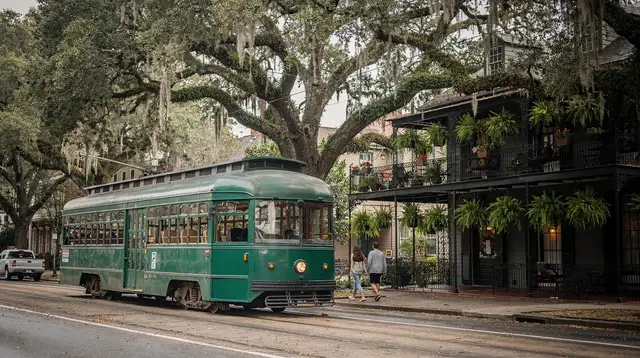
Is the New Orleans Streetcar Easy for Visitors to Use?
I’ll admit I almost skipped the streetcar entirely on my first trip. I’d read enough warnings about “confusing” US transit systems that I’d mentally budgeted for rideshares everywhere and left it at that. Then I watched an actual streetcar rattle past my hotel on Canal Street, packed with a mix of visitors and people clearly on their way to work, and felt a bit silly. It turned out to be one of the easiest things I did all week.
The four lines, and what each one is actually for
The confusion, I think, comes from assuming “the streetcar” is one thing. It isn’t — the RTA runs four separate lines, and they serve different purposes.
The St Charles line is the one people photograph: green wooden cars trundling under oak canopies from the Central Business District, up through the Garden District and into Uptown. It’s also the oldest continuously operating street railway in the world, which is a strange thing to realize you’re casually riding to get to dinner. If you want to see the antebellum mansions along St Charles Avenue without a walking tour, this line does the work for you — just watch the Garden District and the streetcar guide for where to actually get off, because nothing about the mansions is signed for tourists.
The Canal Street line runs from the river up to City Park and the cemeteries, splitting into two branches partway along. I used it mostly to get from my hotel near the CBD down to the river without walking the length of Canal Street in August heat, which is not a walk I’d recommend to anyone.
The Riverfront line is short and mostly useful if you’re moving between the French Quarter and the Warehouse District along the river — convenient, but honestly walkable most of the time.
The Rampart-St Claude line is the newest and runs along the edge of the French Quarter and through Marigny, which made it my go-to for getting back from a night out near Frenchmen Street without walking through empty side streets. If you’re weighing this against just staying on foot, the French Quarter walking guide is worth reading alongside this one — the Quarter itself is small enough that the streetcar barely matters there.
Paying for it — the part that actually trips people up
Here’s what I didn’t know before arriving: you don’t need cash, and you don’t need exact change. You can tap a contactless card or your phone straight on the farebox, the same way you’d tap for a coffee. There’s also the RTA’s own app, which sells single rides and passes and lets you show a digital ticket if a fare inspector asks.
For anyone riding more than once or twice a day, the Jazzy Pass is the better deal — unlimited rides on streetcars and buses for a set number of days, sold as a physical card or through the app. I bought a three-day pass on my second morning once I realized how often I was hopping on and off, and it paid for itself by lunchtime.
| Pass | Covers | Best for |
|---|---|---|
| Single ride | One boarding | A single trip, no plans to ride again |
| 1-Day Jazzy Pass | Unlimited rides, one calendar day | A day spent moving between neighborhoods |
| 3-Day Jazzy Pass | Unlimited rides, three days | Most first-time visitors’ full stay |
| 31-Day Jazzy Pass | Unlimited rides, one month | Longer stays or repeat visits |
If you’re also weighing sightseeing bundles against a plain transit pass, the sightseeing passes compared guide sorts out which ones actually include transit and which don’t.
What the streetcar won’t do for you
This is the part worth being honest about. The network is a city system — it doesn’t leave the city, and it isn’t built around plantation visits, swamp tours, or the airport. If you’re heading upriver to somewhere like St Joseph Plantation, you’ll want an organized guided tour of St Joseph Plantation with pickup, or a rental car — not a transit plan.
Same for a morning at Oak Alley on a half-day tour from the city, or a trip out to Destrehan Plantation and the story of the 1811 revolt — both sit well outside the streetcar’s reach. And the airport is its own separate question entirely; I’d point you to the guide on getting from MSY to the French Quarter rather than trying to make the streetcar do a job it isn’t built for.
Inside the city, though, it genuinely covers a lot. I used it to get to a walking tour in the Quarter, back from an evening out, and up to the Garden District twice — and I never once felt like I was gambling on the schedule. If you’d rather compare it against other city transport before committing, the hop-on hop-off buses compared and carriage and bike tours compared guides cover the alternatives, and do you need a car in Louisiana makes the wider case for skipping a rental altogether.
A few practical notes from actually riding it
Streetcars run less frequently than a big-city subway — expect to wait somewhere between ten and twenty minutes depending on the line and time of day, more at night. I never found this a problem in the daytime, but late at night on the St Charles line the gaps got long enough that I switched to a rideshare rather than stand around on a quiet platform.
Boarding is straightforward: cars stop at marked platforms or curbside stops, you board at the front or through any door if you already have a valid tap or pass, and you pull the cord or press the strip to signal your stop, same as a city bus. Nobody checks your ticket unless an inspector happens to walk through, though I wouldn’t ride without paying — it’s not worth the fine on a system this cheap.
If you’re traveling with a wheelchair or a stroller, it’s worth checking the accessible New Orleans guide before you go — not every historic car is level-boarding, though the newer Rampart-St Claude cars generally are. And if you’re building out a longer visit and wondering how the streetcar fits into a week without renting anything, one week without a car walks through exactly that.
My honest verdict, after using it across a full week: the streetcar is one of the most visitor-friendly things about getting around New Orleans, precisely because it does one job — moving you through the city itself — and does it without fuss. Just don’t expect it to take you anywhere the city ends. If you want to close out the night with something a little stranger than a streetcar ride, a haunted pub crawl through the French Quarter starts a short walk from the Rampart-St Claude line and ends close enough to hop straight back on it.
Frequently asked questions about riding the New Orleans streetcar
How many streetcar lines does New Orleans have?
Four: St Charles, Canal Street, Riverfront, and Rampart-St Claude, each running a different route through the city.
Which streetcar line is the oldest?
The St Charles line, which runs from the Central Business District through the Garden District and Uptown, is the oldest continuously operating street railway in the world.
Do I need exact change for the streetcar?
No. You can tap a contactless card or your phone directly on the farebox, or buy a pass in advance through the RTA’s GoMobile app.
What is a Jazzy Pass and is it worth buying?
It’s an unlimited-ride pass covering streetcars and buses for one, three, or thirty-one days; it’s worth it the moment you plan more than two or three rides in a day.
Does the streetcar go to the airport?
No. No streetcar line reaches Louis Armstrong International Airport; that trip needs a taxi, rideshare, shuttle, or the RTA airport bus.
Is the streetcar accessible at night?
The lines run into the evening, but service thins out late at night, and I’d combine a late ride with a short rideshare rather than wait a long time on an empty platform.
Can I use the streetcar to reach the plantations or the swamps?
No. The streetcar network stays inside the city; day trips upriver or into the swamps need a tour with pickup or a rental car.
Getting around New Orleans on GetYourGuide
Verified deep-linked GetYourGuide tours. Book through these links and we earn a small commission at no cost to you.
GetYourGuide does not provide a product photo for this activity — the image shows the meeting point, photographed by us.