A Walking Guide to the French Quarter, Block by Block
What is the best walking route through the French Quarter?
Start at Jackson Square and the St Louis Cathedral, walk Royal Street toward Canal Street for galleries and antiques, loop back on Bourbon Street, then finish on Decatur Street and the French Market before Café du Monde. The whole loop covers roughly two miles and takes half a day at a relaxed pace.
The French Quarter, or Vieux Carré, is small enough to see in an afternoon and dense enough to fill several. It is laid out as a tight, walkable grid, roughly thirteen blocks by six, bounded by Canal Street, Rampart Street, Esplanade Avenue and the Mississippi River. That size is the point of this guide: rather than a list of things to see, this is a route to walk, in order, block by block, from a fixed starting point to a fixed end point, with the reasoning for each stop along the way.
This route assumes no car. The Quarter is not built for driving, and nothing here needs one.
Starting Point: Jackson Square and the Cabildo
Begin at Jackson Square, the historic heart of the Quarter and the most sensible place to orient yourself before the grid gets busier. The square itself is a formal garden facing the river, framed on three sides by the buildings that give the French Quarter its identity: the St Louis Cathedral at its centre, flanked by the Cabildo on one side and the Presbytère on the other. Both former government buildings are now museums run by the Louisiana State Museum, and either is worth thirty to forty-five minutes if museums interest you; if not, the exteriors alone are worth the stop.
Artists and portrait painters set up along the iron fence of the square most days, and street musicians and tarot readers work the surrounding pavement, especially on weekend afternoons. This is also one of the more reliable spots in the city to see a brass band playing for tips. Take your time here before moving on: everything else in this walk radiates outward from this point, and the square is the easiest place in the Quarter to get your bearings.
From the square, the walk splits naturally into two directions: inland toward Royal and Bourbon Streets, or riverward toward Decatur Street and the French Market. This guide takes the inland loop first, then returns along the river.
Royal Street: Galleries, Antiques and Balconies
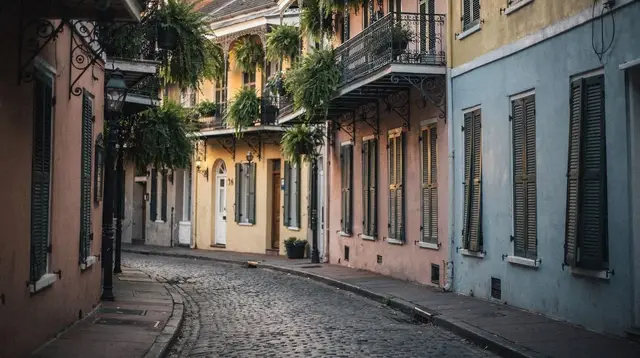
Leave Jackson Square on its inland side and turn onto Royal Street, one block back from Bourbon. This is the Quarter’s quietest major street and, for many visitors, its most photogenic: cast-iron balconies dripping with ferns, art galleries, antique dealers and a scattering of small museums occupy nearly every ground floor. Traffic is restricted to pedestrians for stretches of the day, which makes it comfortable to walk slowly and stop often.
Walk Royal Street from the Jackson Square end toward Canal Street, browsing as you go. The antique shops here range from serious high-end dealers to smaller curiosity shops, and window shopping costs nothing even if you have no intention of buying. Street performers, including classically trained musicians, often set up on the corners where Royal crosses the side streets. If architecture is a particular interest, this is the street to walk slowly rather than quickly; the ironwork balconies along Royal are generally considered finer than those on Bourbon, a legacy of the wealthier Creole townhouses that originally lined it.
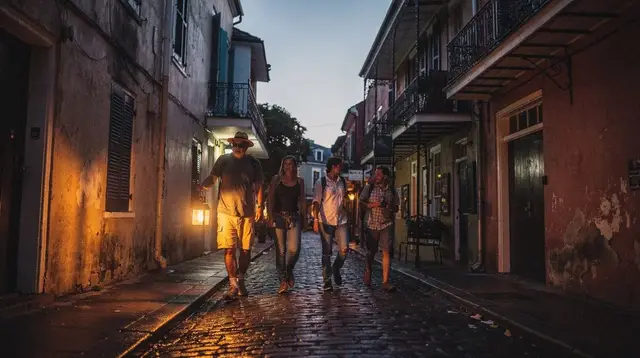
Several outfits in the Quarter build their walking tours specifically around this kind of neighbourhood detail — architecture, courtyards, and the social history behind the façades rather than the bars. A guided small-group walk through the Quarter’s neighbourhoods and everyday culture covers ground very close to this stretch, with the kind of context — who lived behind which balcony, and why — that is easy to miss walking past on your own.
Bourbon Street: What It’s Actually Like by Day and Night
At the far end of Royal Street, or at any cross street along the way, cut over one block to Bourbon Street and walk it back in the direction of Jackson Square. Bourbon by day and Bourbon by night are close to two different streets. In daylight, particularly before noon, it is unhurried: bars are open but quiet, balconies are visible without the crowds below them, and it is genuinely pleasant to walk and look up at the architecture, much of which predates the street’s current reputation by more than a century.
By evening, Bourbon Street becomes what most visitors picture: loud, crowded, lit by neon, and lined with bars spilling drinks and music onto the pavement. New Orleans is one of the few places in the United States where an open container of alcohol is legal on the street, provided it is in a plastic go-cup rather than glass, and Bourbon Street is where that rule is most visibly exercised. It is worth experiencing once, ideally for an hour rather than an entire evening — most locals, and this site, point visitors toward Frenchmen Street in the Faubourg Marigny for a night built more around live music than around the bars themselves.
Walking Bourbon Street south toward Canal Street, rather than toward Esplanade, keeps you moving back toward this route’s next stretch. If your interest runs more toward the Quarter’s darker reputation — its ghost stories, its cemeteries, its history of vampire folklore built up over two centuries of storytelling — a themed evening walk is a better way to see that side of Bourbon and its side streets than wandering alone after dark. A guided ghost-themed walking tour of the French Quarter typically starts near this stretch once the sun goes down, tracing the same blocks with a very different set of stories attached to them.
Decatur Street and the French Market
Return toward Jackson Square and continue past it toward the river to reach Decatur Street, the Quarter’s riverside artery. Decatur is louder and more commercial than Royal, lined with souvenir shops, bars, restaurants and, toward its downriver end, the French Market. The market has operated in some form on this site since the late eighteenth century, making it one of the oldest continuously running public markets in the United States, though today it is largely stalls selling local crafts, spices, hot sauce, and produce alongside food vendors.
Walking Decatur Street from Jackson Square toward Esplanade Avenue takes you the length of the French Market in fifteen to twenty minutes without stopping, longer if you browse the stalls. This stretch is also where several museums and history-focused stops cluster, including options covering the city’s Voodoo history in more depth than a passing glance at a shopfront can offer.
A guided museum and Voodoo walking tour works well as a way to fold that subject in properly, since Voodoo in New Orleans is a real, still-practised religion with a serious history, not simply a shop window of dolls and candles, and is worth more context than a walk-past provides.
Café du Monde and the Riverfront
At the upriver end of the French Market, close to Jackson Square, sits Café du Monde, open around the clock and serving exactly two things worth knowing about: beignets, and chicory coffee, usually as café au lait. The queue can look long from the street but generally moves faster than it appears, particularly outside the peak late-morning and late-evening hours. Order and seating are cafeteria-style at outdoor tables under the green-and-white awning; expect powdered sugar on everything, including yourself.
From Café du Monde, it is a short step across Decatur Street to the raised riverfront promenade along the Mississippi, known locally as the Moon Walk, from which you can watch the river traffic and look back at Jackson Square from the water side. This is a natural place to end the walking loop: you are back at the starting point, having covered Jackson Square, Royal Street, Bourbon Street, Decatur Street, the French Market and the riverfront in a single continuous route.
A Note on St Louis Cemetery No. 1
St Louis Cemetery No. 1, the oldest cemetery in New Orleans and the resting place of, among others, Marie Laveau, the nineteenth-century Voodoo Queen, sits just outside the Quarter’s edge, a short walk from Rampart Street. It is tempting to fold it into a self-guided walk, but it cannot be: the cemetery can only be entered with an authorised guide, and this restriction is enforced, not a formality. If it interests you, treat it as a separate stop rather than a detour from this route, booked as a guided visit in its own right — a guided walking tour of New Orleans’ historic cemeteries is the practical way to see it, since there is no walk-up alternative.
For general background on the city’s above-ground tombs and how the different cemeteries compare, see the fuller cemeteries of New Orleans guide; this walking route stops at the Quarter’s edge rather than covering the cemetery itself.
Practical Notes: Walking, Not Driving
A few things worth knowing before you set out:
| Consideration | What to know |
|---|---|
| Grid size | Roughly 13 blocks by 6, entirely walkable |
| Full loop length | About 2 miles (3.2 km), 3–4 hours with stops |
| Surface | Uneven brick and flagstone in places, especially on Royal and Chartres |
| Parking | Difficult, metered, strictly enforced with active towing |
| Best time to start | Mid-morning, before the day’s heat and crowds build |
| Cemetery access | Guided only; no independent entry to St Louis No. 1 |
Do not plan to drive between these stops or to park inside the grid partway through the walk. Parking in the Quarter is genuinely difficult, and moving a car from one side of the grid to the other rarely saves time over simply walking. If you are staying outside the Quarter, the streetcar network or a short ride-hailing trip is the easiest way to reach Jackson Square before starting the route on foot. Comfortable, closed-toe shoes matter more here than almost anywhere else in the city: the brick and flagstone paving on streets like Royal and Chartres is uneven and can be slick after rain.
If you would rather have the route narrated rather than self-guided, this same ground — Jackson Square, Royal Street, the Cabildo and Presbytère, and the Quarter’s back streets — is the basis for most general orientation walks of the neighbourhood, including the broader food and drink-focused walks and general history and culture tours that operate daily from meeting points near the square. For visitors building a longer stay, see how many days to spend in New Orleans and the one-day itinerary that this walk fits neatly inside.
For a wider sense of what else sits within the grid beyond this specific route, the things to do in the French Quarter hub groups activities by type, and the French Quarter destination guide and New Orleans destination overview cover the neighbourhood’s place within the wider city.
Frequently Asked Questions About Walking the French Quarter
How long does it take to walk the whole French Quarter?
The full route in this guide, done at a relaxed pace with stops, takes three to four hours. The Quarter itself is only about thirteen blocks by six, so it is easy to cover in a single unhurried morning or afternoon.
Can I visit St Louis Cemetery No. 1 on my own during this walk?
No. St Louis Cemetery No. 1 can only be entered with an authorised guide; independent entry is not permitted, and this rule is enforced. Plan a separate guided visit rather than trying to add it to a self-guided walk.
Is it better to walk Bourbon Street by day or by night?
Both show a different side of it. By day it is quiet, almost sleepy, and easy to appreciate for its architecture and balconies. By night it is loud and crowded with bars; it is worth seeing once but is not where most locals recommend spending an evening.
Should I drive into the French Quarter for this walk?
No. The French Quarter is a compact grid best covered entirely on foot, and parking inside it is difficult, metered and strictly enforced, with active tow-away enforcement. Park outside the grid or arrive by streetcar, ride-hailing app or on foot from a nearby hotel.
What is the difference between Royal Street and Bourbon Street?
Royal Street, one block toward the river from Bourbon, is lined with art galleries, antique shops and quieter architecture; Bourbon Street is the bar and nightlife strip. They run parallel for most of the Quarter, so both are easy to include in the same walk.
Is the line at Café du Monde worth it?
Most visitors find it moves faster than it looks, especially outside peak breakfast and late-evening hours, and the beignets and chicory coffee are a genuine local staple rather than only a tourist stop. Visiting mid-morning or mid-afternoon usually means a shorter wait.
Walking tours on GetYourGuide
Verified deep-linked GetYourGuide tours. Book through these links and we earn a small commission at no cost to you.
GetYourGuide does not provide a product photo for this activity — the image shows the meeting point, photographed by us.