Baton Rouge Visitor Guide
Is Baton Rouge the same as New Orleans, and is it worth visiting?
No. Baton Rouge is the capital of Louisiana, a separate city roughly 130 kilometres upriver from New Orleans on the Mississippi. It is worth a stop for its art-deco State Capitol and the USS Kidd, and it sits at the far end of the River Road plantation route rather than being a day trip from the French Quarter itself.
The capital that visitors keep guessing wrong
Ask a first-time visitor which city is the capital of Louisiana, and most will say New Orleans. It isn’t. The capital is Baton Rouge, a separate city roughly 130 kilometres upriver on the Mississippi, and it has held that role since the nineteenth century. New Orleans is the state’s largest city, its cultural capital and the reason most people book a flight, but it has never been the seat of Louisiana’s government.
That distinction matters for how you plan a visit. Baton Rouge is not a quick loop you bolt onto a morning in the French Quarter. It sits at the far end of the River Road, the historic corridor that follows the Mississippi between the two cities and is best known for its plantation museums — Oak Alley, Laura, Whitney and Destrehan among them. Those sites have their own guide, and this page does not re-detail them; what it covers is the city that stands where the River Road ends, and what actually distinguishes it once you get there.
If your plan is New Orleans plus a single plantation, see our plantations along River Road compared guide and treat Baton Rouge as optional. If you want the full corridor, including the capital itself, this page is your starting point.
Where Baton Rouge sits, and how to think about the distance
Baton Rouge sits on a bluff on the eastern bank of the Mississippi, about 130 kilometres upriver from New Orleans. That is a meaningful distance — enough that it is genuinely a separate city trip, not a suburb or a satellite of New Orleans the way, say, Algiers Point is.
We won’t give you a precise driving time in minutes, because the honest answer depends heavily on your route and on traffic through the industrial corridor along the river. Following the interstate is faster than hugging the river itself, and either way you should budget a comfortable half-day round trip if Baton Rouge is your only stop, or a full day if you’re weaving in River Road sites along the way. Treat any specific minute count you see elsewhere with some scepticism and build in slack.
There is no useful rail or transit option for this trip. Amtrak does not serve Baton Rouge on a schedule that works for a day visit, so a rental car or an organised tour with hotel pick-up is the practical way to go, the same as for the rest of the River Road and swamp country. See our guide on whether you need a car in Louisiana if you’re weighing that decision for the whole trip.
If you’d rather not drive yourself, a private tour with hotel pick-up is the usual alternative, and it removes the need to navigate an unfamiliar city’s downtown streets and parking once you arrive. Either way, plan to leave New Orleans in the morning: the round trip plus a couple of hours at each sight fills most of a day, and there’s little upside to arriving in the late afternoon when the Capitol’s observation deck and the Kidd both keep set visiting hours rather than staying open into the evening.
What actually belongs to Baton Rouge
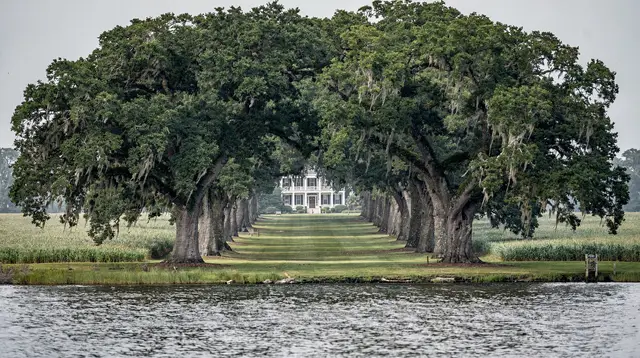
It’s worth being specific about what you’re going to see, because a lot of what people associate with “the River Road” — the oak alleys, the antebellum mansions, the museums built around the history of slavery — belongs to the plantation sites between the two cities, not to Baton Rouge itself. The capital has its own, quite different, set of landmarks.
The Louisiana State Capitol is the headline sight. Completed in 1932, it is an art-deco tower rather than the domed, classical statehouse most US states have — Louisiana’s is the tallest state capitol building in the country, and its lobby and observation deck are open to visitors. It stands in its own landscaped grounds above the river and is as much an architectural landmark as a functioning seat of government.
The USS Kidd is the other anchor. Moored on the Baton Rouge riverfront, it’s a preserved Fletcher-class destroyer from the Second World War, now a museum ship you can walk through deck by deck, paired with a veterans’ memorial museum on shore. It’s an easy complement to a Capitol visit and gives the day a second, quite different, focus — naval history rather than state history.
Beyond those two, Baton Rouge is a working university city — home to Louisiana State University — with a downtown riverfront, a handful of museums, and a slower, more everyday pace than the tourist-facing French Quarter. It rewards visitors who come for the Capitol and the Kidd specifically, rather than those expecting a second New Orleans.
LSU’s campus sits a short drive from downtown and has its own quiet appeal even outside a football weekend — live oaks, a lakeside setting and a scale that has nothing in common with the tight grid of the French Quarter. Most day visitors won’t have time to add a campus detour on top of the Capitol and the Kidd, but it’s worth knowing it’s there if you decide to stay overnight rather than driving back the same evening, since it changes the character of the city from “government seat” to “college town” once the state offices close for the day.
The River Road towns between here and New Orleans
Because Baton Rouge sits at the far end of the River Road, almost every route back to New Orleans passes near at least one plantation site, even if you’ve decided not to stop. On the east bank, that means passing near Houmas House, with its own live-oak-lined grounds and restaurant, and San Francisco Plantation, known for its unusually ornate, brightly painted architecture. On the west bank route, you’ll pass closer to St Joseph and Felicity Plantations, smaller and less visited than Oak Alley or Whitney but still part of the same historic corridor.
None of this requires a detour if your day is built around the Capitol and the USS Kidd — the road itself does the work. But if you have any flexibility in your schedule, even a brief stop breaks up what is otherwise a long stretch of driving with river views on one side and industrial plant on the other. Our plantations along River Road compared guide covers how these sites differ from each other, including which ones suit a quick stop versus a full visit.
What Baton Rouge is not
It’s just as useful to be clear about what this trip doesn’t include. Baton Rouge is not part of Cajun Louisiana. The heart of Cajun and zydeco culture is centred on Lafayette and Acadiana, further west again, and that’s a separate destination with its own guide — this page stops at the state capital and doesn’t extend the itinerary into Acadiana.
It’s also not on the coast. Like New Orleans, Baton Rouge sits inland on the river; the beaches and casinos of the Mississippi Gulf Coast are a different direction entirely, reached from New Orleans rather than from here.
And it is not, in this guide’s framing, a quick add-on to a French Quarter morning. Because of the real distance involved, treat it as a deliberate day out — or an overnight if you want to take it slowly — rather than something you decide on a whim after breakfast.
A simple day plan
| Time | Activity |
|---|---|
| Morning | Drive up, following the River Road or the interstate |
| Late morning | Louisiana State Capitol: lobby, grounds, observation deck |
| Midday | Lunch downtown near the riverfront |
| Early afternoon | USS Kidd and veterans museum |
| Late afternoon | Drive back to New Orleans, or extend with a River Road plantation stop on the way |
If you want to combine the capital with the plantation corridor, our River Road plantations, two days itinerary lays out a version that adds an overnight rather than trying to cram everything into one long day.
Day trip or overnight?
For most visitors staying in New Orleans, Baton Rouge works as a single long day: leave after breakfast, see the Capitol and the Kidd, have lunch downtown, and be back in the French Quarter by dinner. That’s enough time to cover both headline sights without rushing either one, provided you don’t also try to stop at multiple plantations along the way.
An overnight makes more sense if you’re combining Baton Rouge with a proper River Road stop rather than just passing through, or if you’d rather not do the return drive after a full day on your feet. It also opens up the option of an evening in downtown Baton Rouge itself, which has its own restaurant and bar scene around the riverfront distinct from anything in New Orleans. Neither approach is wrong; it depends on whether Baton Rouge is the point of the day or a stop on the way to somewhere else.
Before or after: what to do back in New Orleans
Most visitors base themselves in New Orleans and treat Baton Rouge as one day out of a longer stay, which means the rest of your trip is really about the city itself. Some structured options are worth pre-booking so a rainy morning or a change of plan doesn’t cost you a day:
A private guide who tailors a New Orleans day around your own interests is a flexible way to fill the days either side of a Baton Rouge trip, especially if you’d rather not plan the details yourself.
For getting oriented quickly in the city, a guided segway tour through New Orleans’ historic streets covers a lot of ground fast, which suits a short stay where a day is already earmarked for Baton Rouge.
If Uptown and the river neighbourhoods interest you more than the Quarter, a guided bike tour across New Orleans’ riverside neighbourhoods is a good way to see more of the city than you can on foot.
And food is central to any New Orleans stay: a local-guided street food tour through New Orleans’ classic dishes is worth booking for one of the evenings you’re not on the road.
Planning the rest of your trip
Baton Rouge works best as one clearly defined day within a longer New Orleans stay, not as the centrepiece. If you’re still deciding how many days to give the whole region, start with how many days in New Orleans and best time to visit New Orleans, then layer in the River Road and Baton Rouge once your base itinerary is set. Our four days, New Orleans and a plantation itinerary is a useful reference even if you swap the plantation day for a Baton Rouge day, since the logistics — one full day out along the river — are similar.
If you’re driving yourself rather than joining an organised tour, review driving and parking in New Orleans before you set out, since collecting a rental car downtown and finding your way back into the Quarter afterward is its own small challenge on top of the drive itself.
For the sites you’ll pass along the way but that this guide deliberately leaves for elsewhere, see plantations along River Road compared and Whitney Plantation and the history of slavery. And if military history is part of what draws you to the USS Kidd, the National WWII Museum visitor guide covers the New Orleans institution that pairs naturally with it, even though the two are in different cities.
Baton Rouge, frequently asked
Is Baton Rouge the capital of Louisiana?
Yes. Baton Rouge is the state capital, not New Orleans. It sits roughly 130 kilometres upriver from New Orleans on the Mississippi and is the seat of Louisiana’s state government.
How far is Baton Rouge from New Orleans?
About 130 kilometres by road, following the river or the interstate. There is no fixed, reliable drive-time figure for this stretch, so treat any specific number you see as an estimate and allow extra time if you stop along the River Road.
Can I visit Baton Rouge as a day trip from New Orleans?
You can, but this guide treats it as a destination in its own right rather than an excursion from downtown New Orleans, since it is the end point of the River Road corridor and a genuinely separate city with its own sights.
What is there to see in Baton Rouge itself?
The main sights are the art-deco Louisiana State Capitol, the tallest state capitol building in the United States, and the USS Kidd, a preserved Second World War destroyer moored on the riverfront with a museum.
Do I need to visit the River Road plantations to get to Baton Rouge?
The River Road runs between New Orleans and Baton Rouge and passes plantation sites such as Oak Alley, Laura, Whitney and Destrehan, but visiting them is a separate itinerary decision. This guide does not re-detail those sites.
Is Baton Rouge part of Cajun Louisiana?
No. Cajun Louisiana is centred further west around Lafayette and Acadiana. Baton Rouge sits between New Orleans and that region but is not itself considered part of it.
Is Baton Rouge on the coast?
No. Like New Orleans, Baton Rouge is an inland river city on the Mississippi, not on the Gulf coast. The Mississippi Gulf Coast beaches are a separate area east of New Orleans.
River Road day trips on GetYourGuide
Verified deep-linked GetYourGuide tours. Book through these links and we earn a small commission at no cost to you.
GetYourGuide does not provide a product photo for this activity — the image shows the meeting point, photographed by us.