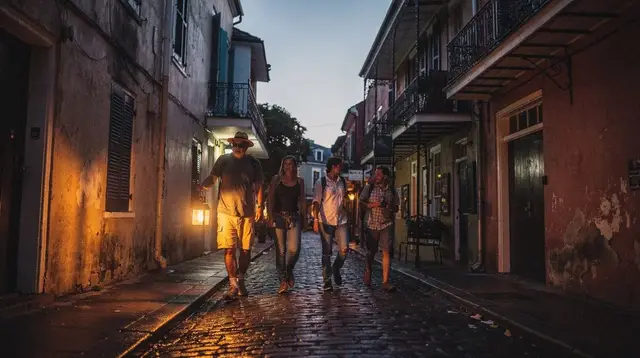
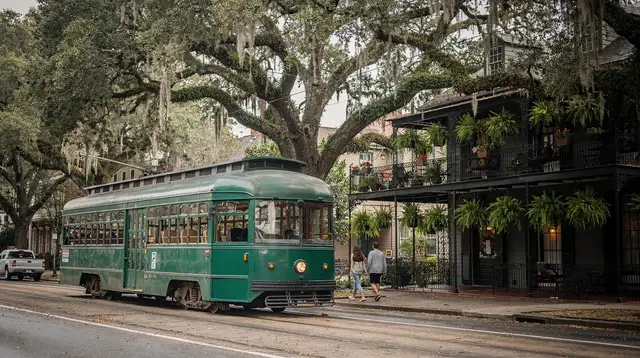
New Orleans sits at the centre of a much larger region, and not everything worth seeing lies within an easy hour of the French Quarter. Push out a little further and the landscape changes: a state capital with its own politics and skyline, a prairie-and-bayou country where French is still spoken and the food is cooked differently, and a stretch of Gulf coastline that looks nothing like the river city at all. These three — Baton Rouge, Cajun country around Lafayette and the Mississippi Gulf Coast — are the farthest reaches this site covers, and they deserve to be thought about differently from the swamps and plantations closer in.
Why these three sit apart from the rest of the region
Most of what draws visitors out of New Orleans — the Barataria Preserve, the River Road plantations, Oak Alley and Whitney Plantation — lies within about 40 minutes to an hour and a half of the city, close enough that a half-day or a single unhurried day comfortably covers the round trip plus a real visit. Baton Rouge, Lafayette and the Gulf Coast are a different order of outing. Each involves enough driving, in a different direction, that the road itself becomes part of the day, and each arrives somewhere that does not feel like an extension of New Orleans at all.
That is the point of grouping them here rather than folding them into the bayou country or day-trip pages that cover the closer excursions. These three are not variations on a theme; they are three separate reasons to leave the city, each pulling in its own direction:
- North and upriver, roughly along the top of the River Road, sits Baton Rouge, Louisiana’s working state capital.
- West, into the prairies and bayous of Acadiana, sits Lafayette and the wider stretch of Cajun country.
- East, along the Mississippi shoreline, sits the Gulf Coast around Bay St Louis, Pass Christian, Gulfport and Biloxi.
None of them is a quick add-on to a plantation tour or a swamp cruise. Each is worth a full day on its own terms, and each competes with the other two for a place on an itinerary rather than with the nearer excursions.
Baton Rouge: the state capital, not the tourist capital
It surprises a fair number of first-time visitors that New Orleans is not Louisiana’s capital. That role belongs to Baton Rouge, roughly at the top of the River Road above the plantation country, and it is a genuinely different kind of city: an art-deco state capitol building, a working port on the Mississippi, university life around LSU, and the retired battleship USS Kidd on the riverfront. It is less obviously built for tourism than New Orleans, and that is part of its appeal for visitors who have already spent a few days immersed in the French Quarter’s density and want to see the state’s political and institutional centre instead.
A trip to Baton Rouge pairs naturally with the River Road plantations, since the road between the two passes several of them, but it does not have to. Some visitors treat it as a standalone day built around the capitol, the riverfront and a walking or ghost-themed introduction to the city’s older streets, such as the evening ghost walk through Baton Rouge’s historic quarter.
Others use the day to get out onto the water, since Baton Rouge is also a starting point for trips into the edge of the Atchafalaya Basin, including a guided kayak paddle through the historic Atchafalaya wetlands.
Cajun country: a different Louisiana altogether
Lafayette and the towns around it are where Louisiana’s Cajun identity actually lives, and it is worth being precise about the distinction, because the two words get used loosely. New Orleans is a Creole city — its food, music and history formed in an urban, coastal port shaped by French, Spanish, African and Caribbean influence.
Cajun culture is something else: the descendants of the Acadians expelled from Nova Scotia in the 1750s, who settled the prairies and bayous west of New Orleans and built a rural tradition around roux-based cooking, fiddle-and-accordion music, and a French dialect that is still spoken at home in some families. New Orleans borrows from Cajun cooking and vice versa, but calling New Orleans a Cajun city, or treating the two as interchangeable, misses what makes Lafayette worth the drive.
Cajun country centres on Lafayette itself, with its living-history sites at Vermilionville and the Acadian Village, and radiates out to Breaux Bridge (which calls itself the crawfish capital of the world), St Martinville, New Iberia and Avery Island, home of the Tabasco factory and its Jungle Gardens.
It also borders the vast Atchafalaya Basin, the largest river swamp in the United States, which straddles the route between New Orleans and Lafayette and offers its own boat and kayak excursions distinct from the smaller swamp tours closer to the city. A guided introduction to the region’s history and folklore, such as the walking tour through Lafayette’s Cajun history and folklore, is a useful way to get oriented before wandering further into Acadiana on your own.
Food and music are the two reasons most visitors make the trip. Zydeco and Cajun music belong here, not to New Orleans, and the region’s cooking — boudin, cracklins, a proper crawfish boil in season — is rural and roux-based rather than the tomato-inflected Creole cooking of the city. A day trip barely scratches the surface; visitors drawn to this side of Louisiana often end up wishing they had built in an overnight instead.
The Gulf Coast: beaches and casinos, a world away from the Quarter
East along the Mississippi shoreline, roughly an hour to an hour and a half from New Orleans, the Gulf Coast is a different kind of place again — closer in feel to a beach town than to anything in the city or in Cajun country. Bay St Louis and Pass Christian are the quieter, more small-town end of the coast, with galleries, seafood restaurants and a walkable waterfront; Gulfport and Biloxi are larger and built more around casinos and beaches. It is the one of the three destinations on this page that has essentially nothing to do with New Orleans’s own food, music or history, which is exactly why some visitors value it: a genuine change of scene rather than more of the same culture at a greater distance.
Bay St Louis in particular has developed a small tourism scene of its own, including evening tours that lean into the coast’s own ghost stories and bayou landscape, such as the Spirit ghost and walking tour of Bay St Louis or the Haunted Bayou cruise out of Bay St Louis along the marshes and inlets near the town. For visitors who want a beach or a casino evening without organising an overnight trip along the actual Gulf beaches further east in Mississippi or Alabama, this stretch of coast is the practical option from New Orleans.
How the three compare
| Destination | Direction from New Orleans | What it actually is | Who it suits |
|---|---|---|---|
| Baton Rouge | North, up the River Road | State capital, riverfront, LSU, art-deco Capitol | History and politics-minded visitors, plantation-route travellers |
| Cajun country (Lafayette) | West, into Acadiana | Rural Cajun and zydeco culture, distinct cuisine | Food and music travellers, longer-stay visitors |
| Gulf Coast | East, along the Mississippi shoreline | Beaches, casinos, small coastal towns | Beach-and-casino travellers, those wanting a change of scene |
None of the three is “better” than the others in any general sense; they suit different interests, and a visitor drawn to Cajun food and music is unlikely to get much out of a casino afternoon on the coast, and vice versa. If forced to choose one, it is worth asking which kind of place appeals more: a capital city, a rural cultural region, or a beach coast.
Planning a day around these destinations
Because all three require real driving time in different directions, the planning question is less “which order” and more “which one, and when.” A few practical points worth weighing before committing a day to any of them:
- Treat each as a full day, not a half-day extension of something else in the city. The driving time alone from New Orleans, in any of the three directions, is longer than the trips to the nearer swamps or plantations, so arriving late in the afternoon leaves little time to actually see anything.
- Do not plan to combine two of the three on the same day. They lie in different directions from New Orleans, and none of them are close enough to each other to make a loop practical within a single day.
- A rental car or an organised tour with transport is close to essential. Public transport does not serve any of the three destinations in a way that supports a day trip, and Amtrak, while it does technically stop near Baton Rouge and the Mississippi coast, runs too infrequently to build a day around.
- Spring and autumn are the more comfortable seasons for a long day involving significant time outdoors or in a car, avoiding both the height of summer humidity and the peak of Atlantic hurricane season, which runs from 1 June to 30 November and is worth planning around rather than ignoring.
- Consider whether a farther destination belongs on a first visit at all. Visitors on their first trip to New Orleans, especially those staying under a week, often get more value from the city itself and the closer swamp and plantation excursions before adding a full day to Baton Rouge, Lafayette or the coast. A seven-day grand tour of Louisiana or a six-day itinerary pairing New Orleans with Cajun country is a more natural fit for these destinations than a short weekend.
For a beach-focused version of the coastal option specifically, a dedicated three-day Gulf Coast and beaches itinerary sets out a slower pace than a single day allows. The question of whether a car is really necessary in Louisiana is also worth reading before deciding how to reach any of these three places, since the answer differs sharply from the question of getting around New Orleans itself, where a car is often more trouble than it is worth.
FAQ: farther day trips from New Orleans
What counts as a “farther” day trip from New Orleans?
This page groups the outings that take an hour or more of driving each way and that lead somewhere genuinely different from the city itself: the state capital at Baton Rouge, Cajun Acadiana around Lafayette, and the Mississippi Gulf Coast around Bay St Louis and Biloxi. The nearer swamps and River Road plantations, most of them 40 minutes to an hour and a half away, are covered separately.
Can I visit Baton Rouge, Lafayette and the Gulf Coast all in one trip?
Only with several extra days set aside, since they lie in three different directions from New Orleans rather than along a single route. Combining two in one day is possible only if one of them is a brief stop rather than a full visit; combining all three in a single day is not realistic.
Do I need a car for these three destinations?
A rental car or a booked tour with transport is effectively required for all three. Amtrak does serve Baton Rouge and stops near the Mississippi coast, but the service is slow and infrequent and is not a practical way to structure sightseeing.
Which of the three is closest to New Orleans?
Baton Rouge, at the top of the River Road, is generally the shortest drive of the three. Lafayette and the Gulf Coast towns each take somewhat longer, and exact travel time depends heavily on traffic and on where in New Orleans a trip starts.
Is Lafayette the same as Cajun New Orleans?
No. New Orleans is a Creole city, not a Cajun one; Cajun culture and cooking belong to the descendants of the Acadians who settled the prairies and bayous west of the city around Lafayette. The two traditions are related but distinct, and Lafayette is where Cajun and zydeco music and cooking are genuinely rooted.
Is the Gulf Coast day trip about beaches or about New Orleans-style nightlife?
Neither, primarily. The Mississippi Gulf Coast towns east of New Orleans are a different kind of destination built around beaches and casinos, closer in spirit to a coastal getaway than to the French Quarter or Lafayette’s music scene.
Should first-time visitors prioritise these over the swamps and plantations?
Generally no. Most first-time visitors get more value from the city itself and the nearer swamp and plantation excursions before adding a farther destination that costs a full day of travel time.