French Quarter History and Culture Tours
What is the best way to see the history of the French Quarter?
Start at Jackson Square and St Louis Cathedral, then walk Royal Street for its Creole townhouses and galleries, ending at the French Market. A guided architecture or history walking tour of 60 to 90 minutes adds the context a self-guided walk misses, since almost nothing on the street is labelled.
The French Quarter is the oldest neighbourhood in New Orleans, laid out on a grid in 1721 and still readable as one today: a compact rectangle of roughly thirteen by six blocks between the Mississippi River and Rampart Street. This page is about its colonial and Creole core, not its nightlife or its restaurants.
It covers Jackson Square, St Louis Cathedral, the Cabildo, the Presbytere, Royal Street’s galleries and antique houses, and the French Market — the buildings and streets that carry the city’s French and Spanish colonial history. Bourbon Street’s bars and Frenchmen Street’s live music belong to other pages; so does the food of the Quarter, and so do the antebellum mansions of the Garden District upriver, which belong to a later, Anglo-American period and a different architectural style entirely.
Why the French Quarter looks Spanish, not French
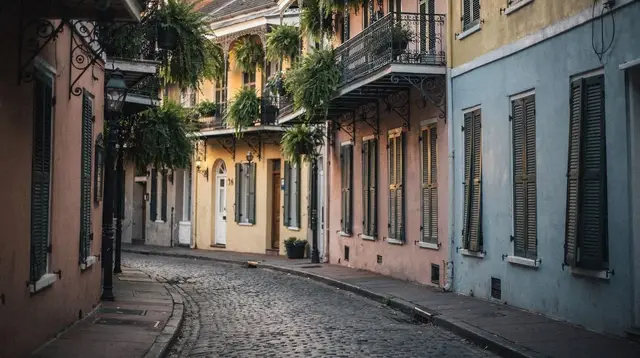
The single fact that reorganises most people’s mental picture of the Quarter: very little of what stands today is architecturally French. Two catastrophic fires, in 1788 and 1794, destroyed most of the original French colonial town, and Louisiana was under Spanish rule for both rebuildings. The wrought and cast-iron balconies, the enclosed courtyards, the thick masonry party walls and the stuccoed brick that define the Quarter’s look are Spanish colonial conventions, not French ones.
The street grid and most of the street names are French, laid down under the original 1721 plan by royal engineer Adrien de Pauger. The buildings on top of that grid are, overwhelmingly, Spanish. Locals and guides sometimes call the neighbourhood by its French name, the Vieux Carre, meaning “old square,” which is a reference to the plan, not the architecture standing on it.
The city itself changed hands more than once: French colony from 1718, ceded to Spain in 1762, returned briefly to France in 1800, then sold to the United States in the Louisiana Purchase of 1803. Out of that layered ownership, and out of the free and enslaved population of French, Spanish, African and Caribbean origin who actually built and lived in the city, grew Creole culture — a term this site uses carefully, and never interchangeably with Cajun, which belongs to a rural population settled around Lafayette, well outside the city.
Jackson Square and its three landmark buildings
Jackson Square is the historic heart of the Quarter, a formal park facing the river, originally laid out as the Place d’Armes, the military parade ground of the French colony. It was renamed for Andrew Jackson after the Battle of New Orleans in 1815, and his equestrian statue stands at its centre. Three buildings frame the square, and together they carry most of the neighbourhood’s institutional history.
St Louis Cathedral is the oldest continuously active Catholic cathedral in the United States, though the building visible today is largely a nineteenth-century reconstruction over an eighteenth-century Spanish colonial base. It is generally open to visitors outside of services, usually free to enter, though hours shift and it can close for events without warning.
The Cabildo, to the cathedral’s left, was the seat of Spanish colonial government and is where the papers transferring Louisiana from France to the United States were signed in 1803. It is now part of the Louisiana State Museum, with exhibits on Louisiana’s colonial period and early statehood.
The Presbytere, on the cathedral’s right, was built as a rectory but never used as one. It now houses the Louisiana State Museum’s permanent Mardi Gras exhibit, tracing the holiday’s development from private balls to the citywide event it is today; the building has also hosted temporary exhibits on Hurricane Katrina in past years, so check current listings rather than assuming a fixed programme.
Around the square, artists and portraitists set up along the iron fence, a tradition with its own long history in the Quarter, and street musicians perform nearby — cash is useful here, since neither group works by card.
Royal Street: Creole townhouses, antiques and galleries
One block toward the river from Bourbon Street, Royal Street is the Quarter’s architectural showcase and its historic commercial spine. It is lined with Creole townhouses built after the 1788 and 1794 fires, many still carrying their original iron balconies and carriageway entrances leading to hidden courtyards. Since the early twentieth century, Royal Street has been the centre of the city’s antique and fine art trade, and dozens of galleries and antique dealers still operate out of these same historic buildings, several open to browsing without an appointment.
A slow walk down Royal Street, glancing through the carriageway gates that most buildings leave open during the day, is one of the few ways to see the Quarter’s private courtyards without a guide. Several buildings carry historical plaques noting a notable resident or event, though the density of unmarked history well exceeds what any plaque covers, which is the main argument for a guided walk over a solo one: a guide will point out what a first-time visitor would otherwise walk past.
Royal Street runs parallel to, and one block away from, Bourbon Street. The two could not be more different in character, and conflating them is a common visitor mistake worth avoiding before arrival.
The French Market
At the downriver edge of the Quarter along Decatur Street, the French Market has operated on the same site since the late eighteenth century, making it one of the oldest continuously used market sites in the country. It began as a Native American trading site before European settlement, later became a formal marketplace under Spanish administration, and has been rebuilt and expanded many times since.
Today it combines a farmers’ market, a flea market and food stalls, and while its present-day retail mix is a modern layer, the site’s continuity of use across roughly two and a half centuries is itself a piece of the city’s history. This page treats the Market as a historic site rather than a food destination; what to eat in and around the Quarter is covered on the food and drink guide for the neighbourhood.
What guided tours add
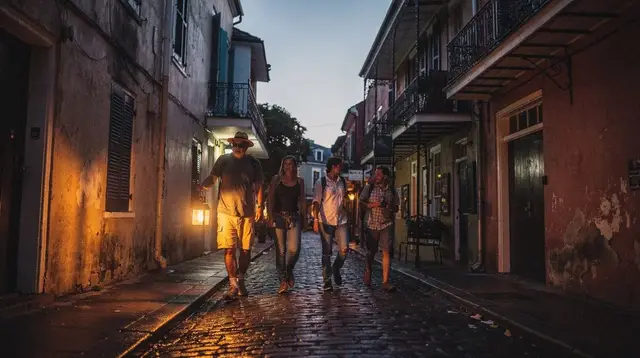
The Quarter can be walked without a guide, and many visitors do exactly that with a map or a phone. What a guided tour adds is context: almost nothing on the street is labelled, and the difference between a plain nineteenth-century facade and a building that hosted a governor, a pirate or a fire that reshaped the city is invisible without someone to point it out.
A dedicated architecture and history walking tour of the French Quarter typically covers the colonial period, the two fires and the Spanish rebuilding, and the courtyards and ironwork of Royal Street in some detail. For visitors with less time, a short 45-minute orientation walk through the Quarter hits the same landmarks at a faster pace.
Two other angles are worth knowing about, even on a history-focused visit. A general history walking tour of the Quarter tends to fold in more of the neighbourhood’s darker and more eccentric episodes alongside its architecture. A tour built around the Quarter’s saints-and-sinners history leans further into crime, scandal and vice across the centuries — useful context, but a different register from a straight architecture walk, and worth choosing deliberately rather than by accident.
Whichever tour is chosen, comfortable shoes matter more than anything else: the sidewalks are old, uneven brick and flagstone in many places, and tours cover most of the grid on foot.
A short comparison of the four core sites
| Site | What it is | Typical visit | Cost |
|---|---|---|---|
| Jackson Square | Public square, historic parade ground | 15–20 minutes, longer with artists and musicians | Free |
| St Louis Cathedral | Active cathedral, oldest in continuous use in the US | 15–20 minutes | Usually free |
| Cabildo / Presbytere | Louisiana State Museum sites on colonial history and Mardi Gras | 45–60 minutes each | Paid entry, museum ticket |
| Royal Street | Historic commercial street, galleries and antiques | 45–90 minutes, self-paced | Free to walk |
Prices for museum entry and tour tickets change; treat any figure quoted elsewhere as a starting point to confirm at booking, not a fixed rate.
Where this fits with the rest of the Quarter
History and architecture are one layer of the French Quarter, not the whole of it. The same streets covered here also carry the neighbourhood’s ghost and voodoo tour circuit, much of it built around the same colonial-era buildings from a different angle, and its live jazz scene, concentrated a short walk away on Frenchmen Street rather than inside the historic core itself.
None of that is covered here by design: keeping the history and the nightlife apart is easier to plan around than one page trying to do both. For food and drink in the same streets, see the Quarter’s dedicated food and drink guide; for the antebellum mansions of the Garden District, a later and architecturally distinct neighbourhood upriver, see its own history guide.
For planning purposes, most visitors give the historic core of the Quarter half a day at most, out of a stay in New Orleans that runs two to four days for a first visit. Pair it with a walk through Treme just to the north, one of the oldest African American neighbourhoods in the country and, alongside the Quarter, foundational to the city’s music history. Visitors extending beyond the city typically add a day trip to the River Road plantations, whose history — colonial and antebellum, and inseparable from slavery — sits in sharp contrast to the Quarter’s mix of commerce, culture and government.
Practical notes for a history-focused visit
The Quarter is flat and entirely walkable, so no transport is needed once inside it; the RTA streetcar and bus network is more useful for reaching the Quarter from elsewhere in the city than for moving around inside it. Mornings are markedly quieter than afternoons and evenings around Jackson Square and Royal Street, and considerably cooler in the humid subtropical summer, when the Quarter can feel very different by mid-afternoon.
Museum sites such as the Cabildo and Presbytere keep their own hours and close on some public holidays, so confirming opening times before a visit is worth the minute it takes. Cash remains useful for the street artists and musicians around Jackson Square even though cards are accepted almost everywhere else in the Quarter.
Frequently asked questions about French Quarter history and culture
Is the French Quarter French?
Only in part. The original 1721 grid and the name are French, but almost all the surviving architecture dates from Spanish colonial rule after the fires of 1788 and 1794, which is why the ironwork balconies and courtyards look Spanish rather than French.
How long do you need for a history-focused visit to the French Quarter?
Two to three hours covers Jackson Square, the cathedral, the Cabildo or Presbytere, and a walk down Royal Street. A guided tour usually runs 60 to 90 minutes and is worth adding on top, since it explains buildings a self-guided walk would pass without comment.
Can you go inside St Louis Cathedral?
Yes, when it is not in use for a service; entry is generally free, though hours vary and it can close for events without notice, so treat any posted hours as approximate.
What is the difference between the Cabildo and the Presbytere?
Both are Spanish colonial buildings flanking St Louis Cathedral on Jackson Square, and both are now part of the Louisiana State Museum. The Cabildo covers Louisiana’s colonial and early statehood history; the Presbytere’s permanent exhibit covers Mardi Gras, with hurricanes covered in past exhibits.
Is Royal Street the same as Bourbon Street?
No. They run parallel a block apart. Royal Street is lined with antique dealers and art galleries in restored Creole townhouses; Bourbon Street, one block over, is the bar and nightlife strip. This page covers Royal Street’s architecture and history, not Bourbon Street’s nightlife.
Do I need a guide, or can I do this self-guided?
The Quarter can be walked alone with a map, but almost nothing is labelled on the street, so a guide or a well-written self-guided route adds most of the value for a history-focused visit.
Is the French Market worth visiting for history rather than shopping?
The site has functioned as a public market since the late eighteenth century, making it one of the oldest continuously used market sites in the United States, which is worth knowing even for visitors who only browse the stalls.
History and culture tours on GetYourGuide
Verified deep-linked GetYourGuide tours. Book through these links and we earn a small commission at no cost to you.
GetYourGuide does not provide a product photo for this activity — the image shows the meeting point, photographed by us.