The oldest square mile in New Orleans
Ask most first-time visitors what New Orleans looks like, and they will describe the French Quarter without knowing it: wrought-iron balconies, pastel Creole townhouses, a horse-drawn carriage clopping past a jazz trio on a street corner. That picture is accurate, but it is a picture of one neighbourhood, not of the city. The French Quarter — the Vieux Carré, French for “old square” — is New Orleans’ original eighteenth-century footprint, laid out on a tight grid of roughly thirteen blocks by six. Everything within it can be walked in a day; almost nothing outside it belongs to it.
That distinction matters more than it sounds. The antebellum mansions people picture when they say “New Orleans” are mostly in the Garden District, a streetcar ride uptown. The live-music strip locals actually go to at night is Frenchmen Street in the Faubourg Marigny, just downriver of the Quarter, not Bourbon Street. The birthplace of much of the city’s music sits in Tremé, immediately north. Treat the Quarter as New Orleans’ historic core and its most convenient base — which it is — but plan at least one excursion beyond it, or you have seen a neighbourhood, not the city.
Parking here is difficult and enforcement is strict: this is a walking neighbourhood, best explored on foot from whichever hotel or short-term rental you choose within or near it.
Jackson Square and the Cabildo
Start where the city itself started. Jackson Square is the French Quarter’s civic and spiritual centre, a fenced garden square facing the Mississippi River, ringed by wrought-iron and named for Andrew Jackson, whose equestrian statue stands at its centre. On its upriver side sits the triple-spired St Louis Cathedral, the oldest continuously active Catholic cathedral in the United States, its white facade the single most photographed building in Louisiana.
Flanking it are two Spanish colonial-era buildings that now form part of the Louisiana State Museum: the Cabildo, seat of Spanish colonial government and the building where the Louisiana Purchase transfer was signed in 1803, and the Presbytère, which houses exhibits on Mardi Gras and Hurricane Katrina under one roof — a pairing that says something honest about how the city holds celebration and loss together.
The square itself is a stage: portrait painters, tarot readers and street musicians work its iron fence day and night, and it is the natural starting point for a walking tour of the Quarter, whether a straightforward architecture-and-history route or one of the ghost and voodoo tours the neighbourhood is known for. A guided walking tour built around this square is the easiest way to have its layers — colonial, Creole, Catholic, and modern tourist economy — explained rather than guessed at.
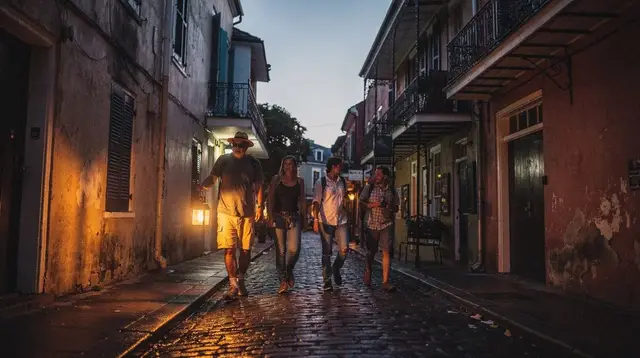
a two-hour evening walking tour through the Quarter’s darker history, starting near Jackson SquareRoyal Street: galleries, antiques and balconies
One block toward the river from the cathedral runs Royal Street, the Quarter’s genteel counterpart to Bourbon Street. This is where the neighbourhood’s wealth shows itself: block after block of art galleries, antique dealers specialising in Louisiana silver and Creole furniture, and some of the finest cast-iron and wrought-iron balconies in the city, hung with ferns and trailing greenery. Several blocks of Royal Street close to vehicle traffic in the afternoons and evenings, filling with buskers — string quartets, jazz combos, solo guitarists — competing gently for pedestrian attention.
Royal Street is also where several of the Quarter’s most photographed private courtyards hide behind unmarked doors; a handful of hotels and shops allow a discreet peek inside, and it rewards slow walking rather than a fixed itinerary. Pair it with a look at the side streets running toward the river — Chartres and Decatur — where the architecture shifts from residential elegance to working commercial blocks.
Bourbon Street and the go-cup rule
Bourbon Street is the Quarter’s loudest export and, for many visitors, its most disappointing surprise: a strip of bars, live-music clubs, drive-through daiquiri counters and neon, busiest after dark and largely a pedestrian zone in the evenings. It is worth walking once for what it is — an American nightlife institution, unlike anything else in the country — but it is not where the city’s serious live music happens; that is closer to Frenchmen Street or Preservation Hall, a few blocks inside the Quarter itself.
One rule worth knowing before you arrive: New Orleans is one of the few places in the United States where it is legal to carry an alcoholic drink on the street within the French Quarter, provided it is in a plastic “go-cup,” never in glass. Bars will pour your drink into one on request if you are heading out. Beyond that, the practicalities of a safe night out — where to be cautious late on Bourbon Street’s fringes, how to get back to your accommodation — are covered in full in a dedicated safety guide; this page sticks to what the street is and how it fits into the Quarter.
a guided crawl through historic French Quarter bars, sampling the cocktails the city claims as its ownDecatur Street, the French Market and Café du Monde
Decatur Street runs along the Quarter’s riverside edge, and it is where the neighbourhood’s commercial life feels most local. The French Market, a covered market that has operated on this site in some form since the late eighteenth century, sells produce, local hot sauce, jewellery, and the kind of souvenirs that range from genuinely handmade to mass-produced. It anchors the downriver end of the Quarter, closest to the Marigny.
No stop is more obligatory, or more photographed, than Café du Monde, the twenty-four-hour open-air café that has served café au lait and beignets — square, deep-fried, and buried under powdered sugar — since 1862. Expect a queue at almost any hour; it moves quickly, and the beignets are worth the wait exactly once, if not several times. From here, the riverfront promenade along the Mississippi offers a break from the grid’s density, with views across the river toward Algiers Point, reachable by a short ferry ride.
Cemeteries: look, but only with a guide
The Quarter’s edges brush against one of the city’s most recognisable images: rows of above-ground tombs, a necessity in a city built on swamp and prone to flooding, where burial below ground was never practical. St Louis Cemetery No. 1, just outside the Quarter proper, is the oldest surviving cemetery in New Orleans and the burial place of Marie Laveau, the nineteenth-century Voodoo Queen whose grave still draws offerings. It can only be visited as part of an authorised guided tour — independent entry is not permitted, and this rule has held consistently in recent years, though it is worth confirming before you go, since cemetery access policies do change.
A guided visit is also, frankly, the better way to understand what you are looking at: the tombs, the layout, and the real, still-practised religion of Louisiana Voodoo, rather than the theme-park version sold on some Bourbon Street storefronts. A combined tour covering the cemetery alongside Voodoo history and French Quarter hauntings is an efficient way to see all three in one outing.
a single guided outing combining St Louis Cemetery No. 1, Voodoo history and French Quarter folkloreEating beyond the beignet
The Quarter is dense with restaurants spanning white-tablecloth Creole institutions to po’boy counters, but its food scene is only a slice of the city’s. A tour built around eating your way past the Quarter’s borders — into the Marigny or the CBD — gives a fuller sense of what “New Orleans food” actually covers, from gumbo and jambalaya to the etouffee and muffuletta sandwiches locals argue about. It’s worth remembering, too, that Creole cooking (urban, French-Spanish-African-Caribbean, often tomato-based) and Cajun cooking (rural, roux-based, from Acadiana around Lafayette) are related but distinct traditions; the Quarter’s kitchens lean Creole.
a food-focused walking tour that ranges past the Quarter’s edges into nearby neighbourhoodsThe Faubourg Marigny and Bywater, just downriver
Walk past the French Market and the Quarter’s grid quietly gives way to the Faubourg Marigny, a smaller, more residential neighbourhood of shotgun houses in candy colours. This is where Frenchmen Street runs for a few short blocks, packed with small live-music clubs that locals actually go to, with none of Bourbon Street’s neon or crowds — cover charges are modest and the bands change most nights of the week. Beyond the Marigny sits Bywater, quieter still, more art galleries and coffee shops than bars, and a reasonable base for visitors who want walking distance to the Quarter without staying inside it. Neither neighbourhood is large enough to need a full day on its own, but either rewards an evening spent wandering after the Quarter’s crowds have thinned, and both are an easy walk or short rideshare from Jackson Square.
Algiers Point: the view from across the river
The free Canal Street Ferry crosses the Mississippi from the Quarter’s upriver edge to Algiers Point, one of the city’s oldest neighbourhoods and, for most visitors, an afterthought worth reconsidering. The crossing itself takes only a few minutes but delivers the single best skyline view of the French Quarter and the river bend that gives New Orleans its nickname, the Crescent City. On the far bank, Algiers Point is a quiet grid of Victorian cottages, largely untouched by the tourist economy, with a small riverside park facing back toward the Quarter. It suits an hour or two rather than a dedicated outing: cross, walk a loop of a few blocks, watch the tankers and paddlewheelers pass, and ride the ferry back as the light changes over the skyline.
Tremé and Congo Square, just north of the Quarter
On the Quarter’s northern edge, past the tourist information centre and the elevated highway, lies Tremé, one of the oldest African American neighbourhoods in the United States and, by most accounts, the place where the city’s music actually began. Congo Square, now inside Louis Armstrong Park, was the site where enslaved and free people of colour gathered on Sundays to play music, dance and trade in the eighteenth and nineteenth centuries — a direct ancestor of jazz, brass-band and second-line traditions that still define the city. The park is a short, flat walk from Jackson Square and worth the detour even briefly, ideally paired with a fuller look at Tremé’s history or a guide to African American heritage across the city, since the Quarter’s own architecture and museums tell only part of that story.
Where to stay in and around the Quarter
Staying inside the French Quarter puts everything in this guide within walking distance, at the cost of noise, especially near Bourbon Street, and a premium on price. A room on a quieter block — toward Esplanade Avenue or Chartres Street’s upper end — keeps the convenience while cutting the noise considerably. Staying just outside, in the Marigny, Bywater or the Central Business District, trades a short walk or rideshare for lower rates and a calmer night’s sleep, and still leaves the Quarter itself a ten- to fifteen-minute walk away. A fuller comparison of neighbourhoods and price bands is covered in a dedicated guide to where to stay in New Orleans.
Planning your time
| How much time | What it covers |
|---|---|
| Half a day | Jackson Square, the cathedral, Royal Street, Café du Monde |
| One full day | Add the French Market, a riverfront walk, and one guided tour (cemetery, history or food) |
| Two days | Add an evening walking tour, a cocktail crawl, and time to wander without an itinerary |
| Typical cost (per person) | Range |
|---|---|
| Guided walking or ghost tour | $25–45 |
| Combined cemetery and Voodoo tour | $30–50 |
| Sit-down Creole dinner | $30–60 |
| Beignets and coffee for two | $10–15 |
For a sense of how the Quarter fits into a longer trip, see the one-day essentials itinerary or the fuller three-day plan, both of which treat the Quarter as a base rather than the entire destination.
Getting there and getting around
The Quarter sits roughly 18 km from Louis Armstrong New Orleans International Airport (MSY), about 25–40 minutes by road; there is no direct rail link, so the practical options are a taxi, a ride-hailing app, a shared shuttle, or the slower RTA airport bus — covered in detail in a dedicated airport guide.
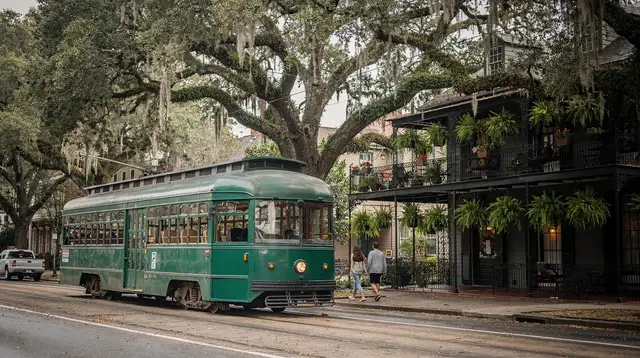
Once inside the Quarter, walking is not just the pleasant option, it is close to the only sensible one: streets are narrow, one-way, and often closed to traffic in the evenings, and parking in the Quarter is both scarce and strictly enforced. The Canal Street streetcar line and the Canal Street ferry to Algiers Point both connect from the Quarter’s upriver edge if you need to go further.
French Quarter frequently asked questions
Is the French Quarter the same as New Orleans?
No. The French Quarter is New Orleans’ oldest neighbourhood and its main historic and visitor core, but the city is much larger, including the Garden District, Tremé, the Marigny, Mid-City and Uptown, each with a different character and its own attractions.
How many days do you need in the French Quarter?
One full day covers the essentials — Jackson Square, the cathedral, Royal Street and the riverfront — but two days allow time for a guided tour, an evening out, and slower wandering without a fixed plan.
Can you drink on the street in the French Quarter?
Yes, alcohol can be carried on the street within the French Quarter, but only in a plastic “go-cup,” never in glass, and only within the permitted area.
Can you visit St Louis Cemetery No. 1 on your own?
No. Independent entry is not permitted; visits require an authorised guided tour. Cemetery access rules can change, so it is worth confirming current policy before you go.
Is Bourbon Street worth visiting?
It is worth a single walk-through for what it represents, but it is not where the city’s best live music or food is found; Frenchmen Street and Preservation Hall are generally better choices for music, and Royal or Decatur Street for atmosphere without the crowds.
What is the best time of year to visit the French Quarter?
Spring (March to May) and autumn (October to November) offer the most comfortable temperatures and lower humidity than the long, hot, humid summer, and avoid the hurricane season’s peak risk period of late August and September.
Is the French Quarter walkable?
Yes, it is designed to be walked: a compact grid of roughly thirteen blocks by six. Parking is difficult and heavily enforced, making walking, ride-hailing or the streetcar far more practical than driving.