Three Days in New Orleans: The Full City, No Car Needed
Why a third day changes the trip
Two days in New Orleans is enough to see the French Quarter and the Garden District, but it is not enough to understand the city. This is the last itinerary in this series that stays entirely inside New Orleans, on foot and on the streetcar, before the four-day and longer versions bring in a rental car for the River Road plantations and the swamps. If you want alligators or oak alleys, start with four days and a plantation instead.
This one is a deeper look at the city itself: a third morning in Tremé, where jazz was born; an evening on Frenchmen Street, where locals themselves point visitors for live music; and a choice of afternoon between the Warehouse Arts District’s National WWII Museum or City Park’s Besthoff Sculpture Garden in Mid-City. No plantations, no bayous — those belong to the itineraries that follow this one.
Quick answer: Three days lets you cover the French Quarter, the Garden District, and one full extra day exploring Tremé, the Faubourg Marigny and Frenchmen Street, plus either the National WWII Museum or City Park — all reachable on foot or by streetcar, without a rental car.
If you are deciding whether three days is the right length at all, see how many days in New Orleans and best time to visit first, since Mardi Gras and Jazz Fest change hotel prices and crowd levels sharply.
Before you go
- Getting in: Louis Armstrong New Orleans International Airport (MSY) sits roughly 18 km west of the French Quarter, 25–40 minutes by road. There is no rail link; see from MSY airport to the French Quarter for the shuttle, taxi and RTA bus options.
- Getting around: this itinerary uses the RTA streetcar network (St Charles, Canal Street, Riverfront, Rampart–St Claude lines) and walking only. A Jazzy Pass covers a day or more; see getting around New Orleans by streetcar.
- Money: US dollars, cards accepted almost everywhere, but keep cash for street musicians, some Frenchmen Street bars and parking meters. Sales tax is added at the till, and tipping runs 18–20% in restaurants; details at tipping and sales tax in New Orleans.
- Timing: New Orleans is humid subtropical, with long hot summers and a hurricane season from 1 June to 30 November. Spring and autumn are the most comfortable seasons; see best time to visit New Orleans.
Day 1: The French Quarter
Start in the French Quarter, the Vieux Carré, laid out on a compact grid around Jackson Square. Spend the morning at St Louis Cathedral, the Cabildo and the Presbytère, then wander Royal Street for its galleries and antiques shops before the afternoon heat sets in. Have beignets and chicory coffee at Café du Monde, then walk Decatur Street and the French Market.
In the late afternoon, join a walking tour that gets underneath the architecture rather than just past it — a walking tour through the Quarter’s haunted history and legends covers courtyards and back alleys most visitors miss on their own. For a broader mix of history, culture and ghost stories, a combined history, culture and hauntings walking tour is a good alternative if you’d rather do one longer walk than several separate ones.
In the evening, walk Bourbon Street once to see it (open containers of alcohol are legal here in a plastic go-cup, never glass), then head toward Frenchmen Street for a preview of what tomorrow evening holds in full. For more on the French Quarter walking guide and Jackson Square and St Louis Cathedral, see the dedicated guides. Note that St Louis Cemetery No. 1 can only be visited with an authorised guide — independent entry is not possible; see cemeteries of New Orleans.
Day 2: The Garden District and Uptown
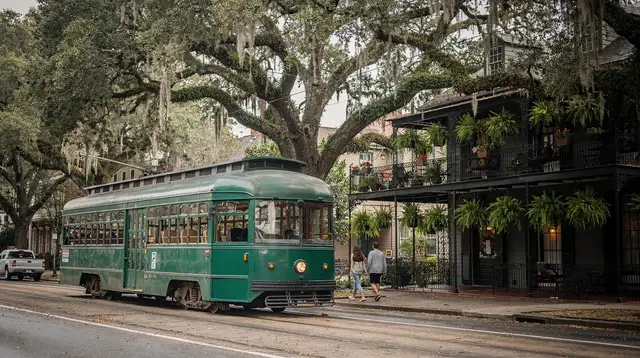
Take the St Charles streetcar — the oldest continuously operating street railway in the world — uptown to the Garden District. Walk the antebellum mansions along St Charles Avenue and the side streets, then visit Lafayette Cemetery No. 1, whose above-ground tombs are one of the city’s signatures and, unlike St Louis No. 1, can generally be visited independently (check current rules before you go).
A guided walk through the cemetery and neighbourhood adds context that self-guided wandering misses: a guided walk through the Garden District’s mansions and above-ground tombs. If ghost stories and voodoo history interest you more than architecture, a Garden District ghost and voodoo walking tour covers similar ground with a different focus.
Ride the streetcar back downtown for the afternoon and evening, and consider one of the Quarter’s famous cocktails — the Sazerac, the Ramos Gin Fizz or the Hurricane — as a way to end the day. Full detail on this half of the trip lives in the Garden District and the streetcar guide and Garden District walking tours.
Day 3: Tremé, Frenchmen Street, and a choice of afternoon
This is the day that separates a three-day trip from a two-day one. Start on foot at Louis Armstrong Park, just north of the Quarter, and walk into Tremé, one of the oldest African American neighbourhoods in the country. Congo Square, inside the park, is where much of the city’s music tradition began — brass bands, second lines and jazz itself trace back here. This is a neighbourhood where people live, not a sightseeing set piece, so walk it with that in mind.
By early afternoon, choose one of two directions:
| Option | Best for | Approx. time needed |
|---|---|---|
| National WWII Museum (Warehouse Arts District) | History, indoor comfort in summer heat | 3–4 hours |
| City Park & Besthoff Sculpture Garden (Mid-City) | Outdoor space, art, a slower pace | 2–3 hours |
If you choose history, the National WWII Museum visitor guide covers what to prioritise in the Warehouse Arts District, a short streetcar-and-walk combination from downtown. If you’d rather be outdoors, City Park and the Sculpture Garden in Mid-City has the New Orleans Museum of Art and the Besthoff Sculpture Garden, reachable by streetcar and bus from the CBD.
In the evening, head to the Faubourg Marigny and Frenchmen Street, the live-music strip that locals themselves recommend over Bourbon Street. Several clubs along a few blocks feature jazz, brass bands and local acts nightly, with no cover in many cases before a certain hour. Compare the two strips in Frenchmen Street vs Bourbon Street, and read live jazz in New Orleans for a nightly rundown of where to go.
If you’d rather end the trip with organised entertainment than club-hopping alone, a guided haunted pub crawl through some of the city’s oldest bars covers several French Quarter and Marigny-adjacent stops in one evening with a guide who knows the history behind each one.
Practical notes for this itinerary
- No car needed at any point. Every location in this three-day plan is reachable by streetcar or on foot; parking in the Quarter is metered and difficult, and tow-away enforcement is strict, so a rental car would be dead weight here.
- Heat and hydration: summer afternoons routinely reach the low thirties Celsius with high humidity. Plan indoor time (museums, the sculpture garden’s shaded paths) for the hottest hours.
- Safety at night: the Quarter, Marigny and Garden District are busy and well-policed, but take a ride rather than walk long distances after dark, and be careful on the fringes of Bourbon Street late at night. See is New Orleans safe for tourists.
- Budget: a Jazzy Pass, a few sit-down meals, one or two guided tours and cover charges on Frenchmen Street put this itinerary comfortably in the mid-range bracket; see New Orleans on a budget to trim it further.
- What’s next: once you’re ready to add a rental car and leave the city limits, four days and a plantation is the natural next step, followed by five days: city, swamp and River Road.
FAQ: three days in New Orleans without a car
Is three days enough time in New Orleans?
Three days is enough to see the French Quarter, the Garden District and a full additional day covering Tremé, Frenchmen Street and either the WWII Museum or City Park, all without a car. It is not enough to add the River Road plantations or the swamps, which need at least a fourth day with a rental car.
Do I need a car for this three-day itinerary?
No. This itinerary is built entirely around the RTA streetcar network and walking. A car is only useful once you leave the city for the plantations, the swamps or Cajun Country, which start on the four-day version of this itinerary.
Should I choose the National WWII Museum or City Park on day three?
Choose the National WWII Museum if you want an in-depth, air-conditioned history experience and don’t mind spending 3–4 hours indoors. Choose City Park and the Besthoff Sculpture Garden if you’d rather be outdoors at a slower pace, especially outside the hottest summer months.
Is Frenchmen Street better than Bourbon Street for live music?
Locals overwhelmingly point visitors to Frenchmen Street for live jazz, brass bands and local acts in a few concentrated blocks. Bourbon Street is worth walking once for the atmosphere, but it is not where residents go for music.
Can I visit St Louis Cemetery No. 1 on my own?
No. St Louis Cemetery No. 1 can only be entered with an authorised guide; independent visits are not permitted. Lafayette Cemetery No. 1 in the Garden District can generally be visited independently, but cemetery access rules change, so check current conditions before you go.
Is Tremé safe to walk through as a visitor?
Tremé, including Louis Armstrong Park and Congo Square, is generally fine to walk during the day as part of a guided or self-guided visit, but it is a residential neighbourhood, not a sightseeing attraction. Stick to daylight hours for an independent walk and be respectful of residents.
What should I pack for the heat and humidity?
Light, breathable clothing, sun protection and a refillable water bottle matter most, along with comfortable walking shoes for the Quarter’s uneven sidewalks. See what to pack for New Orleans for a full list by season.
tours.3 days
Verified deep-linked GetYourGuide tours. Book through these links and we earn a small commission at no cost to you.
GetYourGuide does not provide a product photo for this activity — the image shows the meeting point, photographed by us.