Live Jazz and Music in New Orleans: A Practical Guide
Where do locals go for live music in New Orleans?
Locals point visitors to Frenchmen Street in the Faubourg Marigny, just downriver from the French Quarter, rather than Bourbon Street. Preservation Hall inside the Quarter is the other essential stop, and brass-band second lines are neighbourhood parades, not staged shows.
Where the music actually is
New Orleans did not just host jazz once; it produced it, in the dance halls and brass bands of neighbourhoods like Treme at the turn of the twentieth century, and it still plays the music every single night. That fact surprises some visitors, because the version of New Orleans nightlife sold hardest on postcards and bar-crawl flyers is Bourbon Street, and Bourbon Street is mostly not where the jazz is.
It is loud, it is fun for a walk-through with a go-cup, and it has its place. But ask someone who actually lives here where they go to hear music, and the answer is almost always Frenchmen Street, a few blocks away in the Faubourg Marigny, or Preservation Hall inside the French Quarter itself.
This guide covers the city’s living music culture on its own terms: the clubs, the hall, the brass-band and second-line tradition that belongs to specific neighbourhoods rather than to a stage, and the one confusion worth clearing up before you plan anything, which is that zydeco and Cajun music are not New Orleans music at all.
Frenchmen Street: the street locals actually recommend
Frenchmen Street runs a few short blocks through the Faubourg Marigny, just downriver from the Quarter, and it is the single piece of advice that comes up most often when a New Orleanian is asked where to hear live music. The strip is dense with small clubs, each with its own booking policy and personality: some lean toward traditional jazz, others toward funk, brass, blues or soul, often with several sets a night and a different band in each room.
The practical shape of an evening on Frenchmen Street is simple. Cover charges are modest, usually paid in cash at the door, and nobody expects reservations for most venues. It rewards wandering: a set that isn’t working for you is a short walk from three or four alternatives. The crowd skews local, especially midweek, which is part of the appeal — this is music being played for the city, not staged for a tour bus.
The contrast with Bourbon Street is worth being explicit about, because visitors often assume the loudest, busiest street must be the main event. Bourbon Street’s daily rhythm is built around drinking and crowd noise, with amplified cover bands and DJ sets rather than working jazz musicians, and it is genuinely a different kind of night out — not better or worse, just a different product. If live jazz is the goal, Frenchmen Street is the destination; if a loud walk with a drink in hand is the goal, Bourbon Street delivers exactly that.
Preservation Hall: the other essential stop
Preservation Hall sits on St Peter Street inside the French Quarter, and it is the closest thing New Orleans has to a jazz institution you can walk into on any given night. It is a small, unamplified room — no stage lighting show, no bar service inside, just wooden benches, some floor cushions, and a rotating cast of some of the city’s best traditional jazz musicians playing 45-minute sets.
Because the room is small and the reputation is large, lines form early, and shows do sell out. Buying an advance ticket guarantees a spot; showing up and queueing is possible but not reliable, especially on weekends or during festival season. There is no food or drink inside, and the format is intentionally spare: this is a listening room, not a bar with a band in the corner. For a first encounter with real, unamplified New Orleans jazz, it is hard to beat, and it pairs naturally with a walk afterward toward Jackson Square and St Louis Cathedral a few blocks away.
Brass bands and second lines: neighbourhood events, not shows
The brass-band tradition is the other half of what makes New Orleans’s music culture different from anywhere else, and it is the part most likely to be misunderstood by a visitor. A second line is a parade led by a brass band, typically organised by a Social Aid and Pleasure Club, a church group or a community organisation, that moves through a specific neighbourhood on a set route, usually on a Sunday afternoon. Neighbours join in behind the band — hence “second line” — dancing and following along.
These are not performances staged for tourists, and they should not be treated as one. They are community events with deep roots in African American cultural and mutual-aid traditions going back generations, and they still happen regularly in neighbourhoods across the city, including Treme, one of the oldest African American neighbourhoods in the country and a birthplace of much of this music. A visitor who encounters one is welcome to watch respectfully from the sidewalk and enjoy the music, but it is not a ticketed attraction, it has no box office, and it is not built around visitor convenience — schedules shift, routes change, and the right posture is that of a guest, not a customer.
Brass bands also turn up in more conventional settings — busking on street corners near Jackson Square and in the French Quarter, or booked into Frenchmen Street clubs — and hearing one there, tip in hand, is a perfectly good and much simpler way to experience the tradition without needing to track down a second-line schedule.
Zydeco and Cajun music do not belong to New Orleans
This is worth stating plainly, because the two get conflated constantly in casual travel writing: zydeco and Cajun music are not New Orleans traditions. Both belong to Acadiana, the Cajun-settled region centred on Lafayette, roughly two hours west of the city. Cajun music descends from the folk traditions of the Acadians who settled the prairies and bayous west of New Orleans after their expulsion from Nova Scotia in the 1750s; zydeco grew out of Louisiana Creole communities in the same region, blending those roots with rhythm and blues. Neither is native to New Orleans itself, and a venue in the Quarter billing itself as offering “authentic zydeco” is trading on a geography it doesn’t actually occupy.
If zydeco and Cajun music are genuinely what you’re after — the accordion-and-fiddle dance-hall sound, the two-step, the fais do-do tradition — that means a trip out to Cajun country around Lafayette, not a night in New Orleans. The city’s own music, the thing it actually invented and still plays, is jazz, brass and the second-line tradition described above. Keeping the two straight matters for setting expectations correctly before you book anything.
Comparing the main ways to hear live music
| Option | What it is | Typical cost | Best for |
|---|---|---|---|
| Frenchmen Street clubs | Multiple small venues, walk-in, cash cover | Modest cover per venue, cash | An evening of club-hopping, local atmosphere |
| Preservation Hall | Small unamplified traditional jazz hall | Higher for guaranteed seat than general admission | A focused, short, high-quality set |
| Guided jazz tour with a musician | Walking or driving tour narrated by a working musician, often with a stop for live music or a drink | Fixed tour price | First-timers who want context and history alongside the music |
| Street brass bands | Buskers near Jackson Square, in the Quarter, or booked into clubs | Tips, or included in a club’s cover | A casual, no-commitment taste of the tradition |
| Second lines | Neighbourhood parade, usually Sunday afternoons | Free to watch respectfully | Understanding the culture, not a bookable experience |
| Dinner or riverboat jazz cruise | Live band aboard a cruise on the Mississippi | Fixed cruise price, often including a meal | Combining music with a river view and a sit-down meal |
| Bourbon Street bars | Amplified cover bands, DJ sets, high energy | Varies, often no cover but pricier drinks | A loud night out, not serious jazz listening |
Making an evening of it
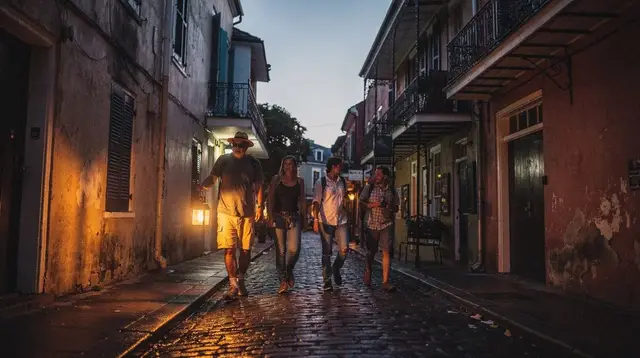
Someone new to the city and short on time can reasonably ask a musician to do the explaining rather than piecing it together alone. A guided walking tour tracing the roots of jazz through the neighbourhoods where it developed, with a stop for a drink along the way gives useful context before a night on Frenchmen Street, and a more personalised small-group jazz tour built around live music and a drink works well for a group that wants the story without a fixed itinerary.
For visitors basing themselves further out or without a car, a citywide driving tour narrated by a working jazz musician covers more ground — including a look at Treme and other neighbourhoods tied to the music’s origins — than a walking tour can manage in an evening. On the river, an evening jazz cruise on the Mississippi with an optional dinner combines a live band with the view of the city from the water, a different but equally New Orleans way to close out a night.
None of these substitute for simply walking Frenchmen Street on foot and following your ears into whichever room sounds good, which remains the cheapest and most local way to hear the city’s music. A guided option earns its price mainly through context — knowing what you’re hearing and why it matters — and through convenience for a first night in an unfamiliar city.
Practical notes for a night out
A few details make the difference between a smooth night and a frustrating one. Frenchmen Street clubs mostly take cash for the cover charge, so carrying a modest amount of small bills matters, and tipping the band — musicians in New Orleans typically work partly for tips dropped in a bucket or jar — is standard practice, not optional generosity.
Preservation Hall’s advance tickets are worth the small premium over hoping to queue in, especially on weekends or around festivals like Jazz Fest or Mardi Gras, when the whole city is fuller and prices rise. The legal drinking age is 21 with identification checked at the door of most clubs, and while open containers are allowed on French Quarter streets in a plastic go-cup, that same allowance does not extend inside most live-music venues, which have their own bar service.
Getting between the Quarter and Frenchmen Street is a short, walkable distance in normal circumstances, but late at night the usual advice applies: stick to lit, busy streets, and consider a short ride-hail rather than a long walk back to a hotel once the music stops. For a broader look at getting around without a car, see the guide to getting around New Orleans by streetcar.
Beyond the club circuit
Music surfaces in New Orleans in places that have nothing to do with a formal venue. Brass bands busk near Jackson Square most days, church services in neighbourhoods like Treme carry their own musical traditions, and the National WWII Museum and other Warehouse District venues occasionally host their own live programming unrelated to the jazz clubs proper.
For visitors who want music paired with food and drink rather than a club night specifically, the French Quarter’s food and drink scene often overlaps with venues that book live sets, though that pairing is its own subject and covered separately.
However you build the evening, the throughline is the same: New Orleans’s music is not a show that starts and stops on a schedule built for visitors. It is a working, nightly, neighbourhood-rooted practice that happens to be extraordinarily good and extraordinarily accessible, provided you know to walk two blocks past Bourbon Street rather than stopping at the first bar you reach.
Live music and nightlife in New Orleans: your questions answered
Is Bourbon Street a good place to hear jazz?
Not really. Bourbon Street is loud, crowded and geared toward drinking, and most of what plays there is cover bands and DJ sets rather than serious live jazz. Musicians and locals go to Frenchmen Street or Preservation Hall instead.
What is Frenchmen Street?
Frenchmen Street is a short strip of clubs and bars in the Faubourg Marigny, just outside the French Quarter, where working musicians play nightly. It is the strip locals recommend over Bourbon Street for genuine live jazz, funk and brass.
How does Preservation Hall work?
Preservation Hall is a small, unamplified listening room in the French Quarter with 45-minute sets several times a night. There is limited bench and floor seating, no food or drink service inside, and lines form early, so arriving well before showtime matters.
What is a second line?
A second line is a neighbourhood brass-band parade that follows a club, church or community organisation through the streets, usually on a Sunday afternoon. It is a local event that visitors may watch respectfully from the sidewalk, not a ticketed performance staged for tourists.
Is zydeco music part of New Orleans culture?
No. Zydeco and Cajun music both belong to Acadiana, the region around Lafayette roughly two hours west, not to New Orleans itself. New Orleans is the birthplace of jazz and home to brass-band and second-line traditions instead.
Do you need to book jazz clubs in advance?
Most Frenchmen Street clubs are walk-in only with a cover charge paid at the door. Preservation Hall sells advance tickets for guaranteed entry, which is worth doing since walk-up lines can be turned away once a set sells out.
Is there a cover charge for live music?
Frenchmen Street clubs typically charge a modest cash cover, often 10 to 20 US dollars, collected at the door. Preservation Hall charges more for a guaranteed seat than for general admission, and some venues waive the cover for early sets.
Jazz dinners and shows on GetYourGuide
Verified deep-linked GetYourGuide tours. Book through these links and we earn a small commission at no cost to you.
GetYourGuide does not provide a product photo for this activity — the image shows the meeting point, photographed by us.