Jackson Square and St Louis Cathedral: A Guide to the Vieux Carre's Civic Heart
What are Jackson Square, the Cabildo and the Presbytere, and why do they matter?
Jackson Square is the original public square of the French Quarter, laid out under French and Spanish colonial rule and framed by St Louis Cathedral, the Cabildo and the Presbytere. The cathedral is the seat of the Archdiocese of New Orleans, while the Cabildo and Presbytere, built as government and church administrative buildings, are now history museums run by the Louisiana State Museum.
Reading the square that built the French Quarter
Almost every visit to the French Quarter passes through Jackson Square at some point, but most people walk across it without noticing that it is, in effect, the reason the rest of the neighborhood is shaped the way it is. The square was laid out as the Place d’Armes when the French engineer Adrien de Pauger platted New Orleans in 1721 and 1722, a parade ground set one block back from the Mississippi River and framed on its landward side by a church. That single decision, a public square with a church facing it, fixed the orientation of the streets around it, and the grid of the Vieux Carre still radiates from this point today.
What stands on the square now is not, for the most part, what stood there in the 1720s. Fire destroyed most of the original colonial city twice, in 1788 and again in 1794, during the period when Louisiana was under Spanish rather than French administration. The buildings that frame the square today, the cathedral, the Cabildo and the Presbytere, are Spanish colonial rebuildings, financed in large part by the wealthy Spanish philanthropist Andres Almonester y Roxas.
So the square you see is French in its layout and Spanish in its architecture, with an American layer added on top in the nineteenth century, most visibly in the wrought-iron galleries and the equestrian statue at its center. Reading the square as this stack of periods, rather than as one single “old” thing, is the most useful lens for understanding the rest of the French Quarter.
St Louis Cathedral: the building that anchors the grid
St Louis Cathedral, formally the Cathedral-Basilica of St Louis, King of France, is the oldest continuously active Catholic cathedral in the United States, though the building itself dates mostly from an 1850 reconstruction that enlarged and remodeled the 1789 Spanish colonial church. It is the seat of the Archdiocese of New Orleans and remains an active parish, which matters practically: Mass schedules, weddings and funerals sometimes close parts of the interior to visitors, so hours are worth checking rather than assumed.
The exterior is the image most associated with New Orleans, three steeples above a pale facade closing the far side of the square, and it photographs from almost every angle of Jackson Square and from the riverfront behind it. Inside, the ceiling murals, the Baroque high altar and the organ are the focal points for a self-guided look, and docent-led tours run on a published schedule when staffing allows. Behind the cathedral, a narrow passage called Pere Antoine Alley (paired with Pirates Alley on the other side) leads through to Royal Street, a shortcut worth knowing when the square itself is crowded.
For visitors who want the history explained on-site rather than pieced together from a plaque, a guided visit inside the cathedral covers the succession of churches on this spot, the fires, and the building’s continuous role as the city’s Catholic center. This is the kind of detail a good guide adds quickly that a self-guided pass through tends to miss: an official guided tour of St Louis Cathedral walks the interior with that context, rather than leaving you to guess at the murals from a guidebook paragraph.
The Cabildo: where the Louisiana Purchase was finalized
To the left of the cathedral as you face it stands the Cabildo, a two-story Spanish colonial building completed in 1799 as the seat of the Spanish colonial government, its name taken directly from the Spanish word for the governing council that met there. Architecturally, it is a clean example of Spanish colonial civic building, arcaded at street level, with a later French-style mansard roof added after an 1850s fire. It is easy to mistake for a slightly grander version of its neighbors; its actual historical weight is much larger than its facade suggests.
The Cabildo is where the formal transfer ceremonies for the Louisiana Purchase were conducted in December 1803, the paperwork that moved sovereignty over the territory from France to the United States after France had briefly reacquired it from Spain. That makes the building a genuine hinge point in North American history, not a themed backdrop.
Today it operates as one of the flagship sites of the Louisiana State Museum system, with exhibits tracing Louisiana’s colonial period, the Purchase itself, and the state’s nineteenth-century history, including its Civil War-era material. A visit runs roughly 45 minutes to an hour if you read the exhibits rather than skim them, and it pairs naturally with the Presbytere across the square, since a single museum ticket often covers both.
The Presbytere: mirror building, different story
On the cathedral’s other side, mirroring the Cabildo almost exactly in scale and style, is the Presbytere. It was designed to be a rectory for the clergy attached to the cathedral, a functional purpose it never actually served: construction dragged on, ownership passed through a series of hands, and by the time it was finished in the 1840s it had already been repurposed as a courthouse. The symmetry between the Cabildo and the Presbytere, one built as government, one intended as church housing, is part of what gives Jackson Square its formal, almost theatrical balance.
The Presbytere is now also a Louisiana State Museum site, and its two long-running exhibitions are worth knowing about in advance because they are unusually good: one on the history and culture of Mardi Gras, tracing the krewes, the float traditions and the costume artistry behind the city’s best-known festival, and a separate, more sober exhibition on Hurricane Katrina and its aftermath, built around oral histories and objects recovered after the levee failures of 2005. That second exhibition is one of the more direct, unsentimental ways to engage with Katrina’s history while in the city, alongside dedicated coverage on this site’s Hurricane Katrina guide.
Around the square: what the grid still shows you
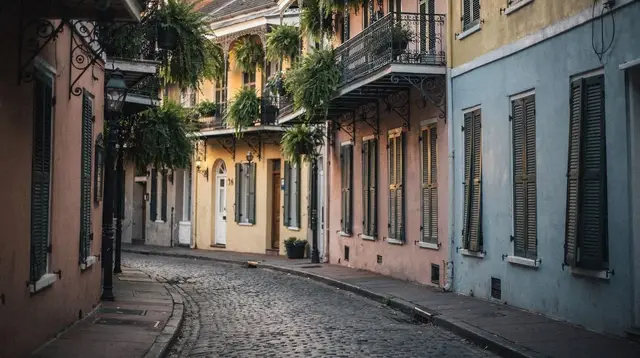
Step back from the three landmark buildings and the square itself tells a second story, the story of New Orleans as a planned colonial town rather than an organic settlement. The blocks immediately around Jackson Square still follow Pauger’s original French survey, a rough grid of long, narrow blocks running back from the river, later infilled with the balconies and courtyards that read as quintessentially “New Orleans” but are in fact largely Spanish colonial and early American additions layered onto a French skeleton.
Decatur Street runs along the square’s river side, separating it from the French Market and the riverfront; Chartres and Royal Streets run parallel a block or two back, carrying the antique dealers and galleries that Royal Street is known for. St Ann and St Peter Streets frame the square’s other two sides, each lined with the matching red-brick Pontalba Buildings, built in the 1850s by the Baroness Micaela Pontalba and often cited as some of the oldest continuously occupied apartment buildings in the country, their ground floors now shops and cafes. Walking the full perimeter, rather than cutting straight across, is the easiest way to see how deliberately the whole ensemble was composed.
The artists, readers and musicians on the square
Jackson Square has functioned as an open-air gathering point for working artists for well over a century, and the practice is regulated rather than incidental: portrait and caricature artists set up along the St Peter and St Ann Street sides under a city permit system, tarot card and palm readers work fold-out tables along the fence line, and musicians, often solo brass or string players, take up positions near the cathedral steps or along Decatur Street. Many of the same individuals work the same stretch of railing for years, and it is a genuinely different scene from the paid ghost-tour guides and costumed performers found elsewhere in the Quarter.
If you stop for a portrait, a reading or a song, cash is the practical currency here. Card readers on folding tables and street musicians working for tips are not consistently set up to take cards, and the same is true of the buskers you will see elsewhere in the Quarter and around Frenchmen Street. It is worth carrying a reasonable amount of small bills specifically for this before you set out for the day, rather than discovering the gap once you are already mid-portrait.
Fitting the square into a Quarter walk
Jackson Square works best as a starting point rather than a destination in itself, precisely because of where it sits in the grid. From the square, Decatur Street and the French Market lead one way toward the Faubourg Marigny, Royal Street leads back through the gallery district, and St Ann Street leads toward Bourbon Street and the deeper blocks of the French Quarter. A logical half-day loop starts at the square, takes in the cathedral, the Cabildo and the Presbytere, then fans out along Royal Street or Decatur Street depending on whether shopping or the riverfront is the priority.
The square also sits close to two of the Quarter’s cemetery and history experiences that are frequently paired with it. St Louis Cemetery No. 1, a few blocks toward the lake side of the Quarter, can only be entered with an authorized guide, and several operators combine that visit with cathedral or square context in a single outing: a guided tour of St Louis Cemetery No. 1 covers the cemetery’s above-ground tombs and its most notable burials, including Marie Laveau, while treating the subject with the seriousness it deserves rather than as a novelty stop.
For a wider architectural view that starts from the same colonial logic as Jackson Square but extends into the residential blocks downriver, a small-group architecture tour of the Marigny is a useful complement, since it explains how the same Creole building types seen around the square evolved once they left the formal civic core. Visitors who prefer to cover more ground in less time, especially in summer heat, sometimes opt for a guided Segway tour that threads the square into a longer loop of the Quarter’s landmarks.
Practical notes for visiting
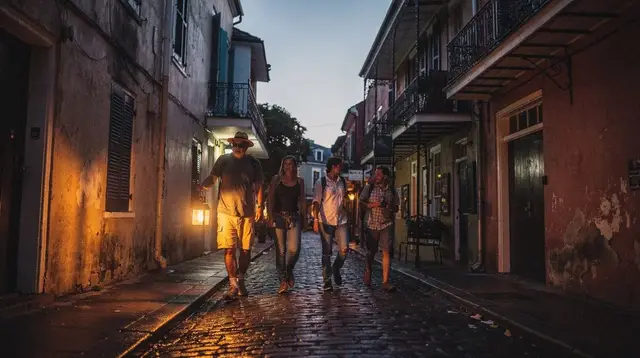
The square itself is outdoors and free to enter at any hour, though it is at its most legible in daylight, when the facades, ironwork and signage are easy to read; many visitors also return in the evening to see the cathedral lit against the sky. The cathedral’s interior and the two museum buildings keep their own hours, generally daytime only, and all three can close without much notice around religious holidays, civic events or Mardi Gras season, so checking same-day hours before planning a visit around them is worth the extra step.
| Site | What it is | Typical visit time | Note |
|---|---|---|---|
| Jackson Square | Public square, colonial parade ground | 20–30 min | Free, outdoors, open at all hours |
| St Louis Cathedral | Active Catholic cathedral | 20–45 min | Closes for Mass and services |
| The Cabildo | Louisiana State Museum, colonial & Purchase history | 45–60 min | Ticketed museum |
| The Presbytere | Louisiana State Museum, Mardi Gras & Katrina | 45–60 min | Ticketed museum, often combined with the Cabildo |
Because the square sits at the geographic and historical center of the Quarter, it also makes a natural reference point for planning the rest of a visit: see things to do in the French Quarter for how it fits alongside Bourbon Street, Royal Street and the riverfront, or the broader French Quarter history and culture tours for other sites built around the same colonial period.
For a first visit to the city as a whole, the New Orleans for first-time visitors guide places Jackson Square within a wider sense of priorities, and the one-day New Orleans essentials itinerary treats it as an anchor stop for a single, tightly planned day.
Travelers curious about the ghost-story side of the Quarter, which is deliberately not the focus here, will find that covered separately in the ghost tours compared guide, and the civic and religious architecture around the square connects naturally to the broader museums of New Orleans guide for those who want to keep the Cabildo and Presbytere visits going into the afternoon. Anyone weighing whether to buy a guided experience at all versus exploring independently should also see guided vs self-guided French Quarter, which addresses exactly this square as one of its central examples.
Jackson Square and St Louis Cathedral: frequently asked questions
Is St Louis Cathedral free to visit?
The cathedral is generally open to visitors outside of Mass times, and self-guided entry does not require a paid ticket, though donations are welcome. Guided tours inside the cathedral run on a schedule and are worth checking locally, since opening hours shift around services and holidays.
What is the Cabildo, exactly?
The Cabildo was built in the 1790s as the seat of the Spanish colonial government and later hosted the signing of the Louisiana Purchase transfer documents in 1803. It is now a Louisiana State Museum site covering the colonial and early American history of the city.
What is the Presbytere, and is it different from the Cabildo?
Yes. The Presbytere was built to house clergy attached to the cathedral, was never used for that purpose, and today is a separate Louisiana State Museum building facing the Cabildo across the square, with exhibits on Mardi Gras and on Hurricane Katrina.
Why is Jackson Square laid out the way it is?
The square sits at the center of the original French colonial grid platted in the 1720s, later reinforced by Spanish rebuilding after the fires of the 1780s, which is why the cathedral, Cabildo and Presbytere still face the square symmetrically along that grid.
Who are the people set up around the square, and should I pay them?
The railings and flagstones around Jackson Square are worked daily by portrait artists, tarot and palm readers, and street musicians, most of them regulars with a long-standing claim to their spot. Cash is genuinely useful here, since not everyone on the square takes cards.
Is Jackson Square connected to Bourbon Street or Frenchmen Street nightlife?
Not really. The square empties out earlier than the bars and clubs, and its character is civic and historic rather than a nightlife destination; the live-music strips are several blocks away in different directions.
How much time should I set aside for the square and its buildings?
Budget 20 to 30 minutes to walk the square itself and read its facades, and add 45 minutes to an hour each if you go inside the cathedral, the Cabildo or the Presbytere.
History and culture tours on GetYourGuide
Verified deep-linked GetYourGuide tours. Book through these links and we earn a small commission at no cost to you.
GetYourGuide does not provide a product photo for this activity — the image shows the meeting point, photographed by us.