Voodoo and Cemetery Tours in New Orleans
What is a Voodoo or cemetery tour in New Orleans actually like?
It is a guided walk, usually 90 minutes to 2 hours, that covers the history of Louisiana Voodoo as a real religion and the above-ground tombs of a historic cemetery such as St Louis Cemetery No 1. Some operators focus on documented history and religious practice, others lean into ghost stories and legend, and a licensed guide is legally required to enter St Louis Cemetery No 1 at all.
A different kind of French Quarter tour
Most visitors to New Orleans start with a walking tour of the French Quarter, and a separate wave books a look at the historic cemeteries once they hear about the above-ground tombs. Voodoo and cemetery tours sit apart from both. They are not general-interest heritage walks through Jackson Square and the Cabildo, and they are not museum visits. They are a specific, popular category built around two linked subjects: Louisiana Voodoo as a living religion, and the cemeteries where some of its best-known figures are buried.
The category is broad enough to include quite different products under one label. Some operators run tours that are essentially religious and social history, told carefully and without spectacle. Others sell an evening of ghost stories, legend and theatrical suspense that happens to pass by a cemetery gate or a Voodoo shop on Rue Royale. Both are legitimate things to sell and to buy. The problem is that they often use the same words in their marketing, so it is easy to book one expecting the other. This guide exists to help you tell them apart before you pay, not to rank one above the other.
Voodoo is a real religion, not a prop
Louisiana Voodoo is a genuine syncretic religion, formed in and around New Orleans from West African spiritual traditions carried by enslaved people, blended with Catholic saints, ritual and imagery over more than two centuries. It has practitioners today, along with temples, altars and shops in the city, including several along Rue Royale and in Treme and the Birth of Jazz, the neighbourhood most closely tied to the city’s African American religious and musical history. It is not a Halloween theme, and it did not originate as entertainment for visitors.
That distinction matters for how you choose a tour. A serious Voodoo-focused operator will talk about the religion’s African roots, its Catholic overlay, the role of spirits and saints, and the community that still practises it, and will generally treat altars, symbols and practitioners with the same respect they would extend to any other faith’s places of worship. A tour built purely around fright will use the same vocabulary but aim at a different feeling: suspense, shock and a good story to tell afterward. Neither approach is wrong to sell or to buy, but knowing which one you are booking changes what you should expect from the evening.
Marie Laveau, historical figure
No name comes up more often on these tours than Marie Laveau, the nineteenth-century Voodoo Queen of New Orleans. She was a real, well-documented person: a free woman of colour who became the city’s most influential Voodoo practitioner, with genuine social and political reach that extended well beyond religious practice. She is buried in St Louis Cemetery No 1, and her tomb, marked with the small crosses left by visitors over the decades, is one of the most visited sites in the cemetery.
Because her life has been retold so many times, with embellishment added at every step, it is worth separating the documented facts (her name, her era, her real social standing, her burial site) from the legend that has grown around her (supernatural powers, specific miracle stories, claims about her descendants). A good Voodoo-history tour will generally flag which parts of the Marie Laveau story are established record and which are folklore that has attached itself to her name over time. A tour pitched purely as ghost entertainment may not draw that line as carefully, and that is fine as long as you know that going in.
St Louis Cemetery No 1: guide required, no exceptions
St Louis Cemetery No 1, the city’s oldest surviving cemetery and the resting place of Marie Laveau, cannot be entered independently. Since a rule change some years ago, visitors may only enter as part of a group led by an authorised, licensed guide; walking in alone, even to look for a specific tomb, is not permitted. The rule was introduced to curb vandalism and unauthorised access to the fragile above-ground tombs, many of which are centuries old and easily damaged.
In practice this means that any legitimate visit to St Louis Cemetery No 1 is a booked, guided one, whether you arrange it through a dedicated cemetery tour, a combined Voodoo and cemetery tour, or a broader history and culture tour that includes it as a stop. There is no walk-up ticket booth and no self-guided option, so if seeing this specific cemetery is a priority, book ahead rather than assuming you can turn up on the day. Rules for individual cemeteries do change from time to time, so treat any claim of free, unguided entry with suspicion and check current conditions before you plan around it.
Lafayette Cemetery No 1, uptown in the Garden District, is a separate site with different access rules and is not the cemetery associated with Marie Laveau; do not confuse the two when booking.
a licensed guided walk through St Louis Cemetery No 1 is the only lawful way to see Marie Laveau’s tomb up close, and most operators combine it with the surrounding Voodoo history on the walk there.
What a serious Voodoo and cemetery tour covers
A history-oriented tour in this category typically combines several threads over roughly ninety minutes to two hours: the African and Catholic origins of Louisiana Voodoo, the life and legend of Marie Laveau, the layout and meaning of above-ground burial in a city built below and at sea level, and often a stop at a working Voodoo shop or altar in the French Quarter or Treme. Guides on these tours tend to be well-read in local history and comfortable answering direct questions about religious practice, rather than performing a script built for jump scares.
a guided walk pairing Voodoo history with a stop at St Louis Cemetery No 1 is the most direct way to get both subjects covered together in one outing, and it is a reasonable starting point if you want the history without the theatrics.
If your interest is specifically the religion rather than the cemetery, a narrower option exists too. a walking tour focused on Voodoo history and practice in the French Quarter and Treme spends more time on the religion’s roots, its practitioners and its shops, and less on tombs and burial customs.
What a ghost-and-legend tour covers instead
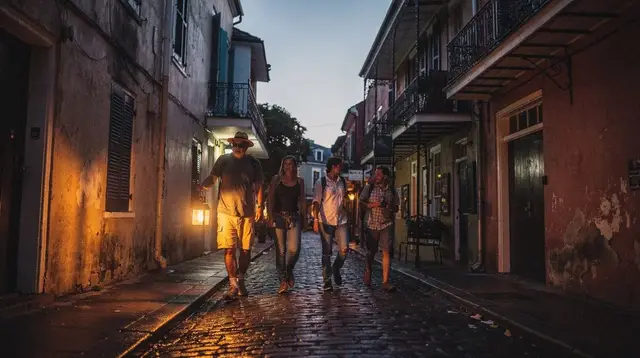
Tours pitched around ghosts, hauntings and the paranormal use much of the same geography, since the French Quarter’s age and the presence of St Louis Cemetery No 1 make it fertile ground for both kinds of storytelling. The difference is in the material and the tone: these tours lean on reported hauntings, unsolved crimes, vampire legend and unexplained events, told for suspense and entertainment rather than as documented religious or social history. Some run at night specifically for atmosphere, walking past cemetery gates that are closed for the evening rather than entering them.
Operators in this vein often name-check vampires, true crime and the paranormal directly. an evening walk mixing vampire lore, Voodoo legend and reported hauntings is a clear example of the entertainment end of the spectrum, aimed at a fun scare rather than a history lesson. a tour built around real crimes and dark local legend tied to Voodoo folklore leans further still into true-crime storytelling.
If you would rather sample the paranormal side without a heavy true-crime angle, a tour focused on Voodoo mystery and reported paranormal activity keeps closer to ghost-story territory. None of these claim to be religious instruction, and treating them as such is the wrong expectation to walk in with; treating them as a well-told evening of local legend is the right one. For background on the wider genre, see our comparison of ghost tours in New Orleans and our separate look at vampire lore and the French Quarter.
Choosing between the two approaches
Neither type of tour is a mistake to book. The question is what you actually want from the evening, and being honest about that before you pay saves disappointment on both sides. Someone hoping for a serious account of a real religion will be let down by a tour built for jump scares, and someone hoping for a fun, spooky night out may find a strictly historical talk slow going.
| If you want… | Look for a tour that… |
|---|---|
| Documented history of Louisiana Voodoo | Names its focus as history or religious practice, not “haunted” or “paranormal” |
| The real story of Marie Laveau | Distinguishes documented fact from legend explicitly |
| Entry to St Louis Cemetery No 1 | States it includes licensed cemetery access, not just a walk past the gate |
| An evening of suspense and stories | Is marketed around ghosts, hauntings or true crime |
| Something suitable for children | Runs during the day and is described as family-friendly |
| A quieter, respectful pace | Runs in a small group rather than a large evening crowd |
Reading the operator’s own description carefully, rather than just the tour name, is the most reliable way to sort one from the other, since “Voodoo tour” and “ghost tour” are sometimes used loosely by sellers who run a blend of both.
Where this fits with the rest of your trip
Voodoo and cemetery tours pair naturally with a broader look at New Orleans history and culture, but they are a distinct product from the general French Quarter walking tours and from the city’s museums and attractions, which is why this guide treats them separately. If your main interest is the cemeteries themselves rather than Voodoo, our cemeteries of New Orleans visitor guide covers Lafayette Cemetery No 1 and other sites alongside St Louis Cemetery No 1.
If it is the religion and its place in the city’s African American history, our Voodoo in New Orleans: history and tours guide and our overview of African American heritage in New Orleans go further into that context, including the connections to Treme and the birth of jazz and the wider French Quarter neighbourhood.
Most of these tours depart on foot from a meeting point in the French Quarter itself, so you do not need a car or rideshare to reach the start; see getting around New Orleans by streetcar if you are coming from a hotel further out, such as the Garden District.
If you are building a longer stay around this kind of theme, our three days in New Orleans itinerary and our guide to how many days in New Orleans are useful references for pacing an evening tour against the rest of a day spent in the French Quarter or exploring things to do in New Orleans more broadly.
Evening tours in this category typically run rain or shine and continue year-round, since they are largely a walking format through covered and open streets alike; the one seasonal factor worth knowing is that summer evenings in New Orleans stay warm and humid well after dark, so light clothing is more useful than a jacket for most of the year. If your visit falls during Halloween in New Orleans, demand for both the historical and the entertainment versions of these tours rises sharply, and booking a few days ahead is worth doing rather than relying on availability the same evening.
Practical booking notes
Group sizes vary by operator, from small walking groups of a dozen or so to larger evening crowds, and this affects both the atmosphere and how well you can hear the guide over French Quarter street noise. Tours typically start in the early evening or after dark for the ghost-oriented options, and during daylight for most cemetery-inclusive and family-friendly versions, since the cemetery itself keeps daytime hours. Comfortable shoes matter more than any other piece of preparation, since the walk covers uneven brick sidewalks and cobbled sections of the Quarter and Treme.
Tipping your guide at the end, in cash, is customary and generally appreciated in the same range as other guided walking tours in the city. If a specific stop, such as entry to St Louis Cemetery No 1 or a working Voodoo shop, matters most to you, confirm it is included in the itinerary before booking rather than assuming every “Voodoo tour” covers the same ground, since the category genuinely spans two different products under one name.
Frequently asked questions about Voodoo and cemetery tours in New Orleans
Is Voodoo a real religion or just a tourist attraction?
It is a real syncretic religion practised in Louisiana today, blending West African spiritual traditions brought by enslaved people with Catholic saints and ritual. It has its own practitioners, temples and shops in New Orleans. The tourist industry around it ranges from careful, respectful history to pure entertainment, and it is worth knowing which one you are booking.
Who was Marie Laveau?
Marie Laveau was a real nineteenth-century Voodoo practitioner in New Orleans, widely known as the Voodoo Queen for her influence over the city’s religious and social life. She is a documented historical figure, not a legend, and she is buried in St Louis Cemetery No 1, where her tomb is a focal point of many tours.
Can I visit St Louis Cemetery No 1 on my own?
No. Independent visits to St Louis Cemetery No 1 are not permitted; entry is only allowed as part of a group with an authorised, licensed guide. This rule exists to protect the fragile above-ground tombs from vandalism and applies to everyone, regardless of how the tour is booked.
What is the difference between a Voodoo tour and a ghost tour?
A Voodoo tour centres on the documented history and practice of Louisiana Voodoo as a religion, including its African and Catholic roots and figures like Marie Laveau. A ghost tour is built around local legend, hauntings and unexplained events, and is presented as entertainment rather than religious or historical instruction, though the two subjects often overlap on the same walk.
Are these tours suitable for children?
Many operators run family-friendly versions during the day that focus on history and culture rather than fright, while evening ghost-oriented tours are pitched at adults and can include intense storytelling. Check an operator’s description and start time before booking if you are travelling with children.
Do these tours go inside a cemetery at night?
Cemeteries in New Orleans, including St Louis Cemetery No 1, are not open to visitors after dark for safety and preservation reasons. Evening Voodoo and ghost tours walk through the French Quarter and Treme discussing cemeteries and Voodoo history from outside gates that are closed for the night, or visit a cemetery separately during daylight hours.
What should I wear or bring?
Comfortable walking shoes for uneven brick and cobbled streets, water in warm months, and cash for tipping your guide, which is customary at roughly the same rate as other guided tours in the city.
Voodoo and cemetery tours on GetYourGuide
Verified deep-linked GetYourGuide tours. Book through these links and we earn a small commission at no cost to you.
GetYourGuide does not provide a product photo for this activity — the image shows the meeting point, photographed by us.