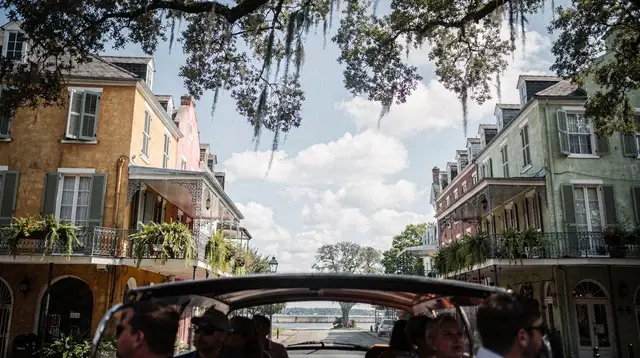
New Orleans River Cruises: Seeing the City from the Mississippi
Are there river cruises in New Orleans, and what do you actually see on them?
Yes. Paddlewheelers and modern riverboats leave daily from the wharf near the French Quarter for daytime, dinner-jazz and historical cruises on the Mississippi River. You see the working port, the downtown skyline and the levees that hold the river back, not a coastline — New Orleans sits on an inland bend of the river, not on the sea.
A different vantage point on the same city
Most visitors get to know New Orleans on foot, block by block through the French Quarter, or from the seat of a bus working through the Garden District. A river cruise is the one format that shows the city from somewhere else entirely: the water. For an hour or two, the skyline, the warehouses, the bridges and the working port slide past from a boat deck rather than a sidewalk, and the city’s oldest relationship — with the river that built it — becomes visible in a way no walking route can quite manage.
Before anything else, it helps to correct an assumption a lot of first-time visitors bring with them. New Orleans is often filed mentally alongside coastal cities, but it isn’t one. The city sits on a bend of the Mississippi River, inland, roughly 160 km upstream from the Gulf of Mexico. It is bordered on its other side not by the sea but by Lake Pontchartrain, a large brackish lake, and a meaningful share of the city itself sits at or below sea level, held dry by a system of levees and pumps rather than by distance from the water.
A “river cruise” here is exactly that — a cruise on the river, past the urban riverfront — not a boat trip toward open water or a beach. If you are picturing a coastal excursion, recalibrate: this is a working river, a working port and a leveed city, and that is precisely what makes the view interesting.
What you actually see from the water
The urban stretch of the Mississippi that the cruise boats work is lined with grain elevators, container terminals, tank farms and the ordinary machinery of one of the busiest ports in the United States. Threaded between the industrial sections are the more recognisable landmarks: the downtown skyline and the Central Business District rising just behind the levee, the Crescent City Connection bridges, the French Quarter’s low rooftops along Decatur Street, and — depending on the route and the day — the outline of the Warehouse Arts District, home to the National WWII Museum.
None of it looks like a resort coastline, and that is the point: the cruise sells a working port and a river city, and the honest version of this guide says so plainly rather than dressing it up as a beach outing.
The levees themselves are worth watching for. From street level in the Quarter they are easy to miss, but from the river they define the whole shape of the city’s edge — tall earthen and concrete walls holding back a river that sits, at points, higher than the streets behind it. Seeing that engineering from the water gives context that a walking tour, which stays inside the levee line, generally doesn’t offer.
The main formats on offer
Three broad formats cover almost everything sold as a “New Orleans river cruise,” and they are different enough in pace and purpose that picking the right one matters more than picking the right operator.
Daytime sightseeing cruises are the simplest option: an hour or two on the water, generally with a captain or guide narrating the port, the bridges and a little of the city’s history as they pass. Light and visibility are best in the middle of the day, which makes this the format to choose if the point of the trip is the view itself. The City Riverboat Cruise with Captain Narration is built around exactly this — a straightforward run up and down the river with commentary rather than a full show.
Historical cruises add a heavier layer of storytelling to the same route, usually paired with a meal. The Creole Queen Historical Cruise with Lunch is the clearest example: a paddlewheeler that works the history of the port and the city’s Creole roots into the narration, with lunch served on board rather than treated as an afterthought.
Dinner and jazz cruises trade some daylight visibility for atmosphere. These run into the evening, with a full dinner service and a live band playing while the boat works the river; the skyline lit up after dark is a different, arguably more dramatic, sight than the daytime version, even if the industrial detail of the port is harder to make out. The Riverboat City of New Orleans Jazz Dinner Cruise is the standard version of this format, and it connects the cruise directly to the city’s music tradition covered in more depth in the guide to live jazz and nightlife.
For anyone who would rather stay on dry land but still wants the river’s story, there is also a land-based alternative worth knowing about: the Walking History Tour of Mississippi River in New Orleans covers much of the same port history from the levee and riverfront paths on foot, which suits visitors who get seasick, are travelling with very young children, or simply prefer walking pace to boat pace.
Comparing the main cruise options
| Format | Typical length | Best for | Daylight or evening |
|---|---|---|---|
| Daytime sightseeing cruise | ~2 hours | Clear views of the port and skyline | Daylight |
| Historical cruise with lunch | ~2 hours | Storytelling plus a meal, midday schedule | Daylight |
| Dinner jazz cruise | ~2 to 3 hours | Live music, evening atmosphere, a full dinner | Evening |
| Riverfront walking history tour | ~1.5 to 2 hours | Seasickness-free, same port history on foot | Either |
Departure points cluster around the wharf area a short walk from Jackson Square and the French Quarter, which makes any of these easy to combine with a morning or afternoon spent in the Quarter itself. Boarding is usually 30 to 45 minutes before departure, and arriving late is a real risk on a boat with a fixed schedule rather than a hop-on-hop-off bus — there is no next departure to catch if you miss the gangway.
How this fits against the rest of the city’s tours
New Orleans sells a dense stack of guided experiences, and it is worth being precise about where a river cruise sits among them, because the overlap is smaller than the marketing sometimes suggests.
Walking tours of the French Quarter cover architecture, Creole and Spanish colonial history, and neighbourhood-level detail street by street — none of which is visible from a boat mid-river. Ghost, voodoo and cemetery tours work a completely different, indoor-and-alley register of the city’s history, tied to specific buildings and burial grounds rather than the waterfront.
Bus and hop-on-hop-off tours, compared in more detail in the sightseeing passes guide, cover ground a boat cannot reach at all — the Garden District’s mansions, City Park, Treme. A river cruise doesn’t compete with any of these; it adds the one perspective none of them can offer, which is the city as seen from the water that built it, shipped its cotton and sugar, and still keeps its port running today.
It is also worth being clear about what a river cruise is not. It is not a swamp tour: the boats stay on the urban Mississippi, and alligators, cypress and Spanish moss belong to a different day trip entirely, out toward the Barataria Preserve or Honey Island Swamp. It is not a way to reach the Gulf Coast or open water — the cruise turns around well short of the river’s mouth.
And it is not primarily a history lesson on the levee failures of 2005, though a good narrator will often point them out in passing; anyone specifically interested in that chapter of the city’s story is better served by the dedicated guide to Katrina-related sites and memory, which handles the subject with the care it needs rather than as a line in a sightseeing script.
Practical notes before you book
Departures run daily, but schedules shift with the season and with river traffic, so checking the exact departure time for the date you want is worth the extra minute rather than assuming a fixed timetable. Dress for the water: even a short crossing on an open upper deck can be breezy, and summer humidity plus direct sun on a metal deck is a real combination — bring water and sun protection for a midday cruise, and a light layer for an evening one. Boarding queues move fastest for anyone who has already checked in online, so print or save any confirmation rather than relying on a name at the gate.
If mobility is a concern, ask before booking: paddlewheelers vary in how boarding ramps and stairs to different decks are arranged, and this is not something to discover at the gangway. Families travelling with young children generally do better on the shorter daytime cruise than the longer dinner format, if only because two extra hours past a small child’s bedtime on a moving boat is a harder sell than it looks on paper.
Tickets for the more elaborate dinner-and-show cruises sell out on weekends and around festival dates, when hotel occupancy across the city spikes and every evening activity fills faster than usual. Booking a few days ahead, rather than the same morning, is the safer approach outside the quietest stretches of the calendar.
Building it into a wider visit
A river cruise slots naturally into a single afternoon or evening rather than needing a day of its own, which makes it easy to fold into a short trip. Anyone working from the one-day essentials itinerary can treat a two-hour daytime cruise as the transition between a morning in the Quarter and an evening on Frenchmen Street; on the two-day itinerary, a dinner-jazz cruise works well as the evening centrepiece of the first day, freeing the second for museums or a day trip out of the city.
For first-time visitors still deciding how to spend limited time, the broader first-timers’ guide and the debate over whether Bourbon Street is worth the time are useful companion reading — a river cruise is one of the few activities in the city that both first-time and repeat visitors tend to rate well, precisely because it offers a genuinely different view rather than a repeat of what’s already visible from the sidewalk.
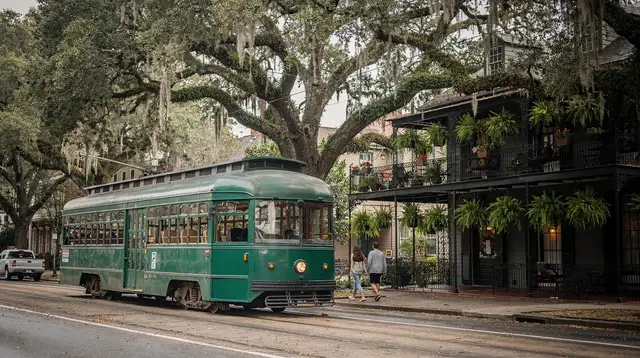
Getting to and from the wharf is simple on foot from most French Quarter hotels; visitors staying further out can use the streetcar network described in the getting-around guide or a short ride-hail trip, since parking near the riverfront on a festival weekend is no easier than parking anywhere else in the Quarter.
FAQ: Mississippi River cruises in New Orleans
Is New Orleans on the coast, and does a river cruise go out to sea?
No. New Orleans lies inland, on a bend of the Mississippi River roughly 160 km upstream from the Gulf of Mexico. A river cruise here travels up and down the Mississippi past the city’s docks and downtown skyline; it does not reach the coast or open water.
Where do New Orleans river cruises depart from?
Almost all of them leave from the wharf area along the river a short walk from the French Quarter and Jackson Square, near the foot of Toulouse Street. Check-in is usually 30 to 45 minutes before departure.
How long does a Mississippi River cruise in New Orleans last?
Daytime sightseeing cruises typically run around two hours. Dinner cruises with a jazz band run closer to two to three hours, including boarding, dinner service and the return leg.
Is a dinner cruise or a daytime cruise better for seeing the city?
A daytime cruise gives clearer views of the port, the skyline and the levees. A dinner cruise trades some daylight visibility for live jazz, a meal and evening lights on the water, so the choice depends on whether you want scenery or atmosphere.
Do river cruises replace a walking tour of the French Quarter?
No, they cover different ground. A river cruise shows the city’s relationship to the Mississippi and its port from the water; a walking tour covers the streets, architecture and history of the French Quarter itself. Most visitors do both rather than choosing one over the other.
Can you see alligators or swamps on a New Orleans river cruise?
No. The Mississippi River cruises depart from the city and stay on the urban river; alligators and cypress swamp are found on separate swamp tours south and west of the city, not on the riverfront cruise routes.
River cruises on GetYourGuide
Verified deep-linked GetYourGuide tours. Book through these links and we earn a small commission at no cost to you.
GetYourGuide does not provide a product photo for this activity — the image shows the meeting point, photographed by us.