French Quarter Walking Tours: A Guide
What is the best way to see the French Quarter's architecture and history?
On foot, with a guide who knows the courtyards, ironwork and Creole building history. The Quarter is a compact grid of roughly thirteen blocks by six, easily covered in two to three hours, and most of what makes it interesting is either unmarked or hidden behind a carriageway door.
Why a walking tour is the right format here
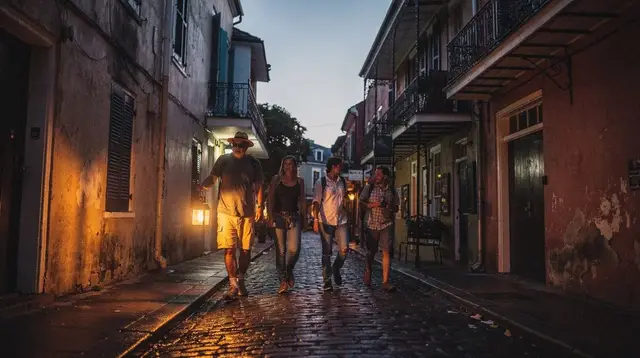
The French Quarter, the Vieux Carre, is not a neighbourhood built for cars, and it rewards a slower pace than most first-time visitors give it. The old grid runs roughly thirteen blocks by six between the Mississippi River and North Rampart Street, which means the whole district can be crossed on foot in well under an hour if you rush it, or comfortably filled with a half day if you don’t. A walking tour is built for exactly this scale: it moves at the pace of a conversation, stops where a car or a bus could never park, and puts a knowledgeable guide beside you at the moment you are standing in front of a wrought-iron balcony wondering who built it and why.
This guide is about that daytime, architectural and historical way of seeing the Quarter — not the after-dark ghost and vampire circuit, which has its own dedicated tours, and not the motorised tours that cover the whole city in one loop, which belong on a bus city tour page instead. Here, you stay inside the Quarter’s boundaries and you walk.
What a French Quarter walking tour actually covers
Routes vary by operator, but most well-built itineraries move through a similar sequence, because the Quarter’s history genuinely concentrates in a few blocks.
Jackson Square is the usual starting or finishing point, and for good reason: it is the historic heart of the old city, laid out as a formal square facing the river, ringed by the Pontalba Buildings and framed by three of the district’s most photographed structures. St Louis Cathedral, with its triple steeples, has stood on this site since the eighteenth century in one form or another, and is the oldest continuously active Catholic cathedral in the United States.
Flanking it are the Cabildo, the old seat of Spanish colonial government where the paperwork for the Louisiana Purchase was signed, and the Presbytere, its twin building across the square, both now part of the Louisiana State Museum. A good guide will use this one square to explain the layers of French, Spanish and American rule that shaped the whole Quarter — because the architecture genuinely tells that story, if you know how to read it.
From the square, most tours move up Royal Street, the Quarter’s genteel spine of antique dealers and art galleries, where the ironwork balconies get their name wrong on purpose in most guidebooks: much of what looks “French” in the Quarter’s ironwork is in fact Spanish colonial in origin, built during the decades after fires in 1788 and 1794 destroyed most of the original French-era wooden buildings.
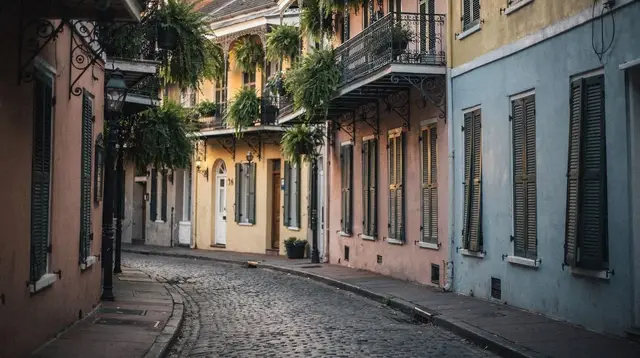
This is one of the small corrections a guide earns their fee for. Royal Street is also where courtyard architecture becomes visible, sometimes only through an open carriageway door: hidden gardens, fountains and balconies built around a private interior, a Creole building form adapted from Caribbean and Spanish precedent, designed to keep the household cool and the street façade discreet.
Depending on the operator, a route may continue toward Decatur Street and the edge of the French Market, the city’s old riverside trading district, ending near Cafe du Monde for the beignets and chicory coffee the spot is known for — a fitting, informal close to a morning spent looking at colonial architecture. Some tours fold in the Quarter’s music history as well, since brass bands and street performers are a constant soundtrack near Jackson Square and along Decatur Street, even on a walk that is not primarily about music.
The architecture worth stopping for
Most of what a good guide points out in the French Quarter isn’t obvious from a passing glance, which is exactly why the walk works better led than self-directed on a first visit. The Quarter’s building stock is almost entirely Spanish colonial and early American in date, not French, despite the neighbourhood’s French name and founding: after fires in 1788 and 1794 destroyed most of the original French-era wooden structures, the district was rebuilt under Spanish rule in brick and stucco, with the courtyards, arched carriageways and iron balconies that define its look today.
The Creole townhouse is the basic unit worth learning to recognise: a two-or-three-story building built flush to the street, with shops or storage at ground level, living quarters above, and a private courtyard tucked behind, reached through a carriageway wide enough for a horse and cart.
From the sidewalk, most of these courtyards are invisible — a closed door, an unremarkable façade — which is precisely why a route that knows which doors are open on a given day, or which buildings allow a peek through a gate, covers ground an independent walk simply can’t. A guide can also usually explain the real difference between wrought iron (hand-forged, older, simpler geometric patterns, mostly Spanish-era) and cast iron (mass-produced from moulds, more ornate, mostly added later in the nineteenth century) — a distinction that turns the balconies from decoration into a dating tool for the building beneath them.
Who a French Quarter walking tour suits
This style of tour tends to work best for first-time visitors who want the district’s layout and history to make sense before they explore further on their own; see New Orleans for first-time visitors for how a walking tour fits into a wider first day. Families with older children generally do fine on the standard route, especially the shorter orientation option, and New Orleans with kids has more on pacing a day around one; teenagers tend to get more out of the fuller history version, covered separately in New Orleans with teenagers.
Travellers with mobility considerations should check a specific tour’s route before booking, since the Quarter’s sidewalks are uneven brick and flagstone in many places and not every operator can adapt on short notice; accessible New Orleans covers the broader picture of getting around the city with mobility needs. However you’re travelling, this is a walk best done at an unhurried pace — it isn’t built to be rushed, and a guide who is asked to skip stops to save time is missing the point of taking one in the first place.
What these tours leave out, on purpose
It’s worth being precise about scope, because the Quarter supports several very different kinds of guided experience and they are not interchangeable. A history and architecture walk does not usually go into St Louis Cemetery No. 1, which in any case can only be visited with an authorised cemetery guide, not on a general walking route — that subject has its own cemetery and voodoo tours.
It does not spend time on hauntings, though a guide may mention a story in passing if it’s tied to a real building; the ghost-focused version of this walk is a separate product with its own after-dark route and different pacing, covered on the ghost and vampire tours page. And it stays inside the Quarter rather than driving out to the Garden District or across the city, which is what a bus or van city tour is for.
The other distinction worth making before you book: Bourbon Street is not the French Quarter, it is one strip within it, known for bars, music venues and, at night, crowds. Daytime architecture and history tours generally cross Bourbon Street rather than lingering on it, because the buildings that matter historically are concentrated on the quieter blocks around Royal Street, Chartres Street and Jackson Square. If Bourbon Street’s nightlife is what you’re after, that’s a different evening entirely, and this guide isn’t it.
Choosing between the main formats
| Format | Typical length | Focus | Good for |
|---|---|---|---|
| History walking tour | 1.5–2.5 hours | Architecture, colonial and Creole history, courtyards | First-time visitors, history-minded travellers |
| Short orientation walk | 45 minutes | Key landmarks only, fast overview | Tight schedules, cruise-day visitors |
| Food-focused walking tour | 2–3 hours | Tastings woven into a shorter history route | Travellers prioritising food over depth of history |
| Ghost or vampire walk | 1.5–2 hours, evening | Folklore, hauntings, selective history | Evening entertainment, not architecture |
If your time in New Orleans is short, a compact option like a 45-minute French Quarter overview walk hits the essentials — Jackson Square, the cathedral, a stretch of Royal Street — without demanding half a morning. For a fuller treatment of the district’s colonial layers, a dedicated French Quarter history walking tour is the better match, typically running closer to two hours and going deeper into individual buildings and courtyards.
Travellers who want the general orientation but also want a broad first look at the neighbourhood’s layout can take a general French Quarter walking tour, which tends to balance landmarks with local anecdotes at a relaxed pace. And for anyone who wants their history lesson interleaved with actual food stops — a po’boy here, a pastry there — a French Quarter food and history walking tour covers much of the same architectural ground while building in tastings along the way.
Planning the rest of your visit around the walk
A walking tour works best as an anchor for a longer day in the Quarter rather than the whole of it. Because the district is so compact, it’s easy to pair a morning tour with independent time afterward: browsing the galleries and antique shops along Royal Street at your own pace, sitting in Jackson Square to watch the street performers, or continuing on to the French Market for a slower look than a tour schedule allows.
If you’re building a full day, see things to do in the French Quarter for the wider list, or check French Quarter history and culture tours for other guided formats that go deeper into specific buildings and museums.
For visitors mapping out more than a single day, a French Quarter walking guide covers self-guided routes for days without a booked tour, while the Jackson Square and St Louis Cathedral guide goes into more depth on that specific corner of the district. Anyone deciding between a guided and independent approach altogether should read guided vs self-guided in the French Quarter before booking anything.
Timing matters more than most visitors expect. Summer heat and humidity make an unshaded midday walk uncomfortable; spring and autumn mornings are the most pleasant conditions for a slow architectural walk, and booking an early slot in July or August is worth the trade-off against a lie-in. If your visit coincides with Mardi Gras or Jazz Fest, expect route adjustments and larger crowds along Royal Street and Jackson Square, since both events draw heavy foot traffic straight through the Quarter’s historic core; check the Mardi Gras guide for visitors or the Jazz Fest guide for visitors if your dates overlap.
Practically, none of this requires a car. The Quarter sits within easy walking or streetcar distance of most Central Business District and Garden District hotels, and getting around New Orleans by streetcar covers how to reach the edge of the district if you’re staying further out. Once you’re at Jackson Square or Canal Street, the tour itself takes over from there.
A morning spent this way also sets up the rest of the day well. The Quarter’s downriver edge shades into the Faubourg Marigny, where Frenchmen Street picks up in the evening as the live-music strip locals actually recommend, a useful contrast to Bourbon Street covered in Frenchmen Street vs Bourbon Street. Just north of the Quarter, Treme carries much of the deeper history behind the music a walking tour only touches in passing, including Congo Square’s role as the birthplace of the city’s musical traditions; Treme and the birth of jazz picks up where an architecture-focused walk leaves off. And if you’re still working out how much time to give the city overall, how many days in New Orleans is worth reading before you book anything else.
Booking notes
Group sizes, accessibility and exact stops vary by operator, so it’s worth checking a tour’s specific route before booking if a particular building or courtyard matters to you — not every itinerary includes every stop mentioned above. Most operators offer both morning and afternoon departures; morning slots are cooler for the six warmer months of the year and tend to sell out first around holidays and festival weekends. Comfortable shoes matter more than any other piece of preparation: the Quarter’s brick and flagstone sidewalks are uneven, occasionally slick after rain, and unforgiving on the wrong footwear.
Frequently asked questions about French Quarter walking tours
How long does a French Quarter walking tour take?
Most run 90 minutes to two and a half hours, covering roughly one to one and a half miles at an easy pace, with stops at Jackson Square, the cathedral and a handful of courtyards along Royal Street.
Is the French Quarter walkable without a guide?
Yes, the grid is small and safe to explore by day, but a guide unlocks details a self-guided visitor will miss: which courtyards allow a look inside, what a plaque actually means, and the difference between Spanish and French-era building styles.
Do these tours go into Bourbon Street’s nightlife?
No, this style of tour is a daytime architectural and historical walk. Bourbon Street’s bars are a separate, after-dark experience and are not the focus here.
Are ghost or voodoo stops included?
Not on a history or architecture walking tour. Those subjects are covered by dedicated ghost, vampire and voodoo tours, which follow a different route and a different kind of storytelling.
What should I wear and bring?
Comfortable walking shoes for uneven brick and flagstone sidewalks, sun protection or a light rain layer depending on season, and water in summer, when humidity makes even a short walk feel long.
Can I do a French Quarter walking tour with children?
Most run comfortably with school-age children if the route is the shorter, architecture-focused option rather than a longer history deep-dive; check the tour’s stated pace before booking.
Does the tour end near Cafe du Monde?
Many do, since the French Market and Cafe du Monde sit at the downriver edge of the Quarter and make a natural final stop for beignets and coffee.
Walking tours on GetYourGuide
Verified deep-linked GetYourGuide tours. Book through these links and we earn a small commission at no cost to you.
GetYourGuide does not provide a product photo for this activity — the image shows the meeting point, photographed by us.