New Orleans for First-Time Visitors
What should a first-time visitor to New Orleans know before arriving?
New Orleans sits in southern Louisiana, not Baton Rouge, between the Mississippi River and Lake Pontchartrain, roughly 18 km from Louis Armstrong International Airport with no rail link into town. First-timers should plan around the French Quarter, Garden District, Tremé and Frenchmen Street, and check whether Mardi Gras or Jazz Fest overlaps their dates, since both push hotel prices up sharply.
Getting your bearings before you go
New Orleans sits in the far south of the United States, in the state of Louisiana, on a wide bend of the Mississippi River roughly 160 km upstream from the Gulf of Mexico. It is not on the coast, and it is not the state capital: Baton Rouge, about 130 km further up the river, holds that role, while New Orleans is simply Louisiana’s largest city and the one built around tourism, music and food. The city occupies a strip of land squeezed between the river on one side and Lake Pontchartrain, a large brackish lake, on the other. Much of that land sits at or below sea level, held dry by a system of levees and pumps that anyone who visits will hear about sooner or later.
That geography matters for planning because almost everything covered on this site lies within a two-hour drive of the French Quarter. Plantation country along the River Road, the swamps and bayous south and west of the city, Cajun Louisiana around Lafayette, and the Mississippi Gulf Coast are all realistic day trips from a New Orleans base. This page is the starting point: it orients a first-time visitor to the city’s core neighbourhoods, the practical basics of arriving and moving around, and the calendar quirks that can make or break a trip’s budget. The detail for each neighbourhood, each festival and each logistical question lives in its own dedicated guide, linked throughout.
Arriving: the airport and the drive into town
Louis Armstrong New Orleans International Airport, usually written MSY, sits in Kenner, about 18 km west of the French Quarter. The drive in takes anywhere from 25 to 40 minutes depending on traffic, and there is no rail or metro connection between the airport and the city at all. First-time visitors sometimes assume a light-rail link exists, as in many US cities, and are caught out.
The realistic options are a taxi at a flat fare into the Central Business District or French Quarter, a ride-hailing app, a shared shuttle van, or the RTA’s route 202 airport bus, which is inexpensive but slow and impractical with more than a small bag. A full breakdown of fares, timings and which option suits which kind of traveller is covered separately; see from MSY airport to the French Quarter for that detail.
Once in the city, the French Quarter itself is compact and walkable, roughly 13 blocks by 6, and most visitors base themselves there or nearby. Getting around beyond walking distance means the RTA’s streetcar lines, buses, the Canal Street ferry to Algiers Point, or ride-hailing apps; parking in the Quarter is difficult and tightly enforced. The mechanics of the streetcar network, passes and fares are covered in getting around New Orleans by streetcar, and the wider question of whether a rental car is worth it in do you need a car in Louisiana.
The neighbourhoods worth knowing on a first visit
A first trip to New Orleans is really an introduction to a handful of neighbourhoods, each with a distinct character. Getting oriented among them before arriving makes the city far less confusing on day one.
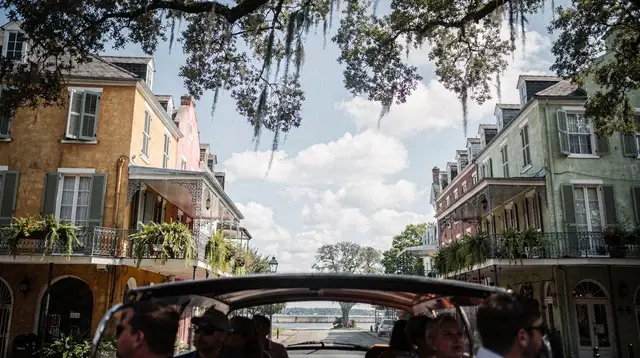
The French Quarter, or Vieux Carré, is the oldest part of the city and the one most visitors picture: a tight grid laid out around Jackson Square, St Louis Cathedral, the Cabildo and the Presbytère, with Royal Street’s galleries and antiques, the bars of Bourbon Street, the French Market and Decatur Street, and the queues outside Café du Monde for beignets. It rewards slow, aimless walking more than any checklist, and the practical route through it, block by block, is set out in the French Quarter walking guide rather than repeated here.
Uptown along St Charles Avenue, the Garden District and Lower Garden District hold the city’s antebellum mansions, reached by the oldest continuously operating streetcar line in the world, and Lafayette Cemetery No. 1, one of several historic cemeteries whose above-ground tombs are a New Orleans signature. The full walking route and streetcar logistics are in the Garden District and the streetcar guide; the wider subject of the city’s cemeteries, including the guided-access-only rule at St Louis Cemetery No. 1, has its own cemeteries of New Orleans visitor guide.
Just north of the Quarter, Tremé is one of the oldest African American neighbourhoods in the country and the place most historians point to as the birthplace of the city’s music, centred on Louis Armstrong Park and Congo Square. Its story is told properly in Tremé and the birth of jazz.
Downriver, the Faubourg Marigny and Bywater are where Frenchmen Street runs, the live-music strip locals tend to recommend over Bourbon Street for a first real taste of the city after dark. The distinction between the two streets, and what each one actually offers an evening visitor, is unpacked in Frenchmen Street vs Bourbon Street.
Beyond these four, first-time visitors also cross paths with the Central Business District and Warehouse Arts District, home to the National WWII Museum; Mid-City, with City Park and the New Orleans Museum of Art; and Algiers Point across the river, reached by ferry. These fill out a longer stay but are not the first-day priorities the way the four neighbourhoods above are. An overview of what’s on offer across the whole city is in things to do in New Orleans, and a broader museums round-up sits at museums of New Orleans guide.
Beyond the city: what a base in New Orleans makes possible
Because so much of southern Louisiana sits within a two-hour drive, a New Orleans base doubles as a base for day trips. Plantation country along the River Road, roughly 45 minutes to an hour and a half upriver, includes Oak Alley, Laura, Whitney and several other sites, each telling the history of slavery and Creole plantation life differently; the comparison across them is in plantations along River Road compared.
South and west of the city, the swamps and bayous around the Barataria Preserve, Honey Island Swamp and the Atchafalaya Basin are where most alligator and airboat tours run, covered in swamp tours compared: airboat vs boat. Further afield, Cajun Louisiana around Lafayette and the Mississippi Gulf Coast make for longer day trips or an overnight extension, detailed in Cajun Country and Lafayette guide and the Mississippi Gulf Coast guide.
For visitors who want a structured overview of all of this rather than piecing it together guide by guide, the things to do in New Orleans page and the one week Louisiana grand tour itinerary both attempt exactly that, at different levels of detail.
Timing a first visit: festivals and the calendar
New Orleans runs on a festival calendar that catches a lot of first-time visitors off guard, mostly because its biggest event doesn’t have a fixed date. Mardi Gras is a movable feast, falling 47 days before Easter, which puts it anywhere between early February and early March depending on the year; the Carnival season that leads up to it actually begins on 6 January, Twelfth Night. There is no month that can be quoted with confidence without checking the specific year, and a guide dedicated to the subject, Mardi Gras guide for visitors, covers what changes year to year.
Two other events reliably push hotel prices up: the French Quarter Festival, held in mid-April, and the New Orleans Jazz & Heritage Festival, known as Jazz Fest, spanning the last weekend of April and the first weekend of May. Both dates shift slightly each year, and during both events, as during Mardi Gras, hotel rates rise sharply, minimum-night stays are often imposed, and the city fills up well in advance.
Anyone planning around either event should read the Jazz Fest guide for visitors before booking. Outside these windows, spring and autumn are generally regarded as the most comfortable and least crowded times to visit; the question of when to go in more general terms is answered at length in best time to visit New Orleans.
A few things this guide leaves to other guides
This page is deliberately an entry point rather than a complete manual, and a few subjects that come up constantly for first-time visitors are covered in full elsewhere rather than repeated here. Tipping norms and the fact that sales tax is added at the till, not shown in the sticker price, are set out in tipping and sales tax in New Orleans.
Safety, including the practical, ordinary precautions worth taking around the edges of the tourist core, is addressed directly in is New Orleans safe for tourists. And packing for the city’s humid subtropical climate, including what changes between a July visit and a January one, is covered in what to pack for New Orleans.
Taken together, those guides and the neighbourhood pages linked above are meant to be read after this one, once the basic shape of a trip — where the city sits, how to get in from the airport, which four or five neighbourhoods to prioritise, and whether the dates land inside a festival — is already in place.
Orientation questions first-time visitors ask about New Orleans
Is New Orleans the capital of Louisiana?
No. Baton Rouge, roughly 130 km upriver, is the state capital. New Orleans is Louisiana’s largest city and its main visitor destination, but it has never been the seat of state government.
How do you get from the airport to the French Quarter?
Louis Armstrong New Orleans International Airport (MSY) is about 18 km west of the French Quarter, a 25 to 40 minute drive depending on traffic. There is no train or metro link; visitors use taxis, ride-hailing apps, shared shuttles or the RTA route 202 airport bus.
Which neighbourhoods should a first-time visitor prioritise?
The French Quarter for history and atmosphere, the Garden District for antebellum architecture and the streetcar ride, Tremé for the roots of the city’s music, and the Faubourg Marigny for Frenchmen Street’s live-music strip. Each is covered by its own dedicated guide.
When is Mardi Gras, and does it affect a trip?
Mardi Gras is a movable feast tied to the Christian calendar, falling 47 days before Easter, so it lands anywhere between early February and early March depending on the year. Carnival season itself starts on 6 January. There is no fixed month, so dates need checking each year.
Do festivals make New Orleans more expensive to visit?
Yes. Mardi Gras, the French Quarter Festival in mid-April and Jazz Fest across the last weekend of April and first weekend of May all raise hotel prices sharply, and many hotels impose minimum-night stays during these periods.
How many days does a first visit need?
Most first-time visitors plan three to five days in the city itself, with an extra day if a plantation or swamp day trip is added. A dedicated guide sets out sample schedules for shorter and longer stays.
Is New Orleans on the coast?
No. The city sits inland on a bend of the Mississippi River, between the river and Lake Pontchartrain, a large brackish lake. The Gulf of Mexico is about 160 km downstream.
A good first orientation to the city on the ground, once the practical basics above are settled, is a general [New Orleans city tour](city tour covering the French Quarter and the Garden District) — a fair way to see the layout described above in a single morning before venturing out on foot.
For visitors planning several attractions across a few days, a [multi-attraction pass](discounted pass bundling several of the city’s main sights) can be worth pricing out against buying tickets separately.
A [daytime steamboat cruise on the Mississippi with a live jazz band](daytime steamboat cruise on the Mississippi with a live jazz band) is a gentle way to see the river the city sits on from the water, and pairs naturally with a first afternoon in town.
Given how seriously Louisiana treats its Voodoo history, a [guided Voodoo tour](guided walk through the city’s Voodoo history) told by a knowledgeable guide is a better first exposure to the subject than the more theatrical options sold along the Quarter’s side streets.
Tours for a first visit on GetYourGuide
Verified deep-linked GetYourGuide tours. Book through these links and we earn a small commission at no cost to you.
GetYourGuide does not provide a product photo for this activity — the image shows the meeting point, photographed by us.