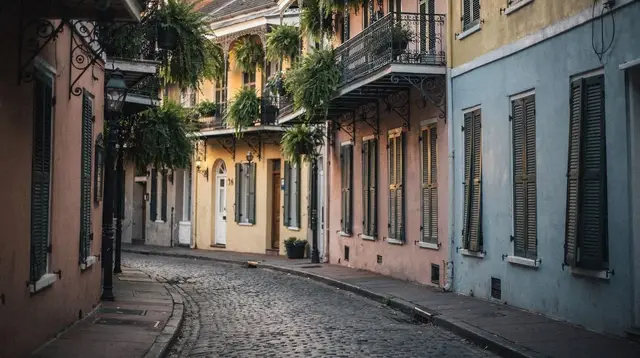
New Orleans Walking Tours: Architecture, Streets and History
What do New Orleans walking tours actually cover?
Most focus on one of two areas: the compact French Quarter grid, with its ironwork balconies, courtyards and colonial-to-Creole architecture, or the Garden District along St Charles Avenue, with its antebellum mansions and above-ground cemetery. They are separate walks, usually two to three hours each, and are distinct from food tours and ghost tours, which cover the same streets with a different focus.
Two Very Different Walks, One City
New Orleans has more than one kind of walking tour, and it is worth being clear about which one this page is describing. Food tours follow the same streets in search of po’boys and gumbo. Ghost and vampire tours follow them after dark in search of legends. This guide is about neither. It covers walks built around what is actually standing on the street: ironwork balconies, courtyards, roofline, brick and timber, and the layout of neighbourhoods that grew up in different centuries under different flags. If you want the food angle, the food and drink tours guide covers that ground, and the ghost and vampire tours guide covers the supernatural one.
Architecturally and historically, New Orleans splits into two walks that should not be merged into one afternoon: the French Quarter, the oldest part of the city, and the Garden District, built later by a different population under a different set of rules. They sit a few kilometres apart, they read completely differently underfoot, and each rewards being taken slowly rather than rushed through as a single loop.
The French Quarter Grid
The Vieux Carre, as it is properly called, is unusually easy terrain for a walking tour: a compact grid roughly thirteen blocks by six, laid out under French and then Spanish rule, flat, and small enough to cover on foot without needing transport between stops. That compactness is what makes an architecture-focused walk work so well here — nothing is far from anything else, so the walk can move slowly through detail rather than rushing between distant points.
A typical route starts at Jackson Square, the square around which the whole Quarter was originally organised, flanked by St Louis Cathedral, the Cabildo and the Presbytere — the two flanking buildings dating to Spanish colonial rule after the fires of the 1780s destroyed much of the original French town, which is why so much of what looks “French” in the Quarter is actually Spanish-era construction, later Creolised by French and Caribbean influence.
From there, a walk typically moves along Chartres and Royal streets, where the real subject of an architecture tour lives: cast-iron and wrought-iron balconies, hidden courtyards behind unassuming street doors, shotgun-style openings, and townhouses that were rebuilt after the fires in brick with stucco rather than the wood-and-timber construction that preceded them. Royal Street in particular rewards a slow pace, since its galleries and antique shops sit inside buildings whose upper floors have barely changed in appearance for two centuries.
Decatur Street and the French Market sit at the river edge of the Quarter and mark a natural point to break for a coffee at Cafe du Monde, though the food itself is outside the scope of an architecture walk. Bourbon Street, by contrast, is worth walking past rather than lingering on for this purpose: its ground floors have been altered for bars and nightlife, and its architectural interest lies mostly above the awnings, in balconies that are easy to miss at street level with a crowd around you.
North of the Quarter’s usual walking loop, Treme is one of the oldest African American neighbourhoods in the country and adds a different layer entirely: Louis Armstrong Park and Congo Square are historically central to the birth of the city’s music, and a walk that includes them tells a different, and important, part of the urban story than the Creole townhouses closer to the river. The African American heritage guide goes further into that ground.
For visitors who prefer structure over wandering, a small guided walk built around these same blocks can be worth the couple of hours, less for logistics — the grid is easy enough alone — and more for the layered history that is not obvious from the street: which buildings survived the fires, which balconies are original ironwork versus later reproduction, and how the Quarter’s population and use changed across French, Spanish and American rule.
A guide framed around this kind of layered urban history, rather than hauntings, is what to look for; the Wicked History Walking Tour and the Dark History Walking Tour both work this angle, covering how the city actually developed rather than what supposedly haunts it. For a fuller comparison of guided versus self-guided options, see the guided vs self-guided walk guide, and the French Quarter walking guide for a full route.
Frenchmen Street, Bywater and the Downriver Edge
Downriver from the Quarter, the Faubourg Marigny and Bywater neighbourhoods are architecturally interesting in their own right, with a denser stock of Creole cottages and shotgun houses than the more commercial blocks of the Quarter itself, though most visitors know Frenchmen Street for its live music rather than its buildings. A walk that extends this far is optional and works best as an add-on to a Quarter walk rather than a separate outing, since the architectural interest, while real, is quieter and more residential than the Quarter’s set-piece squares and courtyards.
The Garden District and St Charles Avenue
The second walk belongs uptown, and it is a different city altogether. The Garden District and the adjoining Lower Garden District were built by Americans in the nineteenth century, largely after the Louisiana Purchase brought an English-speaking, Protestant population that settled apart from the older Creole city downriver — one reason New Orleans has two distinct architectural centres rather than one that simply grew outward.
Where the Quarter is dense, urban and built to the street, the Garden District is spacious, set back from the street behind iron fences and gardens, and built in the antebellum styles — Greek Revival, Italianate, raised cottages — that period wealth from cotton and shipping could afford.
A walk here follows St Charles Avenue and the residential streets that run off it, and it is not a grid in the Quarter’s sense: the pleasure of the walk is in the mansions themselves, their columns, ironwork fences and wraparound porches, seen at a distance from the public sidewalk rather than entered. Lafayette Cemetery No. 1 sits inside the district and is one of the best places anywhere in the city to see the above-ground tombs that New Orleans is known for, a consequence of the city’s high water table rather than any single tradition, and it is usually included as the centrepiece of a Garden District walk.
The St Charles Avenue streetcar, the oldest continuously operating street railway in the world, runs the full length of this walk and is worth treating as part of the itinerary rather than just transport to it: many visitors ride the streetcar one way from downtown, get off partway to walk the residential blocks and the cemetery, then either walk back to the avenue or ride the line onward.
The getting around by streetcar guide covers routes, tickets and the Jazzy Pass in detail. Because the Garden District is a walk of exteriors and distances rather than a compact grid, comfortable shoes and a slower pace than the Quarter matter more here — there is more ground to cover between points of interest, and the appeal is cumulative rather than concentrated on one square.
What These Walks Are Not
It is worth being explicit about what a walking tour focused on architecture and streets deliberately leaves out, since the same blocks in New Orleans are sold under several different framings. It is not a food tour: nothing here is organised around where to eat, though nothing stops a walker from stopping at Cafe du Monde along the way. It is not a ghost or vampire tour: the legends attached to certain Quarter buildings and to St Louis Cemetery No. 1 are a separate, evening-oriented genre covered on the ghost tours guide, and they are worth doing as their own outing rather than folded into a daytime architecture walk.
It is not a museum visit, though the Cabildo and Presbytere sit directly on the Jackson Square route and can be added if time allows. Keeping these threads separate makes each one better: a guide talking about hauntings is not well placed to also explain Spanish colonial rebuilding codes, and vice versa.
Comparing the Two Walks
| French Quarter | Garden District | |
|---|---|---|
| Era | Colonial French/Spanish, rebuilt after 1780s fires | American, antebellum 19th century |
| Layout | Compact grid, roughly 13 by 6 blocks | Spread along St Charles Avenue, not a grid |
| Typical duration | 2–2.5 hours | 2–3 hours, more walking between points |
| Signature buildings | Cathedral, Cabildo, Presbytere, Creole townhouses | Antebellum mansions, Lafayette Cemetery No. 1 |
| Best paired with | Coffee at the French Market, the Cabildo | St Charles streetcar |
| Time of day | Any daylight hour | Daylight; avenue is quieter after dark |
Practical Notes for Walking These Areas
New Orleans is humid subtropical, and that matters more for walking tours than for almost any other activity on this site: a two-hour outdoor walk in July or August, in the low thirties Celsius with heavy humidity, is a different proposition from the same walk in the milder shoulder seasons of spring or autumn. Carrying water, wearing a hat, and choosing a morning slot in high summer are all sensible. Both the Quarter and the Garden District are flat, so the walking itself is easy; the climate, not the terrain, is the limiting factor.
Guided options exist for both areas, and range from the straightforwardly historical to walks that lean into the city’s darker or more scandalous past without going as far as a full ghost tour — the Drunken History Walking Tour is one example, mixing period anecdote with the same streets covered here, and works well as an evening companion to a daytime architecture walk rather than a replacement for one.
Families with younger children are usually better served by a shorter, simpler route; the Kids Walking Tour is built around a pace and set of stories aimed at that age group rather than the fuller architectural detail an adult walk covers.
For visitors trying to fit a walk into a short trip, the one-day essentials itinerary places the French Quarter walk at the centre of a single day, while a Garden District walk fits more comfortably into a second or third day given the streetcar ride involved. The things to do in New Orleans hub lists both alongside the city’s other activity categories for anyone still deciding how to split their time.
Walking Tours in New Orleans: Common Questions
Is the French Quarter walkable without a guide?
Yes. It is a compact grid roughly thirteen blocks by six, flat, and easy to navigate on foot in a morning or afternoon. A guide adds context on the architecture and history that a map cannot, but self-guided walking works well for a first pass.
How long does a French Quarter walking tour take?
Most guided walks run two to two and a half hours at an unhurried pace, covering Jackson Square, the cathedral, the Cabildo and Presbytere, and the residential blocks of Royal and Chartres streets. A self-guided walk can be shorter or stretched over a full day with stops.
Should I do the French Quarter or the Garden District first?
There is no fixed order, but they should not be combined into one walk: they sit roughly three kilometres apart along St Charles Avenue and represent different eras and building styles. Many visitors do the French Quarter on arrival and the Garden District later in the trip, reached by the St Charles streetcar.
Are these tours the same as the ghost tours sold in the Quarter?
No. Architecture and history walks look at facades, ironwork and urban layout in daylight. Ghost and vampire tours, usually in the evening, focus on legends and hauntings attached to the same buildings. They can be treated as two separate visits rather than one.
Is walking safe at night in these areas?
The French Quarter and the Garden District are well-policed tourist areas, but daylight is the better choice for an architecture-focused walk, since the point is to see detail on facades and ironwork. If walking after dark, stick to lit, busy streets or take a ride rather than walk between the two districts.
Do I need to book a guided walk in advance?
Popular guided walks, especially those covering Lafayette Cemetery No. 1, can fill up in peak season around Mardi Gras and Jazz Fest, so booking a day or two ahead is sensible. Self-guided walking needs no booking at all.
Can I combine a walking tour with the St Charles streetcar?
Yes, and it is a natural pairing. The St Charles line, the oldest continuously operating street railway in the world, runs the length of the avenue that borders the Garden District, so many visitors ride part of the route and walk the rest.
Walking tours on GetYourGuide
Verified deep-linked GetYourGuide tours. Book through these links and we earn a small commission at no cost to you.
GetYourGuide does not provide a product photo for this activity — the image shows the meeting point, photographed by us.