Things to Do in New Orleans: A First Orientation
What is there to do in New Orleans, in general terms?
New Orleans centers on the French Quarter's historic grid around Jackson Square, the mansion-lined Garden District along the streetcar line, and the birthplace-of-jazz neighborhoods of Treme and Frenchmen Street. The city itself sits between the Mississippi River and Lake Pontchartrain, not on the coast, and much of it lies at or below sea level behind levees. Baton Rouge, not New Orleans, is the state capital.
Getting your bearings before you set out
New Orleans is easy to love and easy to misread on a first visit. It looks, on a map, like a coastal city, and it gets talked about as if it were the capital of Louisiana. Neither is true, and both facts change how you should plan. The state capital is Baton Rouge, about 130 km upriver, a separate city with its own art-deco skyline and none of New Orleans’s tourist infrastructure.
And New Orleans itself is not on the Gulf of Mexico at all: it sits on a wide bend of the Mississippi River, roughly 160 km upstream from open water, hemmed in on its other side by Lake Pontchartrain, a lake big enough to need a bridge, the Causeway, stretching nearly 40 km across it. Understanding that shape, river on one side, lake on the other, low ground in between, does more to explain the city than any list of sights.
That low ground matters. Much of New Orleans sits at or below sea level, held dry by a system of levees and pumping stations that residents live with quietly most of the year and think about intensely during hurricane season. It is the reason certain neighborhoods flooded catastrophically when the levees failed during Hurricane Katrina in 2005, and it is not a piece of trivia to skip past: it shapes how the city understands itself. This page will not dwell on that history in detail, since it deserves its own space, but it is part of the mental map worth carrying before you arrive.
This guide is deliberately a wide-angle one. Its job is to give you the general shape of New Orleans intra-muros, the parts of the city itself, before you narrow in on the French Quarter or the Garden District in more detail, or step outside the city to the plantations, swamps and bayous covered elsewhere on this site. Think of it as the page you read first, and the French Quarter walking guide or Garden District guide as the ones you read next.
The old city: the French Quarter and its grid
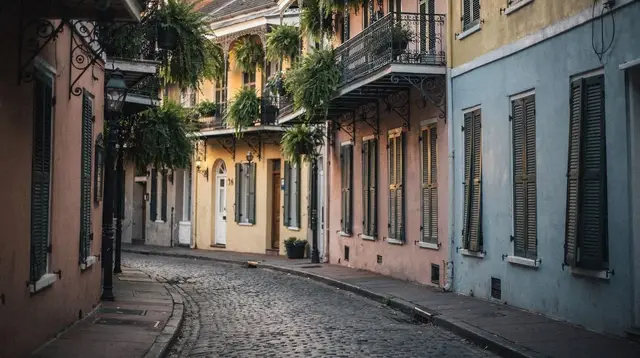
Almost everyone’s New Orleans begins in the French Quarter, known locally as the Vieux Carre, the oldest neighborhood in the city and the reason it exists where it does. It was laid out in a tight, walkable grid, roughly 13 blocks by 6, and that grid is still the easiest way to think about it: a compact rectangle you can cross on foot in twenty minutes, dense with two centuries of building.
At its heart sits Jackson Square, flanked by St Louis Cathedral, the Cabildo and the Presbytere, three buildings that between them cover most of the city’s colonial and early American history. Around the square, the character of each street diverges sharply: Royal Street leans toward galleries and antiques, Decatur Street and the French Market toward food and browsing, and Bourbon Street toward the bars and crowds most visitors have already heard about, for better or worse.
Café du Monde, on Decatur Street, is the closest thing the city has to a mandatory stop, mostly for beignets and chicory coffee eaten standing up, queue or no queue. The Quarter rewards slow walking more than any checklist: its balconies, courtyards and mixed Spanish-and-French colonial architecture are the actual attraction, not any single building. For a fuller sense of how to spend a day there, the dedicated French Quarter walking guide goes street by street; this page only needs to establish that the Quarter is compact, historic, and best explored on foot.
Uptown and the Garden District
A short streetcar ride from the Quarter along St Charles Avenue takes you into an entirely different New Orleans: the Garden District and the Lower Garden District, lined with antebellum mansions, wrought-iron fences and live oaks that predate the houses themselves.
The St Charles streetcar that gets you there is worth noting on its own account: it’s the oldest continuously operating street railway in the world, and riding it is as much a part of the experience as any stop along the route. Inside the Garden District, Lafayette Cemetery No. 1 is the best-known of the city’s above-ground burial grounds accessible without a mandatory guided tour, its raised tombs a visible reminder that the water table here has always been too high for burial underground.
Further uptown again lie the university neighborhoods, quieter and more residential, useful context for understanding that New Orleans is a lived-in city and not only a historic district. The Garden District and streetcar guide covers this area in the depth it deserves; here, the point is simply that the Quarter and the Garden District are the two anchors most first-time visitors move between.
Treme, Frenchmen Street and the sound of the city
New Orleans’s musical identity is not confined to Bourbon Street, and arguably belongs somewhere else entirely. Treme, just north of the Quarter, is one of the oldest African American neighborhoods in the United States, and Congo Square within it is where much of the city’s music has its roots.
Locals who want to hear live jazz tend to send visitors not to Bourbon Street but to Frenchmen Street in the Faubourg Marigny, a few blocks of clubs downriver of the Quarter that stay unmistakably local even as it has become better known. The contrast between the two strips, Frenchmen Street versus Bourbon Street, is one of the more useful things to understand early, since it changes what kind of night out you’ll actually have.
Music in New Orleans is also participatory in a way it rarely is elsewhere: second line parades, brass bands moving through neighborhood streets, are community events rather than staged shows, and stumbling across one is one of the better strokes of luck a visitor can have.
The Central Business District, the Warehouse District and Mid-City
Away from the historic core, the Central Business District and the adjoining Warehouse Arts District hold the city’s modern skyline and its major museums, including the National WWII Museum, one of the most visited attractions in the state and a serious commitment in its own right if you want to see it properly. Mid-City, further out, centers on City Park, a green space considerably larger than it looks on a map, home to the New Orleans Museum of Art and the Besthoff Sculpture Garden, a pleasant counterweight to the density of the Quarter. Across the river, reached only by ferry, Algiers Point offers a quieter, largely residential view of the city and a different angle on its skyline.
Together these districts round out a picture of New Orleans as a working city with a preserved historic core, not a theme park built around one street. For a fuller sense of what’s on offer across all of these areas, the museums of New Orleans guide and the National WWII Museum guide go into detail this orientation deliberately skips, as does the City Park and Sculpture Garden guide.
What this page is not trying to do
Deliberately, this page stays general. The city’s cemeteries, several of which can only be visited with an authorized guide, deserve their own careful treatment, given in the cemeteries of New Orleans guide. The plantations along the River Road, the swamps and bayous south and west of the city, and the drive out to Cajun country and the Gulf Coast are all separate destinations covered under day trips, not part of New Orleans intra-muros.
If your interest runs toward the city’s African American history specifically, the African American heritage guide is a better starting point than this one. And if food is your organizing principle for the trip, Creole versus Cajun food explained untangles a distinction worth understanding before you order.
A general orientation table
| Area | Character | Typical time needed |
|---|---|---|
| French Quarter | Historic grid, architecture, music, food | Half a day to a full day |
| Garden District | Antebellum mansions, streetcar ride | 2 to 3 hours |
| Treme / Frenchmen Street | Jazz history, live music at night | An evening |
| CBD / Warehouse District | Museums, modern downtown | Half a day |
| Mid-City / City Park | Art museum, sculpture garden, green space | Half a day |
| Algiers Point | Quiet residential district across the river | 1 to 2 hours, plus ferry |
These are orientation figures, not fixed rules; how the city fits into a longer trip, including the day trips beyond it, is covered in the three-day New Orleans itinerary.
Getting between neighborhoods
The RTA streetcar network, particularly the historic St Charles line, connects the Garden District to downtown and the Quarter, and a Jazzy Pass covers unlimited rides for a day or several. The French Quarter itself is best simply walked; its grid is small enough that a car adds nothing but parking trouble, since spaces in the Quarter are scarce, metered and strictly enforced. Full detail on getting around, including the airport, ferries and driving, is covered in the streetcar and transport guide, so this page won’t repeat it, beyond flagging that walking and the streetcar cover almost everything described above.
Guided ways to get your first orientation
For a first visit, a guided overview can do in a few hours what independent wandering takes days to piece together, especially given how much of New Orleans’s character sits in stories, not just buildings. A general city tour of New Orleans is a straightforward way to see the Quarter, the Garden District and the city’s layout in one sitting, with a driver-guide filling in the history as you go.
For visitors more drawn to the darker corners of the city’s past, a walking tour through New Orleans’s wicked history covers crime, scandal and the seamier side of the Quarter’s centuries, while a walking tour built around the city’s drinking history pairs its bar-crawl stops with the same kind of storytelling.
Families travelling with children have their own version of this orientation: a walking tour designed for kids pitches the Quarter’s pirates, ghosts and legends at a level that keeps younger visitors engaged rather than dragging along behind the adults. And for a visit that will stretch across several attractions and neighborhoods, a multi-attraction pass covering several of the city’s sights can work out cheaper than paying for each one separately, particularly if museums are on your list alongside the walking.
None of these replace simply walking the Quarter on your own, and none of them are a substitute for the deeper neighborhood guides linked throughout this page. They’re a fast way to get the lay of the land in your first hours in the city, before you decide which neighborhoods deserve a slower second look.
Practical notes for a first visit
A few things are worth knowing before you set out, even at this general level. Tipping is expected across restaurants, bars and guided tours, typically 18 to 20 percent, and sales tax is added at the till rather than shown in the sticker price. The French Quarter allows open containers of alcohol on the street, in a plastic go-cup, one of the few places in the United States where that’s legal, though it’s confined to that area and doesn’t extend to glass containers.
Summers are long, hot and genuinely humid, while winters are mild but can turn sharply cold for a few days; spring and autumn are the more comfortable seasons for walking the city. None of this is unique to any one neighborhood, which is part of why it belongs on this orientation page rather than buried in a district-specific guide.
Where to go from here
If this is your first look at New Orleans, the natural next steps are the French Quarter walking guide for the historic core, the Garden District and streetcar guide for the uptown mansions, and the history and culture category if museums and heritage sites are your priority.
For the areas beyond the city itself, the plantations, swamps and Cajun country, start with day trips from New Orleans rather than trying to fit them into a city-only visit. Wherever you start, the shape to keep in mind is the one this page opened with: an old grid of streets between a river and a lake, mostly below sea level, with a culture built as much around music and food as around any single landmark.
Walking tours on GetYourGuide
Verified deep-linked GetYourGuide tours. Book through these links and we earn a small commission at no cost to you.
GetYourGuide does not provide a product photo for this activity — the image shows the meeting point, photographed by us.