Treme and the Birth of Jazz
Why is Treme called the birthplace of jazz?
Treme is one of the oldest African American neighbourhoods in the United States, and its Congo Square was the place where enslaved and free people of colour gathered to drum, dance and trade on Sundays under French and Spanish colonial law. That sustained African musical practice, layered with brass-band and Creole traditions, is the root historians point to when they trace where jazz came from.
A neighbourhood older than the music it produced
Treme sits just north of the French Quarter, on the far side of Rampart Street, and it is widely described as one of the oldest African American neighbourhoods in the United States. Long before jazz had a name, Treme was already a place where free people of colour owned property, ran businesses and built churches, alongside enslaved residents of the city and, later, freed men and women who stayed after emancipation. Understanding why jazz began here means understanding the neighbourhood first, not the other way round.
New Orleans itself was unusual among American cities in the eighteenth and nineteenth centuries. Under French and then Spanish colonial rule, and briefly under both, the city developed a three-tier social structure that had no real equivalent elsewhere in the American South: white residents, free people of colour, and enslaved people, each with different — though always unequal — legal standings.
Free people of colour in New Orleans could own property, run trades, and in some cases own enslaved people themselves, a fact that complicates any simple narrative of the city’s racial history. Treme grew up as one of the neighbourhoods where this population settled and thrived, and its street names, churches and cemeteries still carry that layered history.
This is also why the African American heritage in New Orleans extends across a much wider map than Treme alone, but Treme is where the earliest layers of that story are most visible, concentrated in a compact, walkable area a few minutes from Jackson Square and St Louis Cathedral.
Congo Square: the gathering that mattered
The single most consequential place in this story is Congo Square, a public space now enclosed within Louis Armstrong Park at the edge of Treme. Under French and Spanish colonial law, enslaved people in New Orleans were granted something almost nowhere else in the American South allowed: Sundays largely free from labour. On those Sundays, from at least the late eighteenth century, enslaved and free Black people gathered in what was then an open square outside the city’s ramparts to drum, sing, dance and trade goods.
What happened at Congo Square was not incidental. It was a sustained, generation-spanning space where West African, Caribbean and Creole musical practices were kept alive, adapted and passed down, in a way that was largely suppressed elsewhere in the enslaved South. Visitors and officials of the time left written accounts describing large gatherings, complex polyrhythms, call-and-response singing and dance forms that had direct roots in West and Central African traditions. Historians and musicologists point to Congo Square specifically — not to a single performer or a single date — as the deepest root from which the musical vocabulary of New Orleans, and eventually jazz, grew.
It is worth being precise about what this means and what it does not mean. Congo Square did not produce jazz directly, as if a band had struck up there in 1800. What it preserved was a living, communal, deeply African musical culture in one American city for roughly a century, at a time when similar practices were being erased almost everywhere else.
That culture then mixed, over the following decades, with brass-band instrumentation brought by military and civic bands, with Creole and European harmonic ideas, with the call-and-response of the Black church, and with the improvisational traditions of Black communities across the city. Jazz, when it coalesced as a recognisable form around the turn of the twentieth century, drew on all of these threads — and Congo Square is where the deepest and longest-running of them was kept alive.
Congo Square is freely open today, a shaded plaza inside Louis Armstrong Park, with markers and public art referencing its history. It rewards a slow, unhurried visit rather than a quick photo stop — this is a place to read the historical markers and picture the square as it was, not a performance venue.
Louis Armstrong Park and the neighbourhood around it
Louis Armstrong Park itself, which now contains Congo Square, was created in the 1970s by clearing several blocks of Treme, a decision that displaced homes and businesses in the very neighbourhood the park was meant to honour — a fact that is itself part of the story of how the city has handled its Black heritage.
The park is named for Louis Armstrong, who was born in New Orleans in 1901 and grew up in a city where the musical culture rooted in Treme and Congo Square was already part of the air. Armstrong did not grow up performing in Congo Square, which had fallen out of active use as a gathering site well before his childhood, but he grew up within the same brass-band, church and dance-hall culture that Congo Square’s traditions had helped sustain.
Beyond the park, Treme’s streets hold churches, social aid and pleasure club halls, and modest historic houses that tell the same story at a smaller scale: this was, and in many blocks still is, a working Black neighbourhood with its own institutions, its own funeral and parade traditions, and its own relationship to music as a communal practice rather than a form of entertainment staged for outsiders. That distinction matters.
A second line — a brass-band parade organised by a social aid and pleasure club, usually on a Sunday — is a living continuation of a community tradition of music as public, participatory and neighbourhood-rooted. It is a different subject from Treme’s colonial-era history, and it deserves its own guide rather than being folded into this one; what matters here is that both practices, more than a century apart, share the same root idea of music as something a Black community makes together in public space, not something performed for an audience.
What Treme is not
It is worth being direct about what this neighbourhood’s story is not, because visitors often blur the lines. Treme is not where you go for a night of live jazz today — Frenchmen Street and Preservation Hall in the French Quarter are the places locals and guides point visitors toward for that, and the mechanics of hearing a live set are covered in the guide to live jazz in New Orleans. Treme’s relevance is historical and social: it explains where the music came from and why New Orleans, uniquely among American cities, became the place jazz coalesced.
It is also worth separating Treme’s story clearly from Cajun Louisiana. Zydeco and Cajun music are a completely different musical lineage, rooted in the Acadian communities that settled the prairies and bayous around Lafayette after their expulsion from Nova Scotia in the 1750s. That music is accordion-and-fiddle-driven, rural, and belongs to Acadiana, not to New Orleans, and certainly not to Treme.
Conflating the two is one of the most common mistakes visitors make, and it erases two genuinely distinct histories. If Cajun music and food interest you, the Cajun Country and Lafayette guide and the Creole vs Cajun food guide cover that separate world properly.
Visiting Treme today
| What | Where | Notes |
|---|---|---|
| Congo Square | Inside Louis Armstrong Park, edge of Treme | Free to enter, historical markers on site |
| Louis Armstrong Park | North edge of Treme, across Rampart Street from the French Quarter | Green space with statues, gates and Congo Square |
| Guided history walks | Depart from or near the French Quarter | Cover Treme’s African American and Creole history in context |
| Backatown churches and halls | Scattered through residential Treme | Best appreciated with a guide who can explain their role |
Most visitors experience Treme’s history through a guided walk rather than wandering independently, since the neighbourhood’s significance lies in context that markers alone do not fully convey — who gathered where, under what laws, and what it led to. A Treme African American Creole History Tour is built specifically around this material, tracing the neighbourhood’s role from the colonial era through the rise of jazz, and it is the most direct way to connect Congo Square, Louis Armstrong Park and the surrounding streets into a single narrative.
For visitors who want the music history folded into a broader afternoon or evening exploring the Quarter and its edges, a walking tour that links Storyville, Voodoo history and Treme covers adjacent chapters of the same city without repeating ground.
Those who want the musical thread carried further, from Congo Square’s legacy into the sound of the city itself, sometimes pair a Treme history walk with a tour tracing the roots of jazz through music, culture and a drink along the way, or with a more tailored private jazz-focused outing that includes live music and a drink — though it is worth repeating that the nightly live-music side of that experience belongs to Frenchmen Street and Preservation Hall, not to Treme itself.
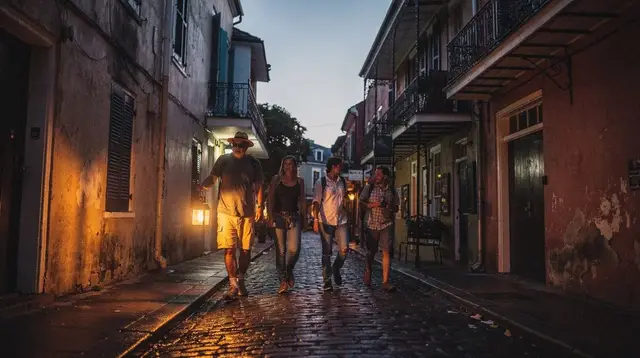
Because Treme is a residential neighbourhood and not a curated attraction, it pays to visit thoughtfully: during daylight, on foot or with a guide, respectful of the fact that people live in these houses and worship in these churches. Nothing about Treme is staged for visitors, which is precisely why its history carries weight.
Where this fits in a wider visit
Treme pairs naturally with a broader look at the city’s African American and Creole heritage, and with the cemeteries of New Orleans, several of which hold figures connected to this same history, including St Louis Cemetery No. 1 nearby. It also sits well alongside the French Quarter walking guide, since the two areas are only a few blocks apart and are often visited in the same outing.
If you are building a longer stay, Treme fits naturally into a three-day or four-day itinerary as a half-day addition to a French Quarter visit, and it is a natural anchor for a music lovers’ three days itinerary that also takes in Frenchmen Street and a river cruise with live music, such as the Riverboat City of New Orleans jazz dinner cruise.
For visitors curious about the city’s history and culture tours more broadly, Treme is one of several strands worth weaving together with plantation history and cemetery visits, rather than treated as a stand-alone stop.
Treme and the birth of jazz: frequently asked questions
Is Treme the same thing as the French Quarter?
No. Treme sits just north of the French Quarter, across Rampart Street, and developed as a separate neighbourhood with its own history as a centre of free people of colour and, later, African American life in New Orleans.
What is Congo Square and can you visit it today?
Congo Square is a public space now inside Louis Armstrong Park, at the edge of Treme. It was the site where enslaved and free Black people gathered on Sundays in the eighteenth and nineteenth centuries to make music and trade. It is freely open to walk through today.
Is Treme where you go to hear live jazz at night?
Not really. Treme’s importance is historical: it explains where the music came from. For hearing live jazz and brass bands today, most visitors head to Frenchmen Street or Preservation Hall in the French Quarter, which are covered in their own guides.
Is a second line parade the same as what happened in Congo Square?
They are related but distinct. Congo Square was a historical gathering under colonial-era rules. A second line is a living neighbourhood tradition of parades led by a brass band, still organised by social aid and pleasure clubs today, and it is covered in its own guide.
Is zydeco music part of Treme’s story?
No. Zydeco and Cajun music come from Acadiana, the Cajun country around Lafayette, roughly two hours west of New Orleans. Treme’s musical legacy is jazz and brass-band tradition, a separate lineage.
Is Treme safe to walk around?
Treme is a real, lived-in residential neighbourhood, not a tourist attraction, and parts of it see less foot traffic than the French Quarter. Stick to daylight visits to Louis Armstrong Park and the main streets, and treat it with the same respect you would any residential area.
How do most visitors experience Treme’s history?
Many visitors join a guided walking tour that covers Treme’s African American and Creole history, since a guide can explain context that a self-directed walk would miss. Independent visits to Louis Armstrong Park and Congo Square are also possible.
History and culture tours on GetYourGuide
Verified deep-linked GetYourGuide tours. Book through these links and we earn a small commission at no cost to you.
GetYourGuide does not provide a product photo for this activity — the image shows the meeting point, photographed by us.