Voodoo in New Orleans: History, Marie Laveau and the Tours Explained
Is Voodoo in New Orleans a real religion or a tourist show?
It is a real syncretic religion with African and Catholic roots, still practised today, not an invention for visitors. New Orleans does sell voodoo-themed tours and shops built purely for entertainment, so the two need to be told apart before you book anything.
What Voodoo actually is, before you book a tour
Most visitors arrive in New Orleans having heard the word “voodoo” attached to dolls, curses and horror-film theatrics. Almost none of that comes from the religion itself. Louisiana Voodoo is a real, living, syncretic faith, and understanding what it actually is — and is not — matters more than any single tour you book, because it changes what you are looking for when you choose one.
“Syncretic” means it formed by blending traditions rather than inventing one from scratch. Enslaved West Africans brought spiritual systems built around a supreme creator, a large family of spirits who mediate between humans and the divine, ancestor veneration, and ritual practice involving music, dance and offerings. In colonial and antebellum Louisiana, French and Spanish authorities enforced Catholicism, often as a condition of any recognised religious practice at all.
Rather than disappearing, the African spiritual framework absorbed Catholic saints, sacraments, prayers and imagery, mapping spirits onto saints and building a practice that could exist inside, and alongside, the Catholic city around it. Caribbean migration, particularly from Haiti in the early nineteenth century, added further layers. The result, Louisiana Voodoo, is distinct from Haitian Vodou and West African Vodun, even though all three share ancestry — related traditions, not the same thing, shaped by different histories and different places.
None of this involves the imagery most visitors expect. Pins in dolls, hexing strangers, black magic as entertainment — that vocabulary comes overwhelmingly from twentieth-century Hollywood and pulp fiction, not from Voodoo practice. Central to the real tradition are gris-gris, small charm bags assembled for protection, healing or luck; veneration of spirits and ancestors; ritual gatherings involving music and dance; and a spiritual worldview that, for many practitioners, coexists comfortably with Catholic faith rather than opposing it. Voodoo has practitioners in New Orleans today. It is not a historical curiosity performed for cameras, even though a tourist market has grown up around it.
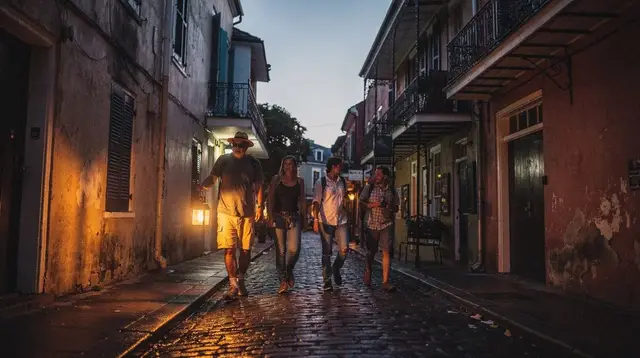
That tourist market is exactly why this distinction matters before you choose a tour. New Orleans sells everything from carefully researched historical walks to pure jump-scare theatre under the same “voodoo tour” label, and a shop window full of dolls tells you nothing about which one you are looking at.
Marie Laveau: the woman behind the legend
If one figure explains Voodoo’s place in New Orleans history, it is Marie Laveau. Born free in the city around 1801, she was a woman of colour who became, by the middle of the nineteenth century, the most prominent Voodoo practitioner the city has ever produced — and one of its most influential residents of any background.
Laveau’s life sits precisely at the intersection this guide has been describing. She was a devout, regular attendee at St Louis Cathedral on Jackson Square, and simultaneously the city’s leading Voodoo Queen, presiding over rituals that drew both Black and white New Orleanians, rich and poor.
She worked as a hairdresser, which gave her regular, intimate access to elite households across the city — a position that, whether by design or by consequence, made her a repository of information and influence that reinforced her spiritual authority. Free women of colour occupied a distinctive social position in Creole New Orleans, and Laveau used hers to become a figure both of Voodoo practice and of the city’s Catholic devotional life, not one or the other.
Separating documented fact from accumulated legend around Laveau is genuinely difficult, and any honest account should say so plainly. She left no memoir, and most of what survives comes from newspaper accounts, oral tradition and reminiscence recorded well after her death in 1881, much of it filtered through the racial attitudes of the era it was written in. What is well established is her prominence, her Catholic-Voodoo dual practice and her enduring reputation. What has grown around that core is harder to verify: specific rituals attributed to her, claimed supernatural powers, and stories that multiplied for decades after her death. A tour or guide that presents every Laveau legend as settled fact is telling a story, not a history.
Tradition holds that Laveau is buried in St Louis Cemetery No. 1, the city’s oldest cemetery, just north of the French Quarter, where her tomb remains a site of visitation and offerings to this day. This guide treats that only as her resting place; everything about visiting the cemetery itself — how access works, why it is guided-only, what else is there — belongs to the dedicated cemeteries guide, which covers that logistics in full.
From lived religion to tourist attraction
Voodoo’s visibility in New Orleans today owes a great deal to the same nineteenth-century period that produced Marie Laveau, and to what happened to its image afterward. Sensationalised newspaper coverage of Voodoo gatherings, often written by outsiders with little interest in accuracy, cemented a public image of mystery and danger long before Hollywood added dolls and curses to the picture in the twentieth century. By the time New Orleans became a major tourist destination, “voodoo” was already a marketable word detached from most of what the religion actually involves.
That gap between image and reality is precisely what the modern tour market sits inside. Because the word draws visitors reliably, it gets attached to a wide range of products: some genuinely engage with African diasporic religion, Creole history and how the two intertwined in this specific city; others use it purely as a hook for a spooky evening walk with little historical grounding. Both kinds are sold within a few blocks of each other in the French Quarter, often using near-identical marketing language, which is exactly why it is worth knowing what to look for.
You will also find real Voodoo shops and practitioners still operating in the city, alongside shops selling mass-produced curios aimed squarely at visitors. There is no infallible way to tell them apart from the street, and this guide will not invent operator names or claim to certify any as authentic. What a visitor can reasonably do is treat the subject with the seriousness it deserves, read what a tour or shop actually says about itself, and check reviews for whether other visitors found substance or only theatre.
Choosing between a history tour and an entertainment tour
The practical question, once you understand the background, is which kind of experience you actually want on a given evening — or whether you want both, on different nights. New Orleans’ walking-tour market roughly splits into two temperaments, and neither is inherently more or less worthwhile; they simply promise different things.
| What you’re looking for | What to expect |
|---|---|
| Serious history and religious context | A guide who discusses African roots, Catholic syncretism, Marie Laveau’s documented life versus legend, and treats Voodoo as a living faith |
| Ghosts, ghouls and jump scares | Theatrical storytelling, costumed elements, legends presented as settled fact, entertainment first |
| A broader dark-history evening | Tours that combine Voodoo with piracy, crime, disease or true-crime elements from the city’s past |
| A comedic, adult-oriented take | Walking tours built around humour and drinking as much as history |
For a grounding-first evening, a dedicated walking tour built specifically around Voodoo history and belief is the most direct route into the material this guide covers. Some operators combine that context with a stop connected to Marie Laveau’s resting place; a tour pairing Voodoo history with a guided cemetery visit is worth considering if you want both pieces in one outing, with the cemetery-access logistics themselves explained in the separate cemeteries guide.
If you would rather fold Voodoo into a wider look at the city’s museums and Creole past, a guided tour combining a museum visit with Voodoo history on foot covers more ground in a single booking. And if your evening is aiming squarely at atmosphere and legend rather than religious history, a haunted history walking tour delivers the ghost-story register plainly, without pretending to be something else.
None of these categories is a trap to avoid — a theatrical ghost walk can be a genuinely fun evening in the French Quarter, and plenty of visitors enjoy one of each kind on different nights. The point of this guide is simply that you should know, before you book, which one you are getting.
Voodoo and the rest of New Orleans culture
Voodoo does not sit in isolation from the rest of the city’s culture; it is woven into much of what New Orleans is known for. The Treme neighbourhood, just north of the Quarter, is often described as the cradle of the city’s Black cultural and musical life, and the same African diasporic heritage that shaped Voodoo also shaped the second-line traditions and brass-band culture that still animate New Orleans streets. Understanding one deepens the other.
It is also worth being precise about a distinction visitors often blur: Voodoo is not the same subject as the ghost and vampire lore that fills much of the Quarter’s tour-marketing, even though the two are frequently sold side by side and sometimes in the same walking tour. Voodoo is a religion with a documented history and living practitioners. Vampire and ghost legends are folklore and entertainment, largely modern in their popular form. A comparison of the city’s ghost tours is a useful next stop if that folklore side is what you are after, kept separate from the material here.
The African American heritage that runs through New Orleans more broadly gives Voodoo its deepest context: a faith carried across the Atlantic under conditions of enslavement, sustained and adapted by free and enslaved people of colour, and passed down through generations of a city that never fully separated its Catholic identity from what came before it. That is a heavier, richer story than “spooky New Orleans,” and it is one this guide has tried to tell on its own terms.
Where this leaves your planning
If you take one thing from this guide, let it be this: ask what a tour or shop is actually offering before you book or buy, rather than assuming the word “voodoo” tells you. A serious historical walk, a guided stop connected to Marie Laveau, a broader dark-history evening and a pure entertainment ghost walk are all sold in the same few blocks of the French Quarter, often with similar posters. Now you know which questions separate them.
For the practical side of visiting Marie Laveau’s tomb — how St Louis Cemetery No. 1 works, why an independent visit is not possible, what else is buried there — the cemeteries visitor guide picks up exactly where this one leaves off. If Voodoo has drawn you toward the city’s wider spiritual and folkloric offerings, the ghost tours comparison and the vampire lore guide sit alongside this page for that purpose, and things to do in New Orleans has the fuller list of what else the city offers beyond its darker corners.
For first-time visitors piecing together a wider plan, New Orleans for first-time visitors and how many days in New Orleans are the natural starting points, and the best time to visit guide will tell you whether your dates line up with festival season, when the city is at its most crowded and its most itself.
Frequently asked questions about Voodoo in New Orleans
Is Voodoo a real religion or just a tourist attraction?
Louisiana Voodoo is a real syncretic religion, blending West African spiritual traditions brought by enslaved people with Catholic saints, sacraments and imagery. It has practitioners today. The costume-shop version sold on some souvenir racks is commercial entertainment layered on top of that real tradition, not the tradition itself.
Who was Marie Laveau?
Marie Laveau (around 1801-1881) was a free woman of colour in New Orleans known as the city’s Voodoo Queen. She combined Voodoo practice with regular attendance at St Louis Cathedral, worked as a hairdresser with access to the city’s elite households, and became the most influential religious and spiritual figure in the Creole city of her time.
Where is Marie Laveau buried?
Tradition places her tomb in St Louis Cemetery No. 1, the oldest cemetery in New Orleans, just north of the French Quarter. Visiting logistics, including the rule that the cemetery can only be entered with an authorised guide, are covered separately in the cemeteries guide, not here.
Is Voodoo the same as Haitian Vodou or West African Vodun?
They share roots but are not identical. Louisiana Voodoo developed in and around New Orleans out of West African traditions, French and Spanish Catholicism, and Caribbean influence, including migration from Haiti. Haitian Vodou and West African Vodun are related but distinct traditions with their own histories, practices and geography.
Is Voodoo the same as black magic or curses?
No. That association comes mostly from Hollywood and pulp fiction, not from the religion itself. Louisiana Voodoo centres on spirits, ancestor veneration, healing and ritual, with practices such as gris-gris (charms) that are closer to folk blessing and protection than to the hexing stereotype.
How do I tell a serious voodoo tour from an entertainment one?
A serious tour engages with Voodoo’s African and Catholic roots, treats living practitioners and their beliefs with respect, and is honest about what is documented history versus legend. A pure-entertainment tour leans on jump scares, ghost-story theatrics and gift-shop mysticism. Read the description and reviews before booking, and expect either type to be sold in the French Quarter.
Can I visit a real Voodoo shop or practitioner in New Orleans?
Yes. Voodoo shops and practitioners operate in the French Quarter and beyond, some rooted in genuine practice, others aimed squarely at tourists. There is no single way to tell them apart at a glance; a guided tour with historical grounding is the easiest way for a first-time visitor to get context before deciding what else to see.
Do I need to book a cemetery tour to see Marie Laveau’s tomb?
Yes, because St Louis Cemetery No. 1 cannot be entered independently — only with an authorised guide. That booking process, along with the cemetery’s other tombs and history, is covered in the dedicated cemeteries guide rather than here.
Voodoo and cemetery tours on GetYourGuide
Verified deep-linked GetYourGuide tours. Book through these links and we earn a small commission at no cost to you.
GetYourGuide does not provide a product photo for this activity — the image shows the meeting point, photographed by us.