Ghost Tours in New Orleans Compared
How do I choose between New Orleans ghost tours?
Read the format before the theme: a small walking group with a guide who cites named buildings and documented fires or epidemics is closer to real history than a bus with a costumed narrator or a tour that blends in voodoo lore for effect. Check the route, the group size and whether cemetery access is included, since only an authorised guide can take you inside St Louis Cemetery No. 1.
Choosing between formats, not just between titles
Search for a nighttime tour in New Orleans and the results blur together fast: dozens of listings with near-identical names, all promising the same haunted French Quarter after dark. The useful distinction is not the title, it is the format. A slow walking group led by a guide who names specific buildings, fires and epidemics is a different evening from a bus loop with a scripted narration, which is again different from a hands-on “ghost hunt” with equipment. All three can be worth booking. The mistake is booking on the strength of the word “ghost” alone, without checking which of these three products you are actually getting.
This page is written for the point just before you book: you have already decided you want a nighttime tour in French Quarter, and you need to work out which one matches what you actually want from the evening - a serious account of the city’s past, a fun group activity, or something in between.
What separates history from spectacle
New Orleans has genuine reasons to lean into the macabre. Yellow fever epidemics killed thousands of residents across the nineteenth century. Fires levelled large parts of the Quarter twice, in 1788 and 1794, which is why so much of what stands today is Spanish-influenced rather than French colonial. Duels were fought under the oaks. The above-ground tombs of Lafayette Cemetery No. 1 and St Louis Cemetery No. 1, built that way because much of the city sits at or below sea level, give the city’s cemeteries a visual drama most American cities don’t have. A tour that draws on this material, with dates, named buildings and sourced events, is doing something closer to history than entertainment.
The other end of the spectrum uses the same backdrop - narrow streets, wrought-iron balconies, old brick - as a stage set for invented hauntings, jump-scare pacing and a guide playing a character rather than presenting research. Neither approach is wrong for every traveller. A group looking for a fun, safe way to spend an evening outdoors in the Quarter may prefer the livelier version. Someone who wants to understand the city’s history through its darker episodes will get more from the other. The problem is that both are marketed with nearly the same language, so the description, not the title, is what tells you which one you are booking.
One signal worth watching for: how a tour handles Voodoo. Voodoo in Louisiana is a real syncretic religion with African and Catholic roots, not a costume theme, and figures like Marie Laveau are historical, not folkloric props. Some ghost tours fold Voodoo references into their narration purely for atmosphere, mixing it with ghost stories in a way that flattens both subjects.
If a serious treatment of Voodoo itself is what you’re after, a tour dedicated to that subject will go deeper than one splitting an hour between ghosts and a passing mention of Voodoo Queens. This page does not develop Voodoo or Marie Laveau further - that is covered on its own page. It also leaves vampire lore aside, which has its own dedicated page, since the two themes are often marketed together but rest on different material.
Walking, bus, or hands-on: the three formats
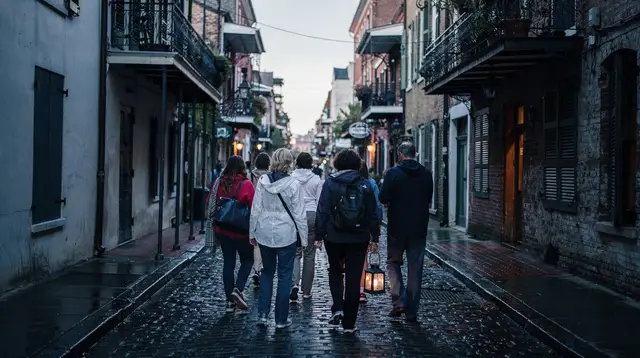
Walking tours move on foot through the Quarter, usually in smaller groups, at a pace slow enough to stop outside a specific courtyard, hotel or former hospital while the guide explains what happened there. They stay within a compact area - the Quarter is roughly 13 by 6 blocks - so the walking distance is manageable, but the trade-off is that they don’t range beyond it.
Bus tours cover more ground, sometimes extending past the Quarter into areas a walking group wouldn’t reach on foot in an evening, and they let you sit down between stops. The New Orleans: Historical Ghost Bus Tour is built on this format, and the New Orleans: Ghost and Graveyard Bus Tour follows a similar structure with a cemetery focus. The narration on a bus is harder to interrupt with a question than on a small walking group, and the group size is usually larger.
Hands-on formats, like the New Orleans: Guided Nighttime Ghost Hunt, put you in an active role rather than a passive one - using equipment, visiting specific reportedly active sites, and building the evening around participation rather than a fixed narrated route. These suit people who want an activity, not a lecture.
If Voodoo history alongside ghost lore appeals to you as a single evening, the New Orleans: Voodoo Tour packages that combination directly, which at least sets the expectation upfront rather than blending it in unannounced.
Comparing the formats at a glance
| Format | Pace | Group size | Best for |
|---|---|---|---|
| Walking (Quarter-focused) | Slow, on foot | Smaller | Close attention to specific buildings and stories |
| Bus (historical or graveyard-themed) | Faster, seated | Larger | Covering more ground, less walking |
| Guided nighttime ghost hunt | Active, hands-on | Varies | Participation over narration |
| Voodoo-themed evening | Slow, on foot | Smaller | Ghost lore paired explicitly with Voodoo history |
Treat prices, exact durations and departure points as details to confirm on the specific listing at the time of booking - they vary by operator and change over time, and this page deliberately does not invent figures that aren’t on the booking page in front of you.
Cemeteries: check access before you assume it
New Orleans’ above-ground tombs are one of the city’s most photographed features, and a fair number of ghost tours use a cemetery as a stop or a finale. The detail worth confirming before booking: St Louis Cemetery No. 1 can only be entered with an authorised guide, and independent entry is not possible. Not every ghost tour that mentions cemeteries actually goes inside one - some stop at the gates, others walk past exterior walls, and only some hold the authorisation to bring a group in.
If cemetery access is the reason you’re booking a particular tour, read the listing closely enough to confirm it’s included rather than assuming it from the tour’s name. For a fuller picture of how cemetery visits work in the city, including which cemeteries allow independent visits, see the dedicated cemeteries guide.
Practical notes for booking a nighttime tour
- Check the meeting point. Most nighttime tours in the French Quarter start from a fixed location, and being late to a walking group is more disruptive than missing a bus pickup.
- Dress for the season. New Orleans summers are long, hot and very humid; evenings offer some relief but not much. Winters can turn genuinely cold for a few days, so check the forecast rather than assuming a mild evening.
- Watch is for solo travellers versus groups. A hands-on ghost hunt can work well solo since the format encourages interaction with strangers; a bus tour is comfortable either way; a walking tour with a small group suits couples and small groups who want to ask questions along the route.
- Combine with an early dinner on Frenchmen Street or in the Quarter, since most nighttime tours run for a couple of hours and finish late enough that a full dinner afterward can be a stretch.
- Don’t assume open containers apply everywhere. Louisiana law allows open containers of alcohol in the French Quarter in a plastic go-cup, not in glass, and not outside the permitted area - relevant if your tour includes a stop at a bar.
- If mobility is a concern, a walking tour’s pace and cobbled streets are worth weighing against a bus tour’s seated format.
Where ghost tours fit into a wider evening
A ghost tour rarely needs to be the entire evening. Many visitors pair it with dinner beforehand in the Garden District or the Quarter, or with live music afterward on Frenchmen Street, which locals point visitors toward over the louder stretch of Bourbon Street. If you’re building a longer stay around New Orleans’s after-dark culture, the live jazz guide and the comparison of Frenchmen Street versus Bourbon Street cover what to do once the tour ends.
For a broader look at how ghost tours compare to each other feature by feature, the dedicated ghost tours comparison format above should already answer most of what a first-time visitor needs; if vampire lore specifically drew you to this page, that subject has its own dedicated guide rather than being folded in here.
If you’re still deciding how many nights to spend in the city before locking in an evening for a ghost tour, the how many days in New Orleans guide and the three days in New Orleans itinerary both build in an evening slot that a nighttime tour like these fits naturally. And if safety after dark is a concern beyond the tour itself, the is New Orleans safe for tourists guide covers the ordinary precautions - well-lit streets, rides rather than long walks after dark - that apply whether or not you’ve booked a tour that night.
Booking one of these tours
Two of the formats above are ready to book directly. The bus tour built around documented history rather than invented scares suits travellers who want the seated, wider-ranging format described above. For a more active evening, the hands-on nighttime ghost hunt using equipment at reportedly active sites puts you in a participatory role rather than a listening one.
If a cemetery stop matters to your choice, the bus tour that combines ghost stories with a graveyard stop is built around that pairing specifically - confirm on the listing which cemetery is included and that guided access is part of the itinerary. And if you’d rather treat Voodoo as a subject in its own right alongside the ghost lore, the evening tour pairing Voodoo history with ghost stories sets that combination out upfront rather than blending it in as an aside.
Frequently asked questions about choosing a New Orleans ghost tour
Are New Orleans ghost tours based on real history?
Some are built directly on documented events - yellow fever epidemics, fires, duels, the Battle of New Orleans - and name real buildings and dates. Others use the same French Quarter backdrop for invented or heavily embellished stories. The two styles are often sold side by side, so the description and the guide’s approach matter more than the word ghost in the title.
What is the difference between a walking ghost tour and a bus tour?
A walking tour moves slowly through the French Quarter on foot, usually in a small group, stopping outside specific buildings the guide can point to directly. A bus tour covers more ground, including areas outside the Quarter, but the group is larger, the stops are shorter, and the narration is harder to interrupt with questions.
Do ghost tours go inside St Louis Cemetery No. 1?
Only if the tour explicitly says so and holds the required authorisation - independent entry to St Louis Cemetery No. 1 is not possible. If cemetery access matters to you, confirm it in the tour description before booking rather than assuming any ghost-themed walk includes it.
Should I book a tour that mixes ghosts and voodoo?
It depends what you want. Some operators combine the two themes into one evening for convenience, which can dilute both subjects into general spookiness. If you want a serious treatment of Voodoo as a religion with real history, a tour focused on that subject alone will usually go deeper than one splitting its time with ghost stories.
Are ghost tours suitable for children?
Many are marketed as family-friendly and keep the content to spooky storytelling rather than graphic material, but a nighttime hunt or an adults-oriented bar-stop tour is a different product. Read the age guidance on the specific listing rather than assuming all ghost tours are the same intensity.
What should I check before booking a ghost tour?
The format (walking, bus or hands-on hunt), the group size, the route and whether it stays inside the French Quarter or ranges further, whether cemetery access is included and authorised, and whether the description leads with documented history or with performance and props. Matching the format to what you actually want to spend your evening doing matters more than the tour’s name.
Is Bourbon Street part of most ghost tours?
Some routes touch the edges of Bourbon Street or gather groups near it, but the historic sites most ghost tours focus on - old hotels, former hospitals, courtyards, and the cemeteries - sit on the quieter streets of the Quarter, not on Bourbon Street itself.
Tours worth comparing on GetYourGuide
Verified deep-linked GetYourGuide tours. Book through these links and we earn a small commission at no cost to you.
GetYourGuide does not provide a product photo for this activity — the image shows the meeting point, photographed by us.