Free Things to Do in New Orleans
What can you do for free in New Orleans?
Most of the French Quarter's charm costs nothing: walking the grid, looking up at Royal Street's ironwork balconies, listening to street musicians on Jackson Square, seeing the St Louis Cathedral facade, and strolling the riverfront levee. A few things people assume are free, like the streetcar and the ferry, are not, though both are inexpensive.
What costs nothing in the French Quarter and beyond
New Orleans has a reputation for expensive dinners, guided plantation tours and pricey cocktails, but a surprising amount of what makes the city worth visiting does not cost a cent. This is not a first-time-visitor overview and not a walking route through the French Quarter step by step — those are covered elsewhere, in the guide for first-time visitors and the French Quarter walking guide.
This page is narrower and more specific: a list of individual, free activities concentrated in the French Quarter, the Garden District, Treme and the riverfront, that you can do in any order, on any day, without a ticket.
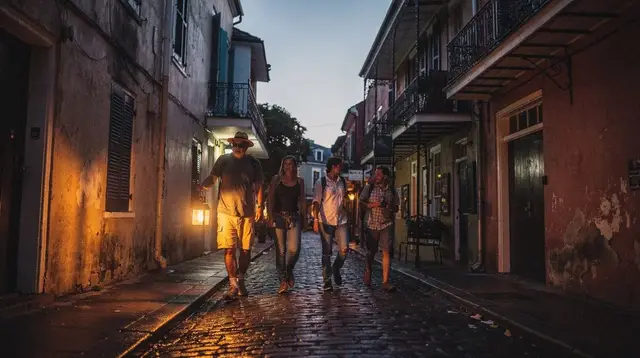
The common thread is that New Orleans rewards slow, aimless movement more than most American cities. Its oldest neighbourhoods were built before cars, at a human scale, and much of what people pay tour operators to point out is also visible for free if you know where to look and are willing to walk.
Walk the grid of the Vieux Carre
The French Quarter, or Vieux Carre, is a compact grid roughly thirteen blocks by six, originally laid out by French colonial engineers, though the architecture visible today is overwhelmingly Spanish colonial and Creole, rebuilt after the fires of 1788 and 1794. Simply walking it, without a plan or a guide, is free and arguably the single best activity in the city. The streets closest to the river carry the heaviest tourist traffic; a block or two back, the pace slows and the architecture becomes easier to actually look at.
There is no fee to enter the district and no gate. Early morning, before the crowds and the heat build up, is the best time to walk it purely for the architecture, since the streets are quiet and the light on the buildings is softer. Late afternoon brings the crowds back and the street life with them, which is its own kind of free entertainment.
Look up: the ironwork balconies of Royal Street
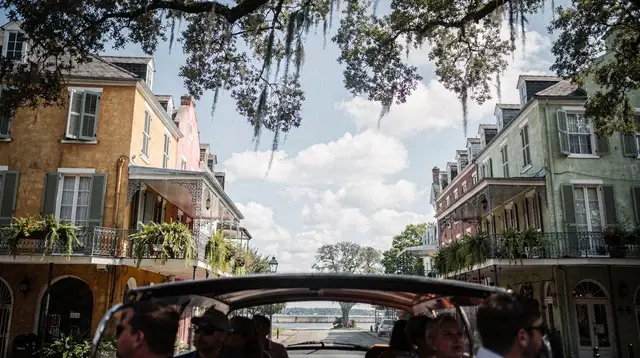
Royal Street runs parallel to Bourbon Street, one block toward the river, and is the Quarter’s gallery-and-antiques street rather than its bar street. What is free about it has nothing to do with the shop windows: it is the ironwork balconies overhead, the lace-like cast and wrought iron galleries that wrap entire building facades, some dating to the Spanish colonial rebuilding of the city after the fires of the 1780s and 1790s.
Walking Royal Street slowly, looking up rather than into shop windows, costs nothing and is one of the most photographed things about the city for good reason. The side streets that cross Royal, particularly toward the lower end of the Quarter, have quieter stretches of the same ironwork without the crowds.
Jackson Square: architecture and street musicians, for the price of a tip
Jackson Square itself is a free, open public park at the heart of the Quarter, and it is worth visiting for the view alone: the St Louis Cathedral facade rising behind it, flanked by the matching buildings of the Cabildo and the Presbytere. None of the three requires paying admission to be appreciated from the outside, and the cathedral’s exterior, with its distinctive triple steeple, is free to photograph from the square at any hour.
What turns Jackson Square from a nice view into a genuine free activity is the street performance around its perimeter: musicians, brass bands, tarot readers, portrait artists and the occasional living statue, working for tips rather than a cover charge. Stopping to listen to a horn player or a string band for ten or fifteen minutes costs nothing upfront, but the accepted etiquette is to tip a few dollars in cash if you stay and enjoy the set — musicians here are working, not performing as a public amenity, and a case or bucket left open is an invitation, not a decoration. A fuller walk-through of the square and the cathedral behind it is in the dedicated Jackson Square guide.
The cathedral’s interior is usually open to the public free of charge outside of Mass and private events, though hours shift and it does close on short notice, so treat entry as a bonus rather than a guarantee.
The Cabildo and the Presbytere, seen from outside
The Cabildo, where the Louisiana Purchase transfer documents were signed, and the Presbytere, its architectural twin on the other side of the cathedral, both operate as museums with paid admission inside. Neither building needs to be entered to be worth seeing: their matching Spanish colonial facades, mansard roofs and arcaded ground floors frame Jackson Square and are part of what makes the square photogenic. Walking around both buildings from the outside, reading their exterior plaques, costs nothing.
Walk the riverfront levee behind the French Market
Behind the French Market and running along the edge of the Quarter, a paved path climbs the levee that holds back the Mississippi River. This walk is free, open at all reasonable hours, and gives a view most visitors miss entirely from street level: the river itself, wide and often busy with tugboats pushing barges, with the skyline of the Central Business District visible downriver and Algiers Point across the water.
Because much of New Orleans sits at or below sea level, the river is often higher than the streets behind the levee, which is part of why the walk feels unusual — you are standing above the neighbourhood, looking down at it in one direction and out at the Mississippi in the other. Sunset is a particularly good time for this walk, with the light hitting the water and the CBD towers behind you.
Decatur Street and the French Market, without buying anything
Decatur Street and the French Market that runs alongside it can be enjoyed as free browsing rather than a shopping trip. The market’s open-air stalls, produce sheds and flea-market section cost nothing to wander through, and people-watching along Decatur, with its mix of locals, street performers and visitors drifting toward the river, is free entertainment in its own right. Cafe du Monde sits at one end of this stretch; standing outside and watching the queue, or simply walking past the powdered-sugar tables, costs nothing even if you decide the beignets themselves are worth paying for another time.
Listen to Frenchmen Street from the sidewalk
Frenchmen Street, in the Faubourg Marigny just downriver from the Quarter, is the live-music strip locals point visitors toward rather than Bourbon Street. Many of its small clubs keep their doors and windows open, especially in mild weather, which means the music spilling onto the sidewalk can be heard, and often clearly seen, without paying a cover charge to go inside.
Walking the length of Frenchmen Street in the evening, moving from doorway to doorway and catching a few minutes of jazz, brass or funk from each one, is free. It is a different experience from sitting down inside a venue for a full set, which usually does involve a cover or a minimum spend, but as a way to sample the range of music the city is known for at no cost, it is hard to beat. How this compares with the noisier, costume-and-cover-charge version of a night out on Bourbon Street is covered separately in Frenchmen Street vs Bourbon Street.
Treme: Louis Armstrong Park and Congo Square
Just north of the French Quarter, Treme is one of the oldest African American neighbourhoods in the country and a place with a direct claim to the origins of jazz. Louis Armstrong Park sits at its edge and is free and open to the public, with Congo Square inside it — the historic gathering point where enslaved and free people of colour once played music and traded on Sundays, and a site widely credited as a root of the city’s musical culture.
Walking through the park and standing in Congo Square costs nothing, though it is worth treating the site with the historical weight it carries rather than as simply a scenic backdrop. Treme’s place in the city’s musical and cultural history is set out at more length in the guide to Treme and the birth of jazz and the wider guide to African American heritage in New Orleans, both free to read as background before or after a walk through the neighbourhood.
The Garden District’s mansions, seen from the sidewalk
Uptown along St Charles Avenue, the Garden District and Lower Garden District are known for antebellum mansions set behind cast-iron fences and old oak trees. None of these are museums open to visitors; they are private homes. But walking the sidewalks of the district, looking at the architecture from the public street, costs nothing and is the way most visitors actually experience the neighbourhood.
Getting there is not free: the St Charles streetcar, the oldest continuously operating street railway in the world, runs the length of the avenue and is inexpensive but requires a fare, paid through the RTA’s ticket app or in exact change on board. Walking there instead, or combining a fare-paid streetcar ride with free walking once you arrive, is the practical way to see the district without spending much; fares, routes and how the line fits into a wider visit are covered in the guide to getting around New Orleans by streetcar.
Lafayette Cemetery No. 1, in the heart of the Garden District, can generally be visited at no charge during its posted hours, unlike St Louis Cemetery No. 1 in the Quarter, which requires an authorised guide. Rules at both cemeteries can change, so this is worth checking before you go rather than assuming either is open on a given day; the visitor guide to the cemeteries of New Orleans covers both in more detail, including what a guided tour of St Louis Cemetery No. 1 involves.
Mid-City: City Park’s grounds and the sculpture garden
Away from the Quarter, City Park in Mid-City is far larger than most first-time visitors expect, with live oaks, lagoons and miles of paths that cost nothing to walk. The New Orleans Museum of Art inside the park charges admission, but the adjoining Besthoff Sculpture Garden is an outdoor collection set among the oaks and is generally open to the public at no charge during the park’s hours, making the pair a slower, quieter alternative to the Quarter for a free afternoon. More on the park and the sculpture garden is in the dedicated City Park guide.
A quick reference: free versus cheap versus paid
| Activity | Cost |
|---|---|
| Walking the French Quarter grid | Free |
| Royal Street ironwork balconies | Free |
| Jackson Square and street musicians | Free to enter, tip appreciated |
| Cabildo and Presbytere, exterior only | Free |
| St Louis Cathedral facade | Free |
| Riverfront levee walk | Free |
| Frenchmen Street from the sidewalk | Free |
| Louis Armstrong Park and Congo Square | Free |
| Garden District sidewalks and mansions | Free |
| Lafayette Cemetery No. 1 | Usually free, hours vary |
| City Park grounds and Besthoff Sculpture Garden | Free, museum inside is paid |
| St Charles streetcar | Cheap, not free |
| Algiers Point ferry | Cheap, not free |
| St Louis Cemetery No. 1 | Guided tour required, paid |
Tipping still matters, even when the activity is free
Almost nothing on this list has a ticket price, but that does not mean nothing is expected in return. Street musicians on Jackson Square and around the Quarter earn their living from tips, not a salary, and the informal guides and performers you encounter along the way generally work the same way. A few dollars in cash, dropped in a case or a bucket, is the accepted local etiquette if you stop to watch or listen for more than a minute or two. It is worth carrying small bills for exactly this reason, since a genuinely free afternoon can still call for cash in your pocket. Broader questions of tipping norms and how sales tax is added at the till are covered in the dedicated guide to tipping and sales tax rather than here.
For a fuller picture of how to keep the rest of a New Orleans trip affordable, including lodging, food and paid attractions, see the general guide to New Orleans on a budget. If you would rather have a guide narrate some of this history in person, a French Quarter walking tour is one way to do it.
an evening pub crawl through the Quarter’s haunted history, with a free shot included turns a free-feeling evening walk into a guided one, and a broader city tour is a way to see Treme, the Garden District and beyond in one guided outing if you would rather not piece it together on foot.
For a deeper look at the city’s spiritual history behind Congo Square, a Voodoo-focused tour adds context a self-guided walk will not. Visitors short on time sometimes prefer a three-hour orientation tour that covers several of these neighbourhoods before deciding where to walk back on their own for free.
Frequently asked questions about free things to do in New Orleans
Is Jackson Square free to enter?
Yes, the square itself is a free public park, open during daylight hours. Only the guided-only interior visits to some buildings on its edges involve a fee; the square, the musicians and the artists along its fence are free to enjoy.
Can you walk into St Louis Cathedral for free?
The cathedral is generally open to the public at no charge outside of Mass times and private events, though hours vary and it can close for services without notice. Even from the outside, the facade on Jackson Square is one of the most photographed views in the city and costs nothing to see.
Is the St Charles streetcar free?
No. It is inexpensive but not free, and fares are usually paid through the RTA’s mobile ticket app or with exact change on board. A single ride costs only a few dollars, which is cheap for what is effectively a moving sightseeing tour of the Garden District.
Do you have to pay to hear music on Frenchmen Street?
You do not have to pay anything to walk Frenchmen Street itself and listen to what spills out of the open doors and windows of its clubs. Going inside a specific venue to sit down and watch a full set is a different matter and usually involves a cover charge or a minimum spend.
Should you tip street musicians and living statues even though the show is free?
Yes. Nothing about it is compulsory, but the musicians on Jackson Square and around the French Quarter rely on tips, and it is the accepted local etiquette to drop a few dollars in the case or bucket if you stop to listen for more than a minute or two.
Is the riverfront walk along the Mississippi free?
Yes, the paved path and viewing areas along the levee behind the French Quarter and the French Market are open and free at all reasonable hours, and no ticket or pass is required to walk along the river or watch the ships and barges go by.
Is Bourbon Street free to walk?
Walking Bourbon Street costs nothing, and in the French Quarter it is legal to carry a drink outdoors in a plastic go-cup while you do. What costs money is anything you buy once you step inside a bar or club along the way.
Low-cost things to do on GetYourGuide
Verified deep-linked GetYourGuide tours. Book through these links and we earn a small commission at no cost to you.
GetYourGuide does not provide a product photo for this activity — the image shows the meeting point, photographed by us.