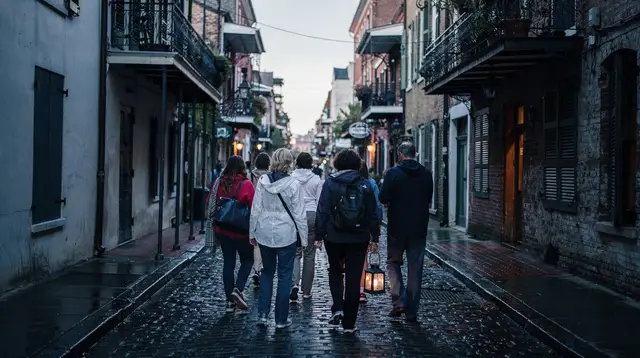
Guided or Self-Guided? How to Actually See the French Quarter
Do you need a guide to visit the French Quarter?
No — the French Quarter is a compact, walkable grid roughly thirteen by six blocks, and most of it rewards wandering on foot without a guide. The exception is St Louis Cemetery No. 1, which has been closed to independent visitors since 2015 and can only be entered with an archdiocese-authorised guide (limited time slots, paid ticket), and history- or Voodoo-focused walks add real context that self-guided strolling misses.
The real question: guide or no guide, on foot, in one neighbourhood
Every visitor to New Orleans eventually asks some version of the same question: should I hire a guide for the French Quarter, or can I just walk it myself? This page answers only that question, for the French Quarter itself, on foot. It has nothing to say about carriage or bike tours, hop-on hop-off buses, or multi-attraction passes — those are different tools for different problems, and mixing them into this comparison would blur the one decision that actually matters here: do you need someone leading you through these particular streets, and if so, where exactly.
The short version is that the Quarter itself does not require a guide. What requires one is a specific handful of experiences layered on top of the Quarter — most notably a single cemetery, and to a lesser extent a few historical and cultural threads that are easy to walk past without understanding.
Why the Quarter is built for walking alone
The Vieux Carre is, by American standards, small. It runs roughly thirteen blocks by six, laid out on a simple grid that has not changed shape since the eighteenth century. That geometry is the whole argument for going without a guide: you cannot really get lost, and almost everything worth seeing sits within a fifteen-minute walk of Jackson Square.
Start there. Jackson Square, fronted by St Louis Cathedral, the Cabildo and the Presbytere, is the Quarter’s obvious centre of gravity, and it works perfectly well as a self-guided stop — read the historical markers, watch the street artists and tarot readers set up along the fence, and take the cathedral’s free entry if it is open.
From there, Royal Street runs parallel to Bourbon, lined with antique dealers and art galleries that are meant to be browsed slowly and alone; a guide walking a group through Royal Street mostly gets in the way of window-shopping. Decatur Street and the French Market give you the working, commercial edge of the Quarter, and a coffee and beignet at Cafe du Monde needs no interpretation beyond powdered sugar and a queue.
None of this is a knock on tours — it is simply a description of terrain that rewards unhurried, self-directed movement more than narrated pace. A few practical points make self-guided walking easier:
| Consideration | Self-guided reality |
|---|---|
| Layout | Compact grid, roughly 13 by 6 blocks |
| Best pace | Slow, with stops — not a fixed schedule |
| Parking | Difficult, metered, strictly enforced — walk instead |
| Cost | Free, aside from what you spend inside shops, cafes and museums |
| Flexibility | Total — skip Bourbon Street entirely if it isn’t your scene |
If your goal is simply to see the Quarter — its architecture, its ironwork balconies, its street life — a paper map or a phone and a few hours will do everything a guide would, and let you linger exactly where you want. For a fuller sense of how to sequence a day here, a dedicated French Quarter walking guide lays out a sensible route block by block, and if you are weighing the Quarter against Bourbon Street’s louder, later cousin, the comparison of Frenchmen Street versus Bourbon Street is worth reading before you plan your evenings.
Where a guide genuinely changes what you see
The case for a guide in the Quarter is not about navigation. It is about context that is invisible from the street. Three areas stand out.
History that isn’t posted on a plaque. The Quarter’s Creole architecture, its layered French, Spanish and Caribbean influences, and the social history behind buildings that now house bars and gift shops are easy to walk past without a second glance.
A history- and culture-focused walking tour turns facades into a narrative — who lived there, what happened, why the balconies look the way they do — and that narrative is genuinely hard to reconstruct from research alone in the time most visitors have. The same is true a few blocks north in Treme, where a guide’s context on the birth of jazz and the neighbourhood’s African American history adds far more than a solo walk would.
Voodoo, treated seriously. Voodoo in Louisiana is a real syncretic religion with African and Catholic roots, not a theme-park prop, and the Quarter is full of shops and tours that treat it with everything from real scholarship to pure kitsch.
A well-chosen guide can walk you through the religion’s actual history and its connection to figures like Marie Laveau with the seriousness the subject deserves; a poorly chosen one will sell you rubber snakes and jump-scares. If this interests you, read reviews carefully and pick an operator known for historical grounding — a guided museum and Voodoo walking tour is a reasonable way to get the serious version rather than the novelty one.
Ghost stories, for what they’re worth. Ghost tours are the Quarter’s most heavily marketed after-dark activity, and quality varies enormously — some are built on documented events and real buildings, others are pure performance with a flashlight. If you like a spooky, narrated evening walk regardless of strict historical accuracy, a guided ghost-themed walking tour delivers atmosphere and storytelling that a solo walk simply can’t replicate after dark, when the same streets feel very different.
For something a little more flexible and self-paced but still narrated, a self-guided audio ghost tour available in six languages splits the difference: you walk on your own schedule while a recorded guide supplies the stories.
If you want something sharper still, a small-group guided nighttime ghost hunt goes further into specific reputedly haunted buildings than a casual stroll would, with the actual equipment and technique framing that only a dedicated guide can offer. None of these substitute for each other — pick based on whether you want history, atmosphere, or genuine investigation, and see vampire lore and the French Quarter if that particular strand of local legend is what draws you.
The one place self-guided is not an option: St Louis Cemetery No. 1
This is the point on which confusion is most common, and it is worth stating plainly: St Louis Cemetery No. 1 cannot be visited independently. Access is restricted to organised, authorised guided tours, full stop — there is no way to simply walk in on your own the way you might wander into a European churchyard. This is not a suggestion for safety or etiquette; it is the actual access rule for this cemetery, and no self-guided plan gets around it.
The reasons given for the restriction involve preserving the fragile above-ground tombs and managing visitor behaviour in a cemetery that is also an active burial ground and a working part of the Catholic archdiocese. Whatever the rationale, the practical result is the same: if St Louis Cemetery No. 1 is on your list — and it usually is, since its above-ground tombs, including the reputed resting place of Marie Laveau, are one of the city’s most recognisable images — you need to book a guided visit rather than plan a solo walk-through.
A dedicated St Louis Cemetery No. 1 guided tour focuses specifically on this cemetery and its history, while a broader cemeteries guided walking tour can combine it with other historic burial grounds if you want more than one stop. Either way, book ahead rather than assuming you can turn up and join a tour on the spot, especially in busy seasons. Worth noting: rules do vary by cemetery, and Lafayette Cemetery No. 1 in the Garden District has historically had different access — never assume one cemetery’s rule applies to another without checking current conditions.
What you’re actually paying for when you book a guide
It helps to be specific about what a fee buys, because “guided” covers several very different formats. A large walk-up group tour and a small-group or private walk solve different problems: the large group is cheaper per head and easy to book on short notice, while a small group means you can actually ask questions, linger at a building that interests you, and hear the guide over street noise. Neither is objectively better — it depends on whether you want the cheapest way to get context, or the most attentive one.
Almost every guided format in the Quarter shares the same practical shape: a fixed meeting point and start time, a route of one to two miles covered on foot, and a guide who is paid to know the specific buildings and stories along that route rather than the neighbourhood in general. That last point is worth remembering when comparing options — a guide who specialises in Voodoo history is not necessarily the right choice for a group wanting architectural or Creole history, and vice versa. Reading what a tour actually covers, rather than just its star rating, tends to matter more than shopping on price alone. The general roundup of New Orleans tours and the narrower New Orleans walking tours page both break formats down by focus rather than just by price, which is a more useful way to compare than scrolling a marketplace.
Indoor stops complicate the guided-versus-self-guided question further, because a museum does not require a guide the way St Louis Cemetery No. 1 does — you can simply buy a ticket and walk through the Cabildo, the Presbytere or any of the Quarter’s smaller museums on your own schedule. A guided tour that includes museum entry is buying you narration and skip-the-line convenience, not access itself. The museums of New Orleans guide is the place to check what’s self-guided-friendly before assuming you need a ticket bundled with commentary. Food works the same way: nothing stops you from following your nose down Decatur Street, but a guided tasting walk earns its fee by explaining what gumbo, jambalaya and a proper po’boy actually are and where the versions worth eating are hiding, which the beignets, po’boys and gumbo guide covers if you’d rather do that part solo.
One more practical wrinkle: New Orleans heat and humidity shape which format makes more sense on a given day. A midsummer afternoon rewards a shaded, air-conditioned museum stop or an evening tour once the sun drops, while a cooler morning is the easiest time to do the self-guided version of Jackson Square and Royal Street justice without needing to duck indoors every twenty minutes. If you’re planning around the calendar rather than just the day, best time to visit New Orleans and New Orleans in summer both cover how heat, humidity and crowd levels shift the guided-versus-self-guided calculation across the year.
None of this changes the core answer — the Quarter itself remains a self-guided neighbourhood, and St Louis Cemetery No. 1 remains the one hard exception — but it does mean the choice between formats within the “guided” category is worth as much thought as the guided-versus-solo decision itself.
A sensible way to combine the two approaches
Most visitors do best mixing self-guided time with one or two targeted guided experiences rather than choosing one approach for the whole visit. A workable pattern for a first visit:
- Morning, self-guided: Walk Jackson Square, the cathedral, Royal Street and the French Market at your own pace, coffee in hand, no schedule.
- Midday, self-guided or with a food-focused guide: Either wander Decatur Street and grab lunch where it looks good, or join a guided tasting if you want the food explained rather than just eaten — see the comparison of food tours in New Orleans if that appeals.
- Afternoon, guided if history matters to you: A history- or culture-focused walk, or a step into Treme, adds the layer of context that self-guided wandering tends to miss.
- Evening, guided for St Louis Cemetery No. 1 or Voodoo history; self-guided for Frenchmen Street: Book the cemetery or Voodoo tour for its required guide, then head to Frenchmen Street on your own once it lets out — it is exactly the kind of low-key, wander-and-listen evening that doesn’t need narration.
If you are building a longer stay around this, the French Quarter category page rounds up more specific options by type, and a broader things to do in French Quarter overview is useful for filling gaps in a itinerary that runs beyond a single day. Anyone piecing together a first visit to the city as a whole should also see New Orleans for first-time visitors and how many days in New Orleans, since the Quarter is usually only one part — if an important one — of a longer stay.
Frequently asked questions about guided vs self-guided French Quarter visits
Can I walk the French Quarter without a guide?
Yes. It is a compact grid of roughly thirteen blocks by six, flat and easy to navigate on foot, with Jackson Square, St Louis Cathedral and Royal Street all within a short walk of each other.
Why can’t I visit St Louis Cemetery No. 1 on my own?
Access rules restrict the cemetery to organised, authorised guided tours; an independent visit is not possible. This applies specifically to St Louis Cemetery No. 1, and rules can vary by cemetery, so always check current access before assuming a cemetery is open to casual visitors.
Is a Voodoo tour worth taking, or is it just for tourists?
It depends on the operator. Voodoo is a real syncretic religion with African and Catholic roots, not a novelty act, and some tours treat it with genuine historical seriousness while others lean toward pure entertainment. Read descriptions carefully and choose a guide who treats the subject as history and living practice, not spectacle.
Are ghost tours historically accurate?
They vary widely. Some ghost- and Voodoo-themed walks are built on documented history, including real figures such as Marie Laveau, while others prioritise theatrics over accuracy. Choosing a specific, well-reviewed guide matters more than choosing the general category of tour.
How long does it take to see the French Quarter self-guided?
A focused half-day covers the core sights around Jackson Square, Royal Street and Decatur Street. A full day allows for museums, the French Market, and slower time in cafes and galleries without rushing.
Do I need a car to get around the French Quarter?
No. The Quarter is meant to be walked, parking is difficult and metered, and enforcement is strict. Ride-hailing apps or a short streetcar ride cover anything just outside its edges.
What’s the difference between a ghost tour and a cemetery tour?
A ghost tour usually walks the streets of the French Quarter recounting stories tied to specific buildings, while a cemetery tour physically enters a cemetery such as St Louis No. 1, which requires an authorised guide by rule, not just by preference.
Tours worth comparing on GetYourGuide
Verified deep-linked GetYourGuide tours. Book through these links and we earn a small commission at no cost to you.
GetYourGuide does not provide a product photo for this activity — the image shows the meeting point, photographed by us.