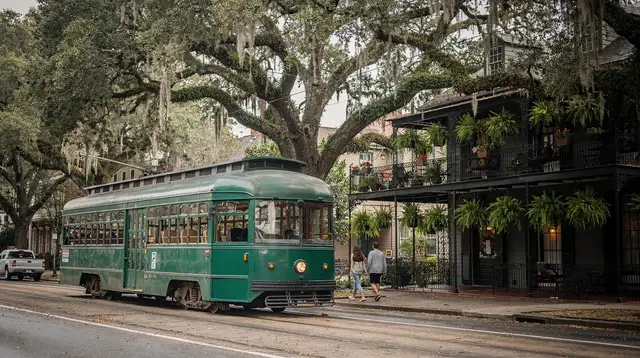
Christmas and Winter in New Orleans
Is winter a good time to visit New Orleans?
Yes. December through February sits between the two big crowd surges — the winter holidays and Mardi Gras — so hotels are cheaper and the French Quarter is easier to move around in. Weather is usually mild, though a handful of genuinely cold, occasionally freezing days should be expected, not treated as a surprise.
The quiet season between two crowds
New Orleans has a calendar shape, not just a weather pattern, and understanding that shape matters more than checking a forecast. Two moments dominate the city’s tourism year: the winter holidays around Christmas and New Year, and the run-up to Mardi Gras, which begins gathering pace as Carnival officially opens on 6 January. Between those two peaks, and again after Mardi Gras season winds down toward spring, sits a genuine lull. That lull — roughly the back half of December through most of February, minus the holiday week itself and minus whatever week Mardi Gras lands on — is what this guide covers.
This is not a page about temperatures month by month; the spring, summer and autumn guides on this site track the climate through the rest of the year. This one is about the calendar: which weeks are slow, which are already crowded again, and what that means for a visitor deciding when to book. If the plan is specifically to attend Carnival, the Mardi Gras guide is the better starting point, since the final days of this off-season already overlap with that page’s territory.
Correcting the postcard image
New Orleans markets itself on humidity, hurricanes and long hot summers, and that reputation leads a lot of visitors to assume winter here barely counts as winter at all. It is a fair assumption to correct before anyone packs a bag. The city has a humid subtropical climate, and most winter days are genuinely mild — the kind of weather where a light jacket in the morning gives way to short sleeves by afternoon. But “mild most days” is not the same as “always warm.” Louisiana winters bring real cold snaps, sometimes for several days at a stretch, and frost is a normal occurrence rather than a freak event. Pipes have burst in past cold spells; locals know to bring plants indoors when a hard freeze is forecast.
The practical takeaway is simple: pack for both conditions. A single warm layer that can come off is far more useful than a suitcase built entirely around New Orleans’ summer reputation. Anyone walking the French Quarter on a cold January morning without a jacket will regret trusting the postcard version of this city’s climate.
Why this window appeals to visitors
The single biggest practical argument for visiting in this window is what it isn’t: it isn’t the week of Christmas and New Year, and it isn’t Mardi Gras. Both of those periods drive hotel rates up and availability down across the French Quarter, the Garden District and the Central Business District, and both come with minimum-night-stay requirements at many properties. The weeks in between carry none of that pressure. Rooms are easier to find, rates tend to sit closer to normal, and the city itself feels more like it belongs to the people who live there rather than to a festival crowd.
That calmer footing shows up on the ground, too. Streetcars are less packed, restaurants take walk-ins more readily, and popular attractions like the National WWII Museum or the New Orleans Museum of Art in City Park don’t require the same advance planning that peak-season crowds demand. None of this means the city goes empty — New Orleans draws visitors year-round — but the difference between a Tuesday in late January and a Saturday during Jazz Fest is real and noticeable.
This guide deliberately avoids naming specific prices or exact dates for any of this, because both shift from year to year and a stale number does more harm than no number at all. The pattern, though, holds consistently: outside the two big peaks, this city is calmer and less expensive to visit.
What the season actually looks like
| Period | What to expect |
|---|---|
| Mid-to-late December (post-holidays) | Festive decorations still up in places, mild days common, occasional cold snap, quieter than the holiday week itself |
| January (before Carnival gathers pace) | The calmest stretch of the year in tourist terms; cold spells more likely than in December; Carnival parades begin building from 6 January onward |
| February (until Mardi Gras) | Weather trends milder toward the end of the month; crowds and prices start climbing again as Mardi Gras approaches, timing depends on the year |
Because Mardi Gras is a movable feast — 47 days before Easter, which can fall anywhere from early February to early March — the length of this quiet window changes year to year. A trip planned for “February” could land squarely in the calm stretch or could collide with Carnival crowds, depending on the specific year. Checking the date for the year of travel, rather than assuming based on a previous trip, is the only reliable approach.
Getting around in winter
Nothing about how to move through the city changes with the season. The French Quarter remains a compact grid best explored on foot, the RTA streetcars still run their four lines including the historic St Charles line through the Garden District, and driving and parking in the Quarter is no easier in January than in July. The one genuine advantage of the season is thinner crowds on the streetcars and lighter foot traffic on Royal Street and Frenchmen Street, which makes casual wandering more pleasant regardless of mode of transport.
Cooler, drier air also makes this a comfortable time for the things New Orleans does on foot: a walking tour through the historic core, a slow lap of City Park, or an above-ground stroll through one of the city’s cemeteries on a guided visit. Summer’s heat and humidity, which can make an afternoon outdoors genuinely uncomfortable, simply aren’t a factor for most of this window.
Day trips still work, with one caveat
Everything within the two-hour range of the French Quarter remains open through winter. The River Road plantations — Oak Alley, Whitney Plantation and the others — run their regular tour schedules, and cooler weather can make walking the grounds more comfortable than in the heat of summer. The swamp and bayou country south and west of the city, including Honey Island Swamp, also keeps operating.
The one meaningful adjustment is wildlife. Alligators are cold-blooded and much less active in the cold months, spending more time submerged or motionless than cruising visibly along the water’s edge. A winter swamp tour still delivers cypress draped in Spanish moss, egrets and herons, and a good guide’s knowledge of the ecosystem — but anyone whose main goal is a close alligator sighting should know the odds are better in warmer months.
Farther afield, Baton Rouge, Cajun Country around Lafayette, and the Gulf Coast toward Biloxi are all reachable and open, though a Gulf Coast beach day is a much less obvious plan in January than in June.
Making the most of a New Orleans base in this season
A city-wide overview is a sensible way to start a winter visit, since shorter daylight hours and the occasional rained-out afternoon reward having a flexible itinerary rather than a single fixed outdoor plan for the whole day. A guided city tour covering the French Quarter, Garden District and other historic neighbourhoods gives a fast, weather-flexible orientation early in a trip, and for visitors planning to see several paid attractions, a multi-attraction pass covering some of the city’s major sights can be worth pricing out against buying tickets separately.
Evenings draw in earlier in winter, which suits New Orleans’ after-dark specialities well. A guided walk through the history of Voodoo in the city, including a stop connected to Marie Laveau works especially well once the sun sets in the late afternoon, and treats a real, syncretic religion with the seriousness the subject deserves rather than as costume-shop entertainment. For a broader half-day introduction that pairs music, food and neighbourhood history, a small-group tour built around the city’s cultural roots is a good fit for a first visit landing in this quieter window.
Christmas week and New Year’s Eve
The holiday week itself sits outside the quiet window this guide is mostly about, but it deserves its own description, since a lot of visitors deliberately choose it despite the higher prices. New Orleans decorates for the season without losing its own character: wreaths and lights go up along Royal Street and around Jackson Square, and City Park mounts an elaborate holiday lights display through its oak-lined paths and lagoons, one of the more popular family outings of the season and a good option on an evening that turns cold or damp. Several of the city’s Creole restaurants also run Reveillon dinners around Christmas Eve, a multi-course tradition with roots in the city’s French and Spanish colonial past, worth booking ahead if the dates line up with a trip.
New Year’s Eve draws its own crowd to the French Quarter, with a countdown and fireworks over the Mississippi River drawing people toward Jackson Square and the riverfront in a scene that, on that single night, resembles the bigger peaks more than the calm weeks around it. Anyone travelling with children should note that both Christmas week and New Year’s Eve bring denser crowds and later closing hours than the rest of the season; the New Orleans with kids guide has more on pacing a family trip around a busy night like that one.
Because both holidays fall inside the same broader winter stretch as the quieter weeks, it is easy to book a trip assuming off-season pricing throughout, only to find the week of 24 December through 1 January priced and booked more like Mardi Gras. Treating that single week as its own separate peak, bracketed by two calmer months, is the clearest way to plan around it.
Where to stay and what to book ahead
Winter’s calmer pace changes the calculus on where to stay less than it changes the calculus on what to reserve in advance. The French Quarter and Garden District remain the two most walkable bases year-round, and the general guidance in where to stay in New Orleans applies just as well in January as in any other month. The difference in winter, outside the Christmas and New Year peak, is availability: rooms that would be sold out or heavily marked up during Mardi Gras or Jazz Fest are often bookable with more notice and, sometimes, at a lower rate, which is one of the better arguments for visiting New Orleans on a budget in this window rather than during either of the city’s big peaks.
Restaurants with a strong local following, and any Reveillon dinner during the holiday week itself, are worth booking further ahead than the quieter weeks would suggest, since kitchen capacity doesn’t expand just because the streets outside feel calmer. Popular guided experiences follow the same pattern loosely, though nothing in this off-season window requires the weeks-ahead planning that Mardi Gras or Jazz Fest demand.
Rainy and cold-day planning
Winter is the wetter half of the New Orleans year on average, and a trip of several days should expect at least one stretch of grey, damp weather somewhere in the itinerary. That is less of a problem here than it sounds, since the city has a deep bench of indoor options: museums, historic house tours, and covered markets all work regardless of what the sky is doing. The rainy day in New Orleans guide runs through the best indoor fallback plans in more detail, and it is worth reading before a winter trip specifically, rather than improvising once a downpour actually arrives.
The same logic applies to a cold snap. A day too cold or too wet for a swamp tour or a long walk through City Park is usually still a good day for the National WWII Museum, one of the French Quarter’s museums, or an evening spent listening to live jazz somewhere warm and close by. Building at least one flexible, weather-proof day into a winter itinerary avoids the scramble of rearranging plans on the morning of a cold front.
Practical notes for a winter trip
Sales tax is added at the till in Louisiana as everywhere in the US, not folded into the sticker price, and that applies exactly the same in December as in July. Tipping norms don’t shift with the season either: roughly 18–20% in restaurants and bars remains standard. What does shift, mildly, is the wardrobe math — layers that can be added or shed through the day are more useful here in winter than a single “New Orleans is always hot” packing strategy, and a compact umbrella is worth having regardless of month, since rain is possible year-round.
Anyone whose trip stretches into late January or February should build in a calendar check before locking hotel dates, specifically for that year’s Mardi Gras date, since a trip planned as an off-season bargain can accidentally land inside Carnival week if the date isn’t confirmed. Outside that overlap, this season remains the most straightforward, least crowded stretch of the New Orleans year — mild more often than not, occasionally properly cold, and consistently easier on both patience and hotel budgets than the two peaks it sits between.
Seasonal New Orleans activities on GetYourGuide
Verified deep-linked GetYourGuide tours. Book through these links and we earn a small commission at no cost to you.
GetYourGuide does not provide a product photo for this activity — the image shows the meeting point, photographed by us.