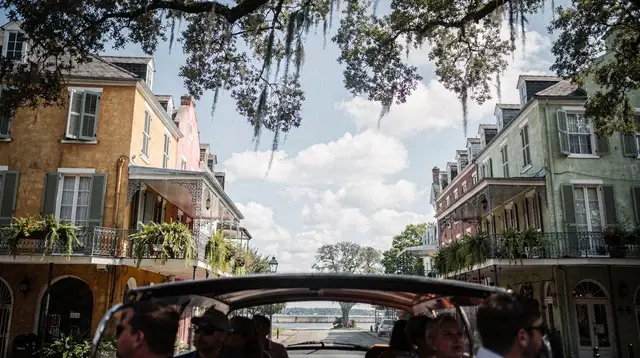
Where to Stay in New Orleans
Where should you stay in New Orleans?
First-time visitors who want to walk everywhere usually choose the French Quarter, accepting late-night noise near Bourbon Street. Those who want a quieter base with easy streetcar access pick the Garden District or Uptown, while the CBD/Warehouse District suits museum-focused trips and the Marigny/Bywater suits visitors chasing live music on Frenchmen Street.
Choosing a base is a different question from how long to stay
Deciding how many days to spend in New Orleans and deciding which neighbourhood to sleep in are separate problems, and mixing them up is a common planning mistake. A three-night trip can work beautifully from the French Quarter or terribly from a far-flung Uptown guesthouse with no rideshare booked for the evening, and vice versa. This guide focuses purely on neighbourhood choice: character, noise, distance from the sights, and two constraints that shape every booking in this city regardless of season or budget — the airport connection and parking.
New Orleans is compact by American standards. Nearly everything a first-time visitor wants sits within about 4 to 5 km of Jackson Square, and the French Quarter grid, roughly 13 by 6 blocks, is genuinely walkable. That compactness is exactly why the choice of neighbourhood matters more here than in a sprawling city: a few blocks can be the difference between falling asleep to brass bands and falling asleep to silence.
The French Quarter: maximum convenience, real noise
Staying inside the French Quarter means Jackson Square and St Louis Cathedral, the Cabildo, Royal Street’s galleries, the French Market and Cafe du Monde are all within a short walk, day or night. For visitors who want to drop their bags and start exploring immediately, without a car or a streetcar transfer, nowhere else in the city offers the same convenience.
The trade-off is noise. Bourbon Street runs loud from mid-afternoon well into the early hours, particularly on weekends and during Mardi Gras or Jazz Fest, and the sound carries into nearby side streets. A hotel a block or two from Bourbon can be noticeably quieter than one facing it, and the calmest Quarter blocks tend to sit closer to Esplanade Avenue or along the residential stretches of Chartres and Dauphine Streets, still a short walk from Jackson Square. It is worth checking a specific hotel’s exact cross-streets rather than assuming “French Quarter” always means quiet.
Parking is the other real constraint. Street parking in the Quarter is scarce, metered, and enforced with genuine strictness — towing is common, not theoretical — and most Quarter hotels either lack on-site parking or charge a separate daily fee for valet or a nearby garage. Visitors who plan to rent a car for day trips to the River Road plantations or the swamp and bayou country should factor that cost and hassle into the choice, or consider picking the car up only on the day it is needed rather than for the whole stay.
| Sub-area | Character | Best for |
|---|---|---|
| Near Bourbon Street | Loud, dense with bars | Visitors prioritising nightlife over sleep |
| Near Jackson Square / Royal Street | Central, moderately busy | First-time visitors wanting maximum walkability |
| Near Esplanade Avenue | Quieter, residential edge | Visitors who still want to walk everywhere but sleep well |
Garden District and Uptown: residential, streetcar-served
The Garden District and Uptown, strung along St Charles Avenue, offer a completely different register: antebellum mansions, live oaks, and the oldest continuously operating streetcar line in the world running down the neutral ground. This is a residential setting, not a nightlife strip, and it appeals to visitors who want a calmer base and don’t mind covering distance by streetcar or rideshare rather than on foot.
The St Charles streetcar connects the Garden District to Canal Street and the edge of the Quarter, but it is slower than walking from a Quarter hotel and runs on its own schedule rather than on demand. A Jazzy Pass makes the fare painless for a multi-day stay, but travellers should expect the streetcar ride into downtown to take 20 to 30 minutes rather than the 5 to 10 minutes a Quarter hotel offers. Lafayette Cemetery No. 1 sits right in the Garden District, which is a plus for visitors interested in the city’s above-ground tombs without a guided tour requirement — unlike St Louis Cemetery No. 1, which can only be entered with an authorised guide.
Uptown proper, further from downtown and closer to the universities, suits longer stays or visitors attending events at the universities, but it is a genuine commute from the Quarter, best planned around rather than treated as equivalent to a Quarter or CBD stay.
Central Business District and Warehouse District: practical, museum-adjacent
The Central Business District (CBD) and the neighbouring Warehouse Arts District sit just upriver from the Quarter, an easy walk or short streetcar ride away. This area has the city’s highest concentration of larger, more conventional hotel brands, which matters for business travellers, convention attendees, or anyone who prefers a familiar hotel chain to a boutique guesthouse.
It is also the natural base for visitors whose priority is the National WWII Museum and the surrounding gallery scene, since both sit inside the Warehouse District itself. What it lacks is much nightlife of its own once museums close — visitors staying here head into the Quarter or the Marigny for evenings out, which is a short trip but not a walk-out-the-door one.
Faubourg Marigny and Bywater: local, music-focused
Downriver from the Quarter, the Faubourg Marigny and Bywater are where a lot of New Orleanians point visitors who want live music without the Bourbon Street crowds. Frenchmen Street, the strip locals actually go to, sits right at the edge of the Marigny, a five to ten minute walk from the Quarter’s lower edge.
Accommodation here leans toward guesthouses and short-term rentals rather than large hotels, and the neighbourhood feels noticeably more residential and less polished than the Quarter — which is precisely its appeal for repeat visitors. It is a good fit for travellers prioritising Frenchmen Street vs Bourbon Street: Which One Is Right for You nightlife and willing to trade some hotel amenities for a more local base.
The airport connection, wherever you stay
Every neighbourhood in this guide shares the same airport reality: Louis Armstrong New Orleans International Airport (MSY), in Kenner, sits roughly 18 km west of the French Quarter, with no rail or metro connection of any kind. The trip takes roughly 25 to 40 minutes by road depending on traffic, and the practical choices are a flat-fare taxi, a rideshare app, a pre-booked shared shuttle, or the RTA 202 airport bus, which is inexpensive but slow and impractical for anyone travelling with more than a small bag.
This matters slightly more for Uptown and Garden District hotels, which sit marginally further from the highway route than Quarter or CBD hotels, though the difference in transfer time is usually only 10 to 15 minutes. For most visitors, the bigger factor is simply booking a fixed-price taxi or rideshare in advance rather than gambling on the 202 bus after a late flight.
Comparing the four areas at a glance
| Neighbourhood | Walkability to sights | Nightlife noise | Streetcar access | Best suited to |
|---|---|---|---|---|
| French Quarter | Excellent | High near Bourbon Street | Rampart–St Claude line | First-time visitors wanting everything on foot |
| Garden District / Uptown | Moderate | Low | St Charles line (historic) | Quieter stays, longer trips |
| CBD / Warehouse District | Good | Moderate | Canal Street line | Museum visits, business travel |
| Marigny / Bywater | Good | Moderate, music-focused | Rampart–St Claude line (edge) | Live-music-focused, repeat visitors |
Putting a stay together
A common pattern for visitors who cannot decide is to split a longer trip: a few nights in the French Quarter for the initial immersion, followed by a couple of nights in the Garden District or the Marigny for a change of pace. This avoids overcommitting to one neighbourhood’s trade-offs and works well alongside the Four Days: New Orleans and a Plantation or Five Days: City, Swamp and River Road itineraries, both of which assume a central base for city days and a car or organised tour for the day trips.
For visitors who want a structured overview of the city itself before settling into a neighbourhood, a general orientation tour on the first day can help — a half-day city overview covering the Quarter, Garden District and City Park gives a useful sense of how the neighbourhoods relate to each other geographically, which can make the accommodation choice easier in retrospect for a return trip.
Visitors weighing several paid attractions at once, from museums to river cruises, may also find it worth comparing costs against a multi-attraction pass covering several of the city’s paid sights, since it can offset the extra transfer time of a non-central hotel by bundling in transport-adjacent perks at some attractions.
Those who know their priority is live music and a local feel from day one often base themselves near the Marigny and add a broader orientation later; a three-hour guided city tour taken mid-stay works well as a way to see the Garden District and Uptown properly without needing to have stayed there. Visitors who prefer a walking-paced, story-led introduction rather than a bus tour can instead consider a walking tour focused on the city’s neighbourhoods and their history, which covers much of the same ground on foot and reinforces exactly the kind of neighbourhood texture this guide is describing.
Practical checklist before booking
- Confirm the hotel’s exact cross-streets if noise matters — “French Quarter” covers both the loudest and some fairly quiet blocks.
- Check whether parking is included, and if not, what the daily rate is; this can add substantially to a Quarter stay for anyone renting a car.
- If staying in the Garden District, Uptown or the CBD, confirm the walking or streetcar time to the Quarter for evening plans, since Driving and Parking in New Orleans: What to Know Before You Rent a Car rarely makes sense for short hops within the city.
- Book a fixed-price airport transfer in advance rather than relying on the RTA 202 bus with luggage.
- During Mardi Gras or Jazz Fest, expect minimum-night stays and sharply higher rates across every neighbourhood, not only the Quarter.
- Cross-check the neighbourhood choice against Is New Orleans Safe for Tourists? and Where to Stay in New Orleans style advice for the specific blocks around a hotel, since safety and noise both vary block by block rather than neighbourhood by neighbourhood.
Frequently asked questions about where to stay in New Orleans
Is the French Quarter too noisy to stay in?
It depends where in the Quarter. Blocks close to Bourbon Street stay loud into the early hours, especially on weekends, but the edges nearer Esplanade Avenue or Chartres Street are much quieter while still being a short walk from everything.
Is the Garden District a good base for a first visit?
Yes for anyone who prefers a residential, tree-lined setting and does not mind a streetcar or rideshare ride into the French Quarter. The St Charles streetcar makes the connection easy, though it is slower than walking from a Quarter hotel.
How do I get from the airport to my hotel?
Louis Armstrong International Airport (MSY) has no train or metro link. Options are a flat-fare taxi, a rideshare app, a shared shuttle, or the slow RTA 202 airport bus, which is not designed for heavy luggage.
Should I rent a car if I’m staying in the French Quarter?
Generally no. Parking in the Quarter is scarce, metered and strictly enforced, and most hotels charge separately for valet or garage parking. A car is more useful if day trips to the plantations or swamps are the priority and you are staying somewhere with easier parking.
Is the Central Business District a good choice?
It works well for visitors focused on the National WWII Museum, convention travel or a more corporate hotel style, and it is an easy walk or streetcar ride to the Quarter, but it has less nightlife of its own after museum hours.
What about staying in the Marigny or Bywater?
These neighbourhoods suit visitors who want to be near Frenchmen Street’s live-music clubs and a more local, less touristy feel, with a short walk into the Quarter, though there are fewer large hotels and more guesthouses and short-term rentals.
Are Uptown hotels far from everything?
Uptown is several kilometres from the French Quarter, so it suits longer stays, university visits or travellers happy to rely on the St Charles streetcar rather than walking, in exchange for a quieter, more residential setting.
Tours for a first visit on GetYourGuide
Verified deep-linked GetYourGuide tours. Book through these links and we earn a small commission at no cost to you.
GetYourGuide does not provide a product photo for this activity — the image shows the meeting point, photographed by us.