Food Tours in New Orleans, Compared
What's the best type of food tour in New Orleans?
A walking food tour through the French Quarter suits most visitors, since the neighbourhood is compact and easy to cover on foot. A bike tour ranges further in the same rough amount of time, and a combined cocktail-and-history format works better for an evening than a hungry afternoon.
Choosing a format, not a menu
New Orleans has no shortage of guides ready to walk, cycle or lead a group between kitchens and bars, and it is easy to confuse that choice with the separate question of what to eat. This page is about the tour itself: how the formats differ, who each one suits, and where a guided outing earns its place next to eating independently. For the dishes and the addresses, a companion guide covers where to eat, and for the difference between Creole and Cajun cooking, a separate cultural guide handles that background. Neither of those pages deals with logistics, tour lengths or how to book - that is what follows here.
The French Quarter is where almost all of this happens. It is worth remembering how small the neighbourhood actually is: a modest grid, easy to cross end to end, which is exactly why walking formats work so well here and why a tour rarely needs to range far to string together a satisfying sequence of stops.
What a stop list usually looks like
Most operators build their route around the same handful of landmarks, simply because that is where the food is. Expect at least one stop near Jackson Square, a pass along Decatur Street and the French Market, and often a mention of Cafe du Monde even when the tour does not stop there directly - the queue for beignets can be long enough that some guides route around it rather than through it. Royal Street sometimes features as a connecting stretch between food stops, its galleries and antique shops giving the group something to look at while they walk off one tasting before the next. None of this is a fixed itinerary; operators change stops seasonally and by availability, but the shape of a typical route rarely strays from this small core of blocks.
Walking food tours
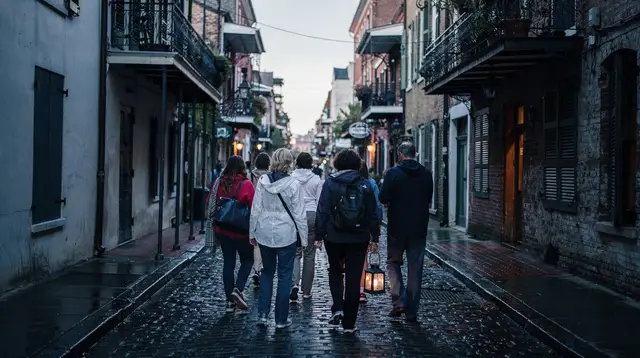
A walking tour is the default format for a reason. Because the French Quarter is compact, a guide can move a small group between several stops - a praline shop, a po’boy counter, a coffee stand - without long gaps of empty walking in between, and can fold in some of the history covered on a dedicated walking guide or a stop at Jackson Square and St Louis Cathedral along the way.
The trade-off is pace: a walking tour generally sticks to the Quarter itself and nearby streets, so it will not stretch out to the Garden District or Mid-City in the same outing. For a visitor whose main goal is a first, well-paced introduction to the neighbourhood’s food culture, that narrower radius is not really a limitation - it is the point.
| Format | Typical radius | Best suited to |
|---|---|---|
| Walking food tour | French Quarter and immediate side streets | First-time visitors wanting a compact, unhurried introduction |
| Culinary bike tour | French Quarter plus nearby neighbourhoods | Visitors who also want a broader orientation ride |
| Cocktail-and-food-history tour | French Quarter, evening-oriented | Visitors prioritising stories and drinks over a full meal |
| Vegan food tour | French Quarter | Plant-based diners who want stops pre-screened for them |
Bike tours: more ground, same idea
A culinary bike tour through the city, built around a sequence of food stops follows the same logic as a walking tour but on two wheels, which lets the guide cover a wider loop in roughly the same span of time. That suits a visitor who wants both a tasting route and a broader first look at neighbourhoods beyond the Quarter’s edges, rather than someone who mainly wants to linger at each stop.
Cycling in city traffic is a genuine consideration, and a bike format asks a little more of participants than a walking one - comfort on a bike, decent weather, and a group pace that keeps everyone together. Anyone unsure about cycling conditions is usually better served by a walking or general city format instead.
How far a bike tour can reasonably reach
The extra range a bike tour offers is real but bounded - it is not a substitute for a dedicated neighbourhood visit. A loop that leaves the Quarter might touch the edge of the Garden District or swing past Treme, the neighbourhood most closely tied to the city’s musical history, but it will not linger long enough in either to replace a proper walking tour built around that area specifically. The same applies to the Marigny and Bywater downriver of the Quarter: a food-focused bike route may skirt their edges without giving them the attention a visitor mainly interested in those neighbourhoods would want. Treat a culinary bike tour as an orientation lap with food built in, not as a way to properly see the Garden District or Treme in the same outing.
Cocktail-and-history hybrids
Not every “food” tour is really about food first. A combined tour pairing cocktails with the food history of the city leans toward storytelling and drinks, with tastings as a secondary element rather than the main course. That makes it a better fit for an evening out than for a hungry midday visitor looking for a proper meal built into the route.
This is also where the line with a straightforward evening on Frenchmen Street gets blurry for some travellers - a guided cocktail-and-history tour is structured and time-boxed, while an independent night out on Frenchmen Street or in the Quarter is looser and open-ended. They are not substitutes for each other so much as different ways to spend an evening, and some visitors do both on separate nights.
Dietary-specific tours
A tour built entirely around plant-based stops solves a real problem: general food tours in a city built on gumbo, po’boys and boudin do not always screen their stops for vegetarian or vegan diners, and checking in advance with a general operator is not always practical. A dedicated vegan itinerary removes that uncertainty by choosing every stop with that diet already in mind, which matters more here than in a city with a less meat-and-seafood-heavy food culture.
When a general city tour covers the ground better
Not every visitor wants a tour organised specifically around eating. A broader general city tour that takes in the French Quarter’s main sights can be a better fit for a first afternoon, with food folded in as one element among the architecture, the squares and the history rather than the sole focus. This suits travellers who plan to eat independently later, using a guide like the one on where to eat in New Orleans, but who want a structured overview of the neighbourhood first.
Comparing the formats side by side
| Question | Walking food tour | Bike food tour | Cocktail-and-history | Vegan tour |
|---|---|---|---|---|
| Focus | Tastings at several stops | Tastings plus a wider loop | Drinks and stories | Plant-based tastings |
| Physical demand | Low | Moderate (cycling) | Low | Low |
| Best time of day | Daytime | Daytime | Evening | Daytime |
| Covers Quarter history too | Often, lightly | Sometimes | Yes, as the main thread | Rarely the focus |
Practical notes before booking
A few things apply across every format rather than to just one. Groups are usually kept small, which means popular departures can fill up, particularly around Mardi Gras and Jazz Fest, so booking a few days ahead is worth doing rather than relying on a walk-up spot. Most tastings are modest portions meant to sample a range of dishes rather than a full meal at each stop, so a very hungry traveller may want a proper lunch or dinner either before or after rather than relying on the tour alone. Tipping the guide is customary, in the same range as tipping elsewhere in the city, and is separate from the tour price itself.
Weather is worth factoring into the choice as well. New Orleans summers are long, hot and humid, which makes an outdoor walking or biking tour more demanding in July and August than in spring or autumn; an evening cocktail-and-history format sidesteps some of that heat by starting later in the day. A visitor building a trip around the best time to visit may want to weigh a walking or bike food tour against the heat of a New Orleans summer specifically, rather than assuming any outdoor tour works the same way year-round.
Fitting a food tour into the rest of the trip
A food tour rarely needs its own dedicated day. On a short trip, it slots naturally into a single afternoon or evening alongside sightseeing rather than displacing it, which is one reason a three-day itinerary built around food can still leave plenty of time for the Quarter’s other sights. Visitors following a more general plan, such as the two-day or three-day itineraries on this site, or working from the broader guide for first-time visitors, can generally drop a walking or bike food tour into an existing afternoon block without reshuffling the rest of the schedule. The main scheduling conflict worth avoiding is stacking a food tour too close to a big sit-down meal - the tastings are meant to sample a range of dishes, not replace a full dinner, so pairing one with an already-booked restaurant reservation on the same evening can mean arriving less hungry than planned.
Which format actually fits your trip
For a first visit with no strong dietary constraints, a walking food tour through the French Quarter remains the simplest choice: it matches the neighbourhood’s compact scale, needs no special equipment, and works at any time of day. Travellers who want to combine a food itinerary with a wider first look at the city are better served by a bike format, provided cycling conditions and traffic are comfortable for the group.
Anyone planning an evening out, rather than an afternoon of eating, should lean toward the cocktail-and-food-history hybrid, and vegan or vegetarian travellers should look at a dedicated plant-based tour rather than hoping a general itinerary accommodates them. None of these formats replace eating on your own using a proper list of dishes and addresses - they are a different, guided way to spend a few hours, useful mainly for the pacing, the route and the stories a solo meal would not include.
FAQ: choosing a New Orleans food tour format
Is a walking food tour enough to see the French Quarter too?
Largely yes. Because the Vieux Carre is laid out on a small grid, a walking guide can weave in Jackson Square, Royal Street and side-street history between stops without much extra distance.
Should I choose a bike tour or a walking tour?
A bike tour covers more ground in a similar span of time, which suits a visitor who also wants a first orientation lap of nearby neighbourhoods. A walking tour stays slower and more focused, with less logistics around cycling in city traffic.
Are food tours and cocktail history tours the same thing?
No. A food tour centres on tastings at a sequence of stops. A combined cocktail-and-food-history tour spends more of its time on the stories behind the drinks and the buildings, with food as a secondary element, and suits an evening better than a midday appetite.
Do food tours replace a dedicated cocktail or nightlife outing?
Not really. A food tour or a cocktail-and-history tour gives an introduction and some pours along the way, but an evening built around Frenchmen Street or a dedicated bar crawl is a separate kind of night out.
Can vegetarians or vegans join a general food tour?
It depends on the operator and the stops chosen, so check in advance. A dedicated vegan food tour removes the guesswork by building the whole route around plant-based stops.
Is a food tour worth it if I already know what to eat?
It depends on what you value. Someone who already has a list of dishes and addresses may prefer to eat independently; a guided tour adds context, pacing and a route through several stops without having to plan it yourself.
How far in advance should I book a food tour?
Popular formats can fill, especially around Mardi Gras and Jazz Fest, so booking a few days ahead is safer than trying to walk up on the day.
Tours worth comparing on GetYourGuide
Verified deep-linked GetYourGuide tours. Book through these links and we earn a small commission at no cost to you.
GetYourGuide does not provide a product photo for this activity — the image shows the meeting point, photographed by us.