Listening to a Second Line
A parade with no box office
The first time I heard one, I didn’t know what I was hearing. It was a Sunday afternoon somewhere north of Treme, and a wall of brass came around a corner before I saw a single person: trombones, a sousaphone, a snare drum, all moving. Behind the band came a crowd, dozens of people, dancing rather than walking, twirling parasols and handkerchiefs. Nobody had sold me a seat. Nobody was collecting money at a rope line. It took me a block to understand that I hadn’t stumbled onto a show — I’d stumbled onto somebody’s neighbourhood having a party, and that the correct thing to do was to fall in at the back and behave like a guest.
That distinction is the whole point of this page. A second line is not a performance booked for tourists; it’s a parade organised by a local social aid and pleasure club, a tradition that grew directly out of Congo Square and the brass-band culture of Treme, one of the oldest African American neighbourhoods in the country. Clubs raise money all year, choose a Sunday, hire a band, and parade through their own streets, often ending at a bar or a hall the club is tied to. It happens because the neighbourhood decided to celebrate itself, not because a venue needed to fill a calendar slot. If you want the fuller history of how these parades and the brass bands that lead them came together, this explainer on second lines and brass bands goes deeper than I can here, and the story connects directly to the wider African American heritage of New Orleans.
Why there’s no fixed schedule to hand you
I’d love to give you a reliable weekly time and address, but that would be dishonest. Second lines run mostly from Labor Day through the late spring, mostly on Sunday afternoons, and mostly outside the French Quarter — in Treme, the Seventh Ward, Central City and other neighbourhoods where the clubs are based. Beyond that, routes and exact start times can shift close to the day, and a hurricane-season storm or a scheduling clash can cancel a parade outright. That season, roughly Labor Day through late spring, also happens to overlap with the two biggest reasons most visitors already have for coming — Mardi Gras and Jazz Fest — so it’s worth checking the second line calendar even if a parade wasn’t the reason you booked the trip; if you’re still choosing your dates at all, our page on the best time to visit New Orleans covers how that season fits the rest of the year.
What I actually do is check the community calendar published by WWOZ, the local jazz and heritage radio station, in the days before I arrive, since it lists that week’s confirmed parades with a rough start time and neighbourhood. I also ask people who’d actually know — a bartender on Frenchmen Street, staff at a music venue, someone at my guesthouse — because word travels locally faster than any website updates. And I keep my ears open. More than once I’ve found a second line simply by walking toward the sound of a tuba.
Following the sound, not a route map
If I catch even a distant brass line, I go toward it rather than checking a phone. Once you’re near a parade, it is genuinely hard to miss: a rolling crowd, a banner carried by club members in matching suits, a police escort clearing the way, and a run of people dancing in the street behind. There’s a structure to who’s where — the club members and their banner are the “first line,” the crowd of onlookers and dancers who join in behind them are the “second line,” which is where the whole tradition gets its name.
I treat that structure as the etiquette. I don’t push toward the front, I don’t try to walk alongside the club’s own members, and I don’t plant myself in someone’s driveway to get a better angle. I dance along at the back of the crowd, keep pace, and let the parade set the tempo rather than the other way around. It’s the same instinct as being invited into someone’s block party: you show up, you enjoy it, and you don’t rearrange the furniture.
That instinct is worth carrying into the rest of a trip too. Our broader guide to New Orleans travel mistakes to avoid covers a few more places where a visitor’s good intentions can still read as inconsiderate to people who live here.
Respect the street before the photo
This is the part I’d underline twice. A second line moves through residential blocks where people live, sit on their porches, and watch their own neighbourhood parade go by — it is not staged sightseeing, and it existed decades before anyone thought to visit New Orleans for tourism. I keep my phone down more than up. When I do shoot something, it’s quick and from a respectful distance, never a close-up pushed into someone’s face mid-dance, and never blocking the route for the people the parade actually belongs to.
I’d also separate this firmly from the bar-and-club scene of Frenchmen Street or a set at Preservation Hall — those are wonderful, but they’re programmed venues with a door and a schedule, which a second line deliberately isn’t. If what you want is guaranteed live music on a given night, our guides to live jazz in New Orleans and to the city’s wider jazz, music and nightlife scene are a better starting point than this page; if what you want is this specific, unbookable, neighbourhood tradition, patience and local ears matter more than any itinerary.
What actually helps on the day
Comfortable shoes matter more than anything else — parades can run for miles and hours in real heat and humidity, especially outside the cooler months. I bring water, sunscreen, and cash in case I want to tip the band or buy a drink from a cooler someone’s selling from a porch. I don’t bring a big bag or valuables I’d hate to lose track of in a moving crowd, and I stay aware of my surroundings the way I would on any unfamiliar block, since the route isn’t inside the well-policed core of the French Quarter. Our general page on whether New Orleans is safe for tourists covers that same everyday caution in more detail, and if the timing lines up with the warmer months, it’s worth reading what to expect during hurricane season before you lock in dates.
Cash is also useful for reasons beyond tipping the band — a quick read of our page on tipping and sales tax in New Orleans will save you doing the maths on the day. And if a second line is the anchor of your trip rather than a bonus, it’s worth choosing where to stay in New Orleans with an eye on the neighbourhoods — Treme, the Seventh Ward, Central City — where most parades actually happen, rather than assuming the French Quarter puts you close to the action.
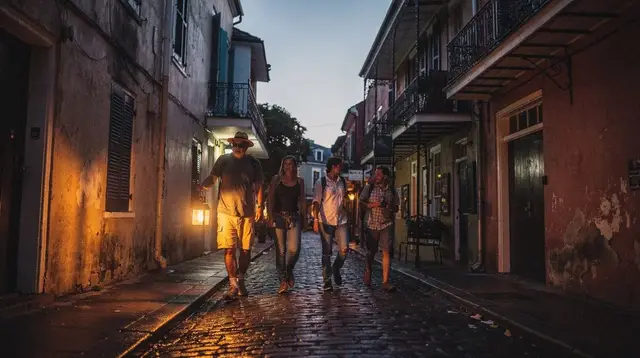
Between second lines, the city gives you plenty of other, plannable ways into its music and history. I’ve done a guided evening haunted pub crawl through the French Quarter on a night when no parade was running, which scratched the same itch for a guided, sociable evening out.
On a day trip upriver, a guided tour of St Joseph Plantation or a half-day tour of Oak Alley Plantation fills an afternoon with a fixed schedule, which a second line never will. And if you’re basing part of a trip along the coast, a haunted bayou cruise out of Bay St Louis is the kind of bookable evening you can pair with the unpredictability of the parades back in the city.
If I had to boil down everything I’ve learned chasing these parades: check the calendar as a starting point, ask locals once you’re on the ground, follow your ears, and once you’re in the crowd, act like a guest at someone else’s celebration — because that’s exactly what you are.
Second lines in New Orleans: your questions answered
Can I buy a ticket to a second line?
No. A second line is not a paid event or a show put on for visitors — there is no box office, no seating and no company selling entry. It is a street parade organised by a local social aid and pleasure club, and anyone on the route can watch or fall in behind the band for free.
How do I know when and where one is happening?
The rough dates come from WWOZ’s community calendar, which lists that week’s confirmed parades, but exact routes can shift and are rarely announced far in advance. Treat any schedule as a starting point, plan to be flexible, and be ready to just follow the sound of a brass band if you hear one.
Is it rude to take photos?
It is not forbidden, but a second line moves through a residential neighbourhood, not a stage, so I keep my phone down more than up. If I do take a picture, I do it quickly, without blocking the route or pointing a camera at close range at people dancing or at their front porches.
Can visitors actually join in and dance?
Yes, falling in with the crowd behind the band is normal and welcomed — that is what a second line is for. The line to be careful of is trying to lead, perform for the camera, or push toward the club members themselves, who are the first line; a visitor’s place is further back, dancing along, not staging a moment.
Is a second line safe for visitors to attend?
Second lines pass through ordinary streets, including blocks that see little other tourist traffic, so the usual New Orleans advice applies: keep valuables out of sight, stay with the crowd rather than lingering alone at the edges, and expect heat and long walking distances, especially in summer.
What is the difference between a second line and a jazz funeral?
A jazz funeral is one specific occasion for a second line: a funeral procession for a member of the community, with a slow dirge on the way to the burial and an upbeat send-off afterward. A Sunday second line, by contrast, is a recurring celebration with no connection to a death, held by a club simply parading its neighbourhood.
Should I book a tour that promises a second line?
Be cautious of anything sold as a guaranteed second line experience, since no company controls when or where a real one happens. Some ghost, history and music tours mention second lines in passing, but the parades themselves are never a purchasable product — only the neighbourhood and the calendar decide.
tours.Inspiration
Verified deep-linked GetYourGuide tours. Book through these links and we earn a small commission at no cost to you.
GetYourGuide does not provide a product photo for this activity — the image shows the meeting point, photographed by us.