French Quarter Ghost & Vampire Tours
Are French Quarter ghost and vampire tours worth doing, and how are they different from a citywide ghost tour?
Yes, if you pick a guide who treats the history and the Voodoo faith seriously rather than playing it for shock value. Unlike a citywide ghost tour, these stay entirely inside the Quarter's compact grid, on foot, usually after dark, covering roughly a dozen blocks of Royal Street, Bourbon Street and the streets around Jackson Square in 60 to 90 minutes.
Why the French Quarter After Dark Is Its Own Kind of Tour
New Orleans has a citywide reputation for ghost stories, but a French Quarter ghost or vampire tour is a narrower, more specific thing than “a New Orleans ghost tour.” It never leaves the Vieux Carre. It doesn’t stretch out to the Garden District’s antebellum mansions or the raised tombs of Lafayette Cemetery No. 1, both of which belong to a different neighbourhood and a different kind of walk covered elsewhere on this site.
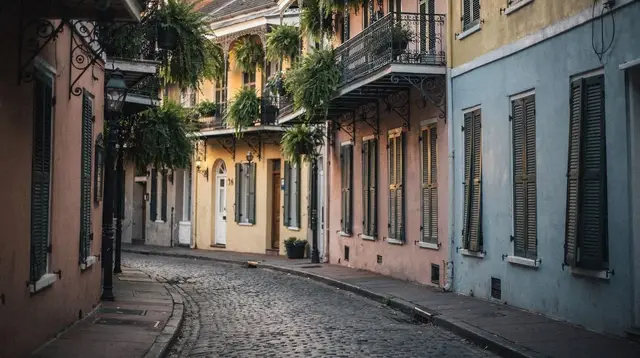
Instead it stays inside the roughly 13-by-6 block grid the Spanish and French laid out centuries ago, moving on foot between French Quarter: A First-Time Visitor’s Guide landmarks: the balconies of Royal Street, the shuttered courtyards behind them, the narrower lanes off Bourbon Street, and the streets ringing Jackson Square.
That tight geography is what makes these tours work as a genre. The French Quarter is old by American standards, largely rebuilt after two catastrophic fires in the 1780s and 1790s, and dense with buildings that have stood through yellow fever epidemics, duels, fires, floods and more than two centuries of continuous use as homes, bars, brothels, convents and shops. A 90-minute walk can plausibly stop at a dozen sites within a few blocks of each other, each with its own story, without ever needing a car, a streetcar or a long transfer. That density is also why this guide sits in the Ghost and vampire tours category specifically for the Quarter, distinct from the citywide version of the same subject.
What a French Quarter Ghost Walk Actually Covers
Most operators build their route around a handful of recurring sites and themes, mixed and matched depending on the company:
- Haunted houses and hotels. Several French Quarter buildings, some now hotels or private residences, carry well-worn stories of murders, suicides or epidemic deaths, and guides will point out facades on Royal Street, Dauphine Street and Bourbon Street where these are said to have happened.
- The LaLaurie Mansion. A Royal Street house tied to one of the city’s most notorious documented cases of cruelty toward enslaved people in the 1830s, and now one of the most-told stories on almost every ghost tour route.
- Fires, duels and epidemics. The devastating fires of 1788 and 1794, the era of Creole duelling under the oaks, and repeated outbreaks of yellow fever all left behind buildings guides use as anchors for specific, dated stories rather than vague hauntings.
- Vampire lore. New Orleans has an older, homegrown thread of vampire folklore, and a newer, very visible one from Anne Rice’s novels, several of which she set in real French Quarter houses. Vampire-themed tours usually walk both threads, pointing out the actual buildings tied to Rice’s fiction alongside older local legends.
- Voodoo, carefully framed. Louisiana Voodoo is a real, still-practised religion with roots in West African traditions and Catholicism, not a costume-shop caricature, and it’s a subject a good guide treats with some seriousness rather than pure spectacle. Marie Laveau, the historical nineteenth-century Voodoo Queen who lived and worked in the Quarter, comes up on nearly every route. She’s buried in St Louis Cemetery No. 1, which is guide-access only — a serious operator will say so plainly rather than imply you can just wander in.
For deeper background on any of these threads, see the dedicated guides on Voodoo in New Orleans, vampire lore and the French Quarter, and how the various ghost tours compare citywide.
The Different Formats on Offer
Not every ghost or vampire experience in the Quarter is the same walk with a different name. The main formats are:
Standard walking tours. A guide leads a small group on foot for 60 to 90 minutes, stopping at 8 to 12 sites, telling stories at each stop rather than walking continuously. This is the baseline format most companies use, and it’s the one to pick for a first visit. One well-reviewed version is the Ghosts of the French Quarter walking tour, which sticks to this classic stop-and-story structure.
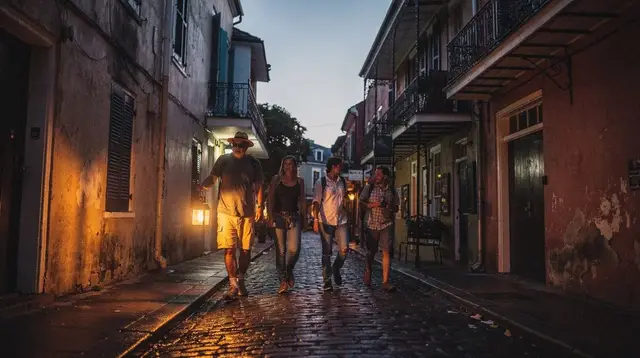
After-dark and evening departures. Some operators specifically time their walk for full darkness rather than dusk, leaning into atmosphere with lantern light and quieter side streets once the daytime crowds have thinned. The After Dark French Quarter Ghost Tour is built around this later, darker timing.
Combined cemetery-and-Voodoo itineraries. A handful of tours pair a French Quarter ghost or history walk with a separately guided visit to a cemetery and a look at Voodoo history and practice, run as connected but distinct legs rather than one continuous route. The 3-in-1 French Quarter, Cemetery and Voodoo Tour is the clearest example of this format, and it’s worth booking specifically if you want the cemetery access folded into the same outing rather than arranging it separately.
Themed variations. Some companies market a near-identical walking route under a different theme or narrator style — a “shadows” or noir-toned version, for instance, such as the Shadows of the French Quarter walking tour — while others build a dedicated Voodoo-first route, like the French Quarter Voodoo Tour, which spends more time on Voodoo history and practice and less on jump-scare storytelling.
Beyond these, a couple of formats worth knowing about even though they’re not this page’s focus: a segway-based route covers similar ground faster and by wheel rather than on foot, and a short 45-minute version exists for visitors who want a taste of the Quarter’s history without committing a full evening. Neither is primarily a ghost or vampire product, but both cover overlapping streets.
Comparing the Main Options
| Format | Typical length | Best for |
|---|---|---|
| Standard walking ghost tour | 60–90 min | First-time visitors wanting the classic stories |
| After-dark departure | 60–90 min | Visitors who want maximum atmosphere, later start |
| 3-in-1 cemetery & Voodoo combo | 2–3 hrs total | Travellers who want cemetery access folded in |
| Voodoo-focused walk | 60–75 min | Visitors more interested in religion and history than scares |
| Themed/narrative variants | 60–90 min | Repeat visitors wanting a different storytelling angle |
Prices, exact durations and start times change by season and operator, so treat this table as a way to compare shapes of tour rather than a fixed price list — check the current details when you book.
What to Expect on the Night
Groups are usually small, walking single file or in a loose cluster along narrow sidewalks, and guides stop the group at each site rather than narrating while moving, which keeps the pace comfortable for most fitness levels. Expect uneven brick and flagstone sidewalks, occasional gaps where an old building meets a modern one, and blocks that shift quickly between quiet and loud as you pass from a residential stretch of Royal Street or Dauphine Street to the noise spilling out of Bourbon Street. A guide will typically weave between these registers deliberately, using the contrast for effect.
The French Quarter’s core tourist streets are busy and reasonably well lit well into the evening, and a guided group is a fairly safe way to be out after dark in an unfamiliar city. That said, ordinary caution still applies once the tour ends: stay on the lit, populated blocks the guide used, and take a short ride rather than walk a long distance back to your hotel alone late at night, particularly near the edges of Bourbon Street. If you want to combine the ghost walk with more general orientation to the neighbourhood in daylight first, the French Quarter walking guide and the broader French Quarter walking tours roundup are useful preparation.
Booking Tips: Timing, Season and Group Size
Smaller walking-tour companies in the Quarter run frequent, often nightly departures, but the smallest and most personal groups sell out first, especially around Halloween, the Mardi Gras season and busy weekends. Booking a day or two ahead is sensible for most of the year, and a week or more ahead is worth it in October. Outside peak season, a quieter Tuesday or Wednesday evening often has more availability and, some visitors find, a more atmospheric, less crowded walk.
If cemetery access matters to you, don’t assume any ghost tour includes it — check specifically, since only a licensed combined tour, like the 3-in-1 format above, folds a guided cemetery visit into the same booking. A standalone ghost walk will talk about St Louis Cemetery No. 1 from the street or from a distance, not from inside the gate.
Tipping the guide at the end, in the range typical for a walking tour, is customary and appreciated, and cash in small bills is the easiest way to do it since not every guide can take a card on the spot.
Pairing This With the Rest of Your Quarter Visit
Because this tour type stays so tightly inside the neighbourhood, it pairs naturally with other things-to-do in the same footprint rather than requiring a separate day. A common pattern is to spend the day exploring things to do in the French Quarter, have dinner around Frenchmen Street or Bourbon Street, and finish the evening with the ghost or Voodoo walk once it’s dark.
If you’re deciding between the two after-dark music strips first, Frenchmen Street versus Bourbon Street lays out the difference. And if you’re still mapping out how a first day in the city should flow before adding an evening tour on top, the one-day New Orleans essentials itinerary is a reasonable starting frame.
For visitors weighing whether the whole subject is worth their time at all, or wondering how it fits against a citywide cemetery visit, two shorter pieces are useful: the Cities of the Dead explained on the above-ground tomb tradition generally, and are cemetery tours still allowed on the current access rules, since these do change and shouldn’t be assumed from an old blog post or a tour company’s marketing copy. For the fuller citywide picture of cemeteries specifically, the cemeteries of New Orleans visitor guide is the place to go next.
Ghost and Vampire Tours in the French Quarter: Common Questions
Do French Quarter ghost tours actually enter St Louis Cemetery No. 1?
No standard walking ghost tour walks inside it. St Louis Cemetery No. 1 can only be entered with an authorised guide on a dedicated cemetery tour; an independent visit is not possible. A few combined itineraries pair a French Quarter ghost walk with a separately licensed cemetery visit, but they are two distinct legs, not one continuous walk.
Is the vampire angle on these tours based on anything real?
It is based on New Orleans folklore and, more recently, on Anne Rice’s novels, which she set in the French Quarter houses she knew. Guides usually separate the literary tradition from the older ghost lore of the neighbourhood, rather than presenting vampires as documented history.
Who was Marie Laveau, and will she come up on the tour?
Marie Laveau was a real nineteenth-century Voodoo Queen who lived and worked in the French Quarter, and her name comes up on nearly every ghost or Voodoo tour here. She is buried in St Louis Cemetery No. 1, which, again, is guide-access only, so a French Quarter walking tour will point toward the cemetery rather than take you inside it.
Is Voodoo treated as a joke on these tours?
It shouldn’t be, and most reputable operators are careful about it. Louisiana Voodoo is a real syncretic religion with African and Catholic roots that is still practised today, and a serious guide will explain that rather than reduce it to horror-movie imagery.
How late at night do these tours run, and is the French Quarter safe after dark?
Most start at dusk or in the evening, commonly 6pm to 9pm, and last 60 to 90 minutes. The core tour streets around Jackson Square, Royal Street and Bourbon Street are busy and well lit at those hours, but it’s still sensible to stay with the group, keep to the lit blocks the guide uses, and take a ride rather than walk far alone afterward.
Are these tours suitable for children?
Some are built around genuine scares and mature history, including violent crimes and slavery-era stories, and are not aimed at young children. Family-friendly options exist; check the specific tour’s age guidance before booking rather than assuming.
What should I wear and bring?
Comfortable walking shoes for uneven, sometimes narrow sidewalks, and a light layer even in warm months since evenings can cool off. Cash in small bills is useful for tipping the guide at the end, which is customary at a few dollars per person.
Do I need to book in advance, or can I just show up?
Booking ahead is worth it, especially around Halloween, Mardi Gras and weekends, when the smaller walking groups sell out. Showing up on spec works more often on quieter weeknights outside peak season.
Ghost and vampire tours on GetYourGuide
Verified deep-linked GetYourGuide tours. Book through these links and we earn a small commission at no cost to you.
GetYourGuide does not provide a product photo for this activity — the image shows the meeting point, photographed by us.