Things to Do in the French Quarter
What are the best things to do in the French Quarter?
Walk Jackson Square and see St Louis Cathedral, the Cabildo and the Presbytere, browse the galleries and antique shops of Royal Street, eat beignets at Cafe du Monde, and wander Decatur Street and the French Market. The Quarter is a compact grid of roughly 13 by 6 blocks, and it rewards walking far more than driving.
A Compact Grid Built for Walking
The French Quarter, or the Vieux Carre, is the oldest neighbourhood in New Orleans and the one every visitor sees first. It is small enough to be misleading on a map: roughly 13 blocks by 6, a tight grid laid out under French and then Spanish colonial rule long before the rest of the city existed. Because it is compact, flat and dense with things to see, it is a district best covered on foot, not by car or rideshare hopping from corner to corner. If you only read one page about New Orleans neighbourhoods, this is the one that goes block by block rather than city-wide; for the broader picture across the whole city, see things to do in New Orleans.
This guide sticks to the Quarter itself. The Garden District, further south along St Charles Avenue, has its own character and its own page at things to do in the Garden District, and it is a streetcar ride away rather than a walk from here. St Louis Cemetery No. 1, just outside the Quarter’s edge, is covered in the cemeteries of New Orleans guide, because it can only be entered with an authorised guide and deserves its own explanation rather than a paragraph here.
Jackson Square and the Historic Core
Start at Jackson Square, the green, gated plaza at the heart of the Quarter and the natural centre of any visit. It faces St Louis Cathedral, the oldest continuously active Catholic cathedral in the United States, flanked by two matching civic buildings from the Spanish colonial period: the Cabildo, where the Louisiana Purchase transfer documents were signed, and the Presbytere, which today holds exhibits on Mardi Gras and on Hurricane Katrina. Both are compact museums that reward half an hour to an hour each, and both sit right on the square, so pairing them with a walk around the plaza costs little extra time.
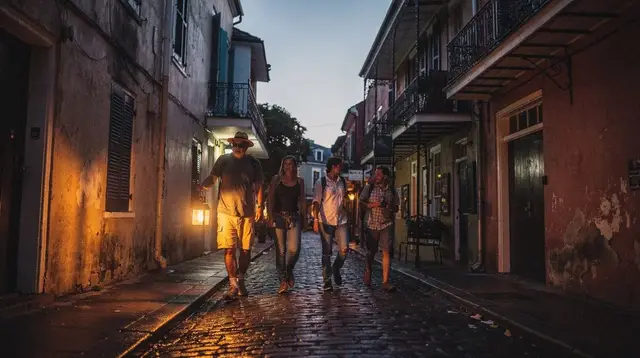
The square itself is a working public space rather than a static monument. Street artists sell paintings along its iron fence, tarot readers and musicians set up on the flagstones, and the fence itself is worth a slow circuit before you go inside anything. It is also the traditional starting point for the walking tours, both historical and ghost-themed, that leave from this corner throughout the day and evening.
For a first orientation to the neighbourhood with a guide who can point out details you would otherwise walk past, a French Quarter walking tour is a practical way to spend your first hour here, and a good primer before you strike out on your own for the rest of the day; see the guided walk through the historic core for one option that covers this ground with commentary.
Royal Street: Galleries, Antiques and Balconies
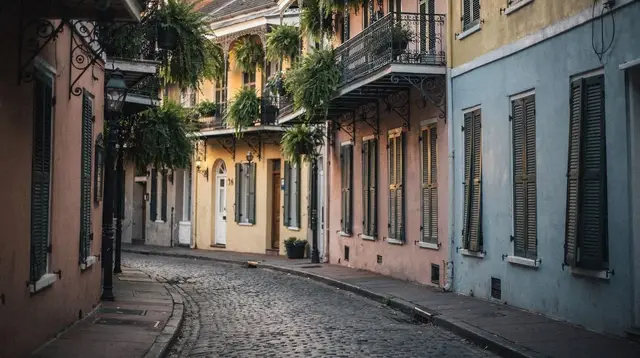
One block toward the river from Bourbon Street, Royal Street is the Quarter’s quieter, more polished spine. It is lined with art galleries, antique dealers and jewellery shops, many occupying buildings with the cast-iron balconies and courtyards that define the neighbourhood’s look. Royal Street is closed to vehicle traffic for stretches of the day, which turns it into an open-air pedestrian corridor where street musicians and living statues perform between the shopfronts. Even travellers with no intention of buying anything find it one of the most pleasant streets in the city simply to walk slowly and look up at the architecture rather than into the windows.
Royal Street is also a good vantage point for understanding the Quarter’s building style more broadly: the ironwork balconies most people associate with “French” New Orleans are, more precisely, largely Spanish colonial in origin, dating to the rebuilding after fires in the late eighteenth century. A history-focused walking route through these streets draws out details like this that are easy to miss on your own; see the French Quarter history walking tour if that context interests you.
Bourbon Street: Day and Night Are Different Streets
Bourbon Street runs parallel to Royal, one block closer to the lake side of the grid, and it is the street most people picture when they hear “French Quarter.” By day it is a fairly ordinary commercial street with striking balconies and a scattering of open bars; after dark, especially from Thursday through Sunday, it becomes a loud, crowded strip of live-music bars, daiquiri shops and, for a stretch, adult entertainment venues. Locals themselves are more likely to recommend Frenchmen Street, in the Faubourg Marigny just outside the Quarter, for a better night of live jazz; a comparison of the two is in the Frenchmen Street versus Bourbon Street guide.
One detail that regularly surprises European visitors: New Orleans allows open containers of alcohol on the street within the French Quarter, but strictly in plastic “go-cups,” never in glass, and only inside the permitted district boundary. Bars will pour a drink into a go-cup on request as you leave. This is unusual within the United States, where public drinking is normally banned outright, and it is worth knowing before you assume the rule works the same way it might at home. The legal drinking age is 21 and identification is checked at the door of every bar.
Decatur Street, the French Market and the Riverfront
Decatur Street runs along the river side of the Quarter, between Jackson Square and the Mississippi, and it is where the neighbourhood’s daytime energy concentrates. The French Market, a covered market that has operated on this site in some form since the late eighteenth century, runs for several blocks along Decatur and North Peters, mixing produce stalls, a flea market section and food vendors. It is an easy, unstructured way to spend an hour browsing, and it connects naturally to a walk along the riverfront levee, where the Mississippi is close enough to watch tugboats and paddlewheelers pass.
At the upriver end of Decatur, right by Jackson Square, sits Cafe du Monde, the open-air coffee stand credited with popularising beignets, the square, powdered-sugar-dusted fried dough that has become one of the city’s most photographed foods. It operates around the clock, seats outdoors under a green-and-white awning, and queues can be long at peak hours; going early in the morning or late at night avoids the worst of the wait. It is a tourist landmark rather than a hidden find, and it earns the reputation. For visitors who want beignets alongside a broader taste of the neighbourhood’s food, the beignets, po’boys and gumbo guide covers where else to eat within a few blocks.
Music, Ghosts and Voodoo in the Quarter
The French Quarter is dense with music history, though the deepest roots of jazz as a living tradition lie just outside it in Treme; within the Quarter itself, Preservation Hall remains the best-known venue for hearing traditional jazz in an intimate, unamplified setting most nights of the week. It is worth booking ahead in peak season, since the room is small by design. For a fuller picture of where the music lives across the wider city, the live jazz in New Orleans guide covers Frenchmen Street, the second-line tradition and Treme alongside this neighbourhood.
The Quarter’s narrow, atmospheric streets have also made it the centre of the city’s ghost tour and voodoo tour industry, which ranges from serious historical storytelling to pure entertainment aimed at an evening crowd. Voodoo itself is a real, syncretic religion with African and Catholic roots practised in Louisiana today, not simply a theme for tours, and it is worth treating the subject with that in mind even on a lighter evening walk.
If an evening ghost walk appeals, the evening ghost walk through the Quarter’s oldest streets covers many of the same blocks described above after dark, when the atmosphere changes considerably. A comparison of the different ghost tour operators and formats is in the ghost tours in New Orleans compared guide, and voodoo’s actual history is covered properly in voodoo in New Orleans: history and tours.
Getting There and Getting Around
The French Quarter sits close to the Central Business District and is reachable from most Uptown and Mid-City hotels by the Canal Street or Riverfront streetcar lines, or by a short rideshare ride. Once inside the Quarter, walking is faster than any vehicle: the grid is narrow, one-way streets loop traffic around, and parking is both scarce and strictly, promptly enforced with towing.
If you are staying outside the Quarter and coming in for the day, the getting around New Orleans by streetcar guide and the driving and parking in New Orleans guide cover the practical options in more detail than fits here. Visitors flying in should also see from MSY airport to the French Quarter, since there is no rail link and the drive in takes 25 to 40 minutes depending on traffic.
For a different way to cover the grid quickly, a segway tour lets you see more ground in less time than walking, at the cost of some of the slower, stop-and-look experience a walking tour allows; see the segway tour of the French Quarter if that trade-off suits your schedule better.
A Half-Day Route Through the Quarter
The table below sketches one practical order for a first visit, starting at Jackson Square and working outward. It assumes a relaxed pace with stops, not a race.
| Stop | What it’s for | Approx. time |
|---|---|---|
| Jackson Square | Orientation, street artists, the cathedral facade | 30–45 min |
| St Louis Cathedral, Cabildo, Presbytere | Colonial and Carnival history | 45–90 min |
| Royal Street | Galleries, antiques, ironwork balconies | 45–60 min |
| Decatur Street & French Market | Browsing, riverfront views | 45–60 min |
| Cafe du Monde | Beignets and coffee | 30 min |
| Bourbon Street (daytime) | Architecture without the crowds | 20–30 min |
This covers the historic core comfortably in half a day; a full day allows for a sit-down lunch, a museum visit, and time to return in the evening for music or a ghost walk.
Where the Quarter’s Story Gets Heavier
Not every corner of the French Quarter is only architecture and food. The neighbourhood’s history includes the slave markets that once operated within a few blocks of Jackson Square, a fact some tours address directly and others skip.
Visitors who want that fuller, more serious history of the city and the region, including how it connects to the plantations upriver, are better served by the French Quarter history and culture guide and, for the deepest version of that story, Whitney Plantation and the history of slavery, which sits outside the Quarter on the River Road but is the natural next stop for anyone taking this history seriously.
Practical Notes Before You Go
A few things are easy to get wrong on a first visit. The Quarter’s charm is partly its age: pavements are uneven, many buildings have no air conditioning in their public areas, and summer heat and humidity are intense enough that a slow pace and frequent water breaks matter more than they might elsewhere. Winter days are mild but can turn genuinely cold for short stretches, so a layer is worth packing even in a subtropical city. Cash still matters here more than in most US neighbourhoods: street musicians, tarot readers and some smaller bars expect it, even where cards are accepted elsewhere.
Safety in the Quarter itself is generally good during the day and in the busy, well-lit blocks at night; the ordinary precautions apply on the fringes of Bourbon Street after midnight and on any quiet side street once the crowds thin out. For a broader answer on safety across the city, see is New Orleans safe for tourists. For a first-timer’s overview of costs, tipping and the sales tax added at the till rather than shown on the price tag, see New Orleans for first-time visitors and tipping and sales tax in New Orleans.
If you want a structured overview rather than a self-guided wander, a broader city walking tour that starts in the Quarter and adds context along the way is a reasonable way to open a first day; see the guided walk through the Quarter’s oldest blocks for one version of that route. For how the Quarter fits into a longer New Orleans trip, how many days in New Orleans and three days in New Orleans both build the wider schedule around a day or more spent exactly here.
Frequently Asked Questions About the French Quarter
Can you drink alcohol on the street in the French Quarter?
Yes, within the French Quarter open containers are tolerated, but only in plastic go-cups, never in glass, and only inside the permitted area. Bars will usually pour a drink into a go-cup on request when you leave.
How many days do you need for the French Quarter?
A focused first visit takes a full day on foot, but most visitors return to the Quarter on several evenings during a longer New Orleans stay for meals, music and a second look at streets seen quickly the first time.
Is the French Quarter walkable?
Yes, and it is the best way to see it. The grid is only about 13 blocks by 6, flat, and dense with things to see, so a car adds nothing and parking is scarce and strictly enforced.
Is Bourbon Street worth visiting if you are not going out at night?
By day Bourbon Street is quieter and easier to appreciate for its architecture and balconies; it becomes a loud bar strip after dark, which is a different experience some travellers skip entirely in favour of Frenchmen Street.
Can you visit St Louis Cemetery No. 1 from the French Quarter?
The cemetery sits just outside the Quarter, but it can only be entered with an authorised guide, not independently. It is covered in a separate cemeteries guide rather than here.
What is there to do in the French Quarter besides bars?
Jackson Square and its street artists, the Cabildo and Presbytere museums, the galleries and antique shops of Royal Street, the French Market, riverfront views along Decatur Street, and live jazz at Preservation Hall all sit within a few blocks of each other.
Where do locals go for live music in the French Quarter area?
Locals more often point visitors to Frenchmen Street, just outside the Quarter in the Faubourg Marigny, for live jazz and brass bands, while Preservation Hall inside the Quarter itself is the best-known dedicated jazz venue.
Walking tours on GetYourGuide
Verified deep-linked GetYourGuide tours. Book through these links and we earn a small commission at no cost to you.
GetYourGuide does not provide a product photo for this activity — the image shows the meeting point, photographed by us.